WASHINGTON (AP) — On Monday, the fragile ceasefire in Gaza led to freedom for Israeli hostages and the release of Palestinian prisoners held by Israel. It was the culmination of a long and tortuous process — but it may, in the end, have been the easier part.
The coming weeks, months and years will require more than just rebuilding from the devastation that has left much of Gaza in ruins. Key details of the peace plan may remain unsettled. Granular details will need to be negotiated to keep the plan moving forward and prevent the resumption of fighting. The path to long-term peace, stability and eventual rebuilding will be a long and very precipitous route.
Click to Gallery
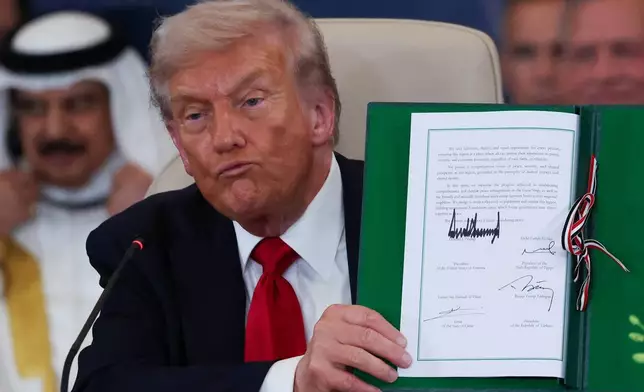
President Donald Trump holds a signed document during a summit to support ending the more than two-year Israel-Hamas war in Gaza after a breakthrough ceasefire deal, Monday, Oct. 13, 2025, in Sharm El Sheikh, Egypt. (Suzanne Plunkett/Pool via AP)
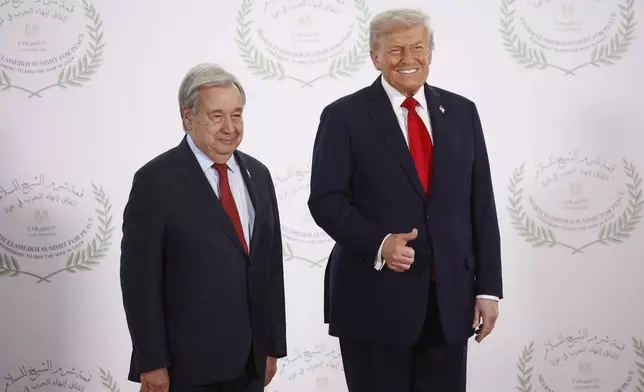
President Donald Trump and United Nations Secretary-General Antonio Guterres pose during the greeting ceremony before the family picture at the Gaza International Peace Summit, in Sharm el-Sheikh, Egypt, Monday, Oct.13 2025. (Yoan Valat, Pool photo via AP)

People wave Israeli flags and spray foam in celebration after the arrival of freed hostages at Beilinson Hospital in Petah Tikva, Israel, following their release from Hamas captivity in the Gaza Strip, Monday, Oct. 13, 2025. (AP Photo/Francisco Seco)
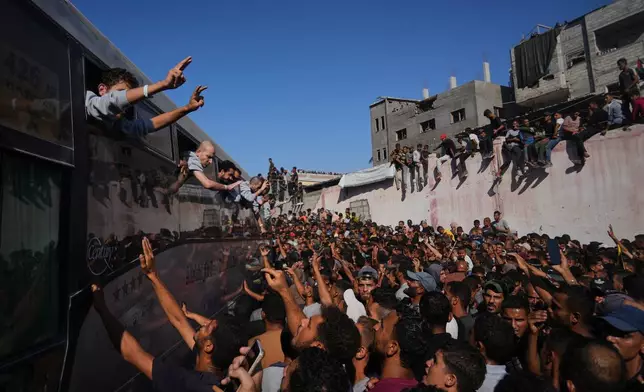
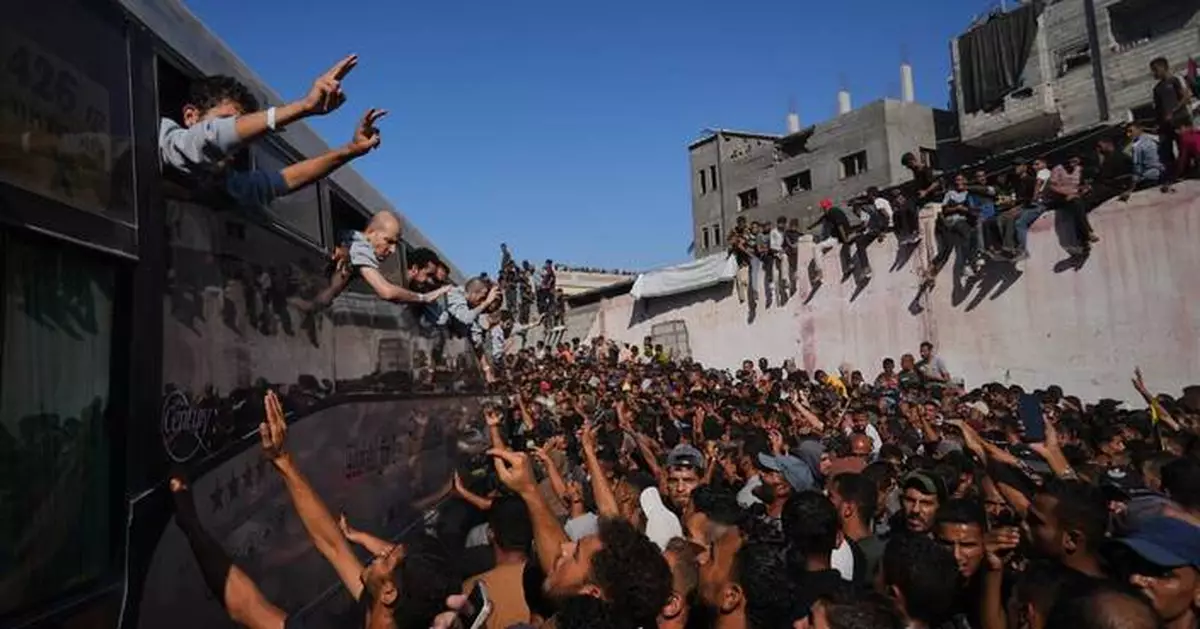
People gather to greet freed Palestinian prisoners arriving on buses in the Gaza Strip after their release from Israeli jails under a ceasefire agreement between Hamas and Israel, outside Nasser Hospital in Khan Younis, southern Gaza Strip, Monday, Oct. 13, 2025. (AP Photo/Abdel Kareem Hana)
“The first steps to peace are always the hardest,” President Donald Trump said as he stood with foreign leaders in Egypt on Monday for a summit on Gaza’s future. He hailed the ceasefire deal he brokered between Israel and Hamas as the end of the war in Gaza — and start of rebuilding the devastated territory.
And while Trump expressed optimism that the most challenging part was over — “Rebuilding is maybe going to be the easiest part. I think we’ve done a lot of the hardest part because the rest comes together" — others were more tentative about the intricacies that lie ahead.
“Peace has to start somewhere," said Mona Yacoubian, director of the Middle East Program at the Center for Strategic and International Studies. She called it an important and “euphoric moment."
But, Yacoubian warned, “Unfortunately, I think there are several potential points of failure going forward.”
As publicly presented, the plan brims with unanswered questions.
How and when Hamas is to disarm, and where its arms will go, are unclear, as are plans for Israel’s withdrawal from Gaza. A new security force is to be established for Gaza, made up of troops from other nations, but it is not known which countries will send forces, how they will be used and what happens if they encounter resistance. It’s also not clear who will staff a temporary governing board for Gaza, where it will be located and how the population will respond.
To settle those details and keep fighting from returning, the United States and other nations that pushed to reach the ceasefire must continue to exert pressure and devote attention, experts say.
All of that is layered atop a legacy of conflict, deep distrust among the sides and a vague, conditional possibility of an eventual Palestinian state — an issue that has been a core sticking point for decades. “When you realize how far things have to go for that current pause to be sustained, that’s where I think it does become very daunting,” Yacoubian said.
Since the war began with Hamas’ attacks on Israel on Oct. 7, 2023, two other ceasefires have come and gone without any progress beyond temporary pauses in fighting and limited exchanges of hostages and prisoners. With Hamas demanding a permanent halt to the fighting and Israel demanding the release of all hostages, talks on postwar arrangements never got off the ground. Those positions began to change after Trump’s reelection as he leveraged his power and relationships — both with Israel and Arab mediators with sway over Hamas — to push things forward.
Despite the enthusiasm for this latest deal, there are reasons for skepticism, not least of which being that U.S. attempts to bring about an end to the Israeli-Palestinian conflict have failed for decades.
Starting with the 1991 Madrid Conference and moving through various iterations — including the landmark Oslo Accords in 1993 and 1995, which created the Palestinian Authority — all the efforts to restart the process through 2014 collapsed.
Lucy Kurtzer-Ellenbogen, a senior fellow with the Middle East Institute, said the current ceasefire is “a welcome and meaningful but fragile pause.” Now, she said, it’s a question of “whether or not it fully collapses and just serves as a chance for both sides to regroup, rather than a launching pad for progress on these issues. That’s going to depend on President Trump and the other actors he’s coordinating with staying with it.”
In the peace proposal brokered by the Trump administration, it remains unclear to what degree agreements have been reached on two of the biggest sticking points: the extent of Israel’s withdrawal and the extent of Hamas’ retreat from power. Israel remains in control of roughly half of Gaza.
Prime Minister Benjamin Netanyahu was careful Monday to say he is “committed” to Trump’s peace plan, but he has not declared the war over. Over the past two years he repeatedly vowed to achieve “total victory” over Hamas.
Hamas, while weakened after two years of war, is far from being out of governance and fully disarmed as Netanyahu sought. He relies on hardline coalition partners that oppose an end to the war, and by declaring it over, Netanyahu could see his government crumble and be forced into an early election at a time when his popularity remains low and his war goals unfulfilled. The next election is scheduled next October.
It also remains unclear who will oversee it all on a so-called “Board of Peace,” which Trump said he will chair. Despite Trump’s plan announcing that former British Prime Minister Tony Blair would help head the board, the president on Sunday made that sound tentative, too. The Palestinians have expressed displeasure over Blair’s possible involvement.
“I like Tony. I’ve always liked Tony, but I want to find out that he’s an acceptable choice to everybody,” Trump told reporters as he flew to Israel.
Settling all those details comes against the backdrop of the Gaza Strip needing “massive rehabilitation,” Kurtzer-Ellenbogen said, and a population that has undergone unremitting physical and psychological trauma.
Tens of thousands of Palestinians have been killed. More than 90% of Gaza’s population of more than 2 million people is displaced. The medical system is shattered. Homes and buildings are flattened. Croplands are razed. Hunger is pervasive.
Those urgent needs will need to be addressed while simultaneously standing up the transitional security and government systems. “There’s really no luxury of sequencing here,” Kurtzer-Ellenbogen said. “Everything has to happen all at once."
The World Bank, the United Nations and the European Union estimated earlier this year that the cost of rebuilding Gaza would be about $53 billion. Wealthy Arab states are expected to help with that cost, but that buy-in is expected to be met by reassurances that there will be a pathway to Palestinian independence and there will not be a return to fighting. The biggest sticking point is a Palestinian state, which Trump’s plan holds out as a possibility only after a lengthy transition period in Gaza and reform process for the Palestinian Authority. It's something Netanyahu and his partners oppose.
Yacoubian said the agreement struck by Trump’s administration seemed “purposely very vague” on the issue of Palestinian statehood. It seemed designed, she said, to “thread the needle between the minimum that the Palestinians and their Arab supporters will accept” without mentioning a “two-state solution,” which seems to remain a nonstarter for Israel.
On his way back to the U.S. on Monday night, Trump pushed aside questions about an independent Palestinian state and told reporters that was separate from his plan for rebuilding Gaza.
“A lot of people like the one-state solution. Some people like the two-state solution. We’ll have to see," Trump said.
He went on and added: “At some point I’ll decide what I think is right, but I’d be in coordination with other states and other countries."
Robert Wood, the deputy U.S. ambassador to the United Nations during the Biden administration, cast several vetoes on U.N. Security Council resolutions calling for immediate ceasefires in Gaza. He said the next phase is going to be difficult and “is going to require a tremendous amount of work.”
“The administration needs to stay engaged, particularly at the highest levels, if this has a chance of working,” Wood said. “It’s a good day, but the war isn’t over yet.”
Associated Press writers Matthew Lee in Washington, Josef Federman in Truro, Massachusetts and Darlene Superville aboard Air Force One contributed to this report.

President Donald Trump holds a signed document during a summit to support ending the more than two-year Israel-Hamas war in Gaza after a breakthrough ceasefire deal, Monday, Oct. 13, 2025, in Sharm El Sheikh, Egypt. (Suzanne Plunkett/Pool via AP)

President Donald Trump and United Nations Secretary-General Antonio Guterres pose during the greeting ceremony before the family picture at the Gaza International Peace Summit, in Sharm el-Sheikh, Egypt, Monday, Oct.13 2025. (Yoan Valat, Pool photo via AP)

People wave Israeli flags and spray foam in celebration after the arrival of freed hostages at Beilinson Hospital in Petah Tikva, Israel, following their release from Hamas captivity in the Gaza Strip, Monday, Oct. 13, 2025. (AP Photo/Francisco Seco)

People gather to greet freed Palestinian prisoners arriving on buses in the Gaza Strip after their release from Israeli jails under a ceasefire agreement between Hamas and Israel, outside Nasser Hospital in Khan Younis, southern Gaza Strip, Monday, Oct. 13, 2025. (AP Photo/Abdel Kareem Hana)