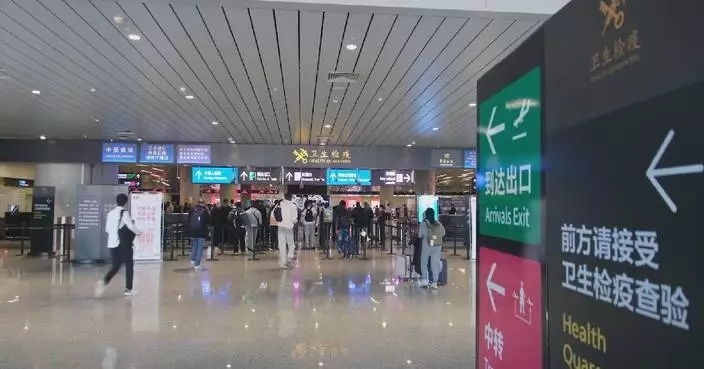
West Kowloon Station in the Hong Kong Special Administrative Region, part of the Guangzhou-Shenzhen-Hong Kong Express Rail Link, is seeing large numbers of overseas passengers arriving for the upcoming Canton Fair.
The 138th Canton Fair is scheduled to begin Oct 15 in Guangzhou, capital of south China's Guangdong Province, featuring an import exhibition area of 30,000 square meters.
"I'm from Poland, BS Trading. Purpose to China is looking for new products and purchasing products. And normally we go two times a year. So I'm very positive about China," said a Polish businessman.
The comfortable and convenient high-speed rail and the fast customs clearance are handling the uptick in passenger traffic.
"We are from Russia and intend to buy keyboards and earphones. We participate in the Canton Fair every year and have found a very good business partner," said a trader.
"It is expected that during this autumn's Canton Fair, the number of foreign visitors will increase 30 percent compared with last year. To properly handle the peak flow of foreign tourists, the border inspection station at West Kowloon has set up a designated area and lane for foreigners, and dispatched officers fluent in foreign languages to provide on-site services, offering efficient and smooth customs clearance services to the merchants," said Jiang Jiang, officer at the West Kowloon Border Inspection Station under the Shenzhen General Station of Exit and Entry Frontier Inspection.
By Saturday, West Kowloon Station had recorded over 100 million inbound and outbound foreign passenger crossings this year, achieving this milestone 59 days earlier than last year and marking a 33 percent year-over-year rise.

Overseas passengers arrive in numbers at West Kowloon Station for Canton Fair

The two-day 2025 Brain-Computer Interface (BCI) Conference concluded on Friday in Shanghai, where multiple globally leading "China solutions" took center stage.
Under the theme "Brain connects the world, wisdom gathers in Shanghai," the event gathered research teams from major universities, leading industry developers, and experts across the BCI sector to strengthen the connection between research, application, and policy.
As part of the event, the first BCI competition featured four categories—fatigue detection, emotion recognition, brain-controlled robotic cars, and brain-controlled robotic arms - with 40 out of nearly 100 teams from across China received prizes.
In the BCI Industry Innovation Exhibition Zone, more than a dozen frontier-tech companies presented cutting-edge technologies ranging from key components to comprehensive system-level solutions.
Exhibits spanned the entire technology chain, from underlying hardware to clinical applications, covering fields such as sleep intervention, mental illness treatment, and rehabilitation for degenerative diseases—highlighting the latest trends in BCI development.
"We completed the first domestic clinical trial this March, and next year we will launch large-scale clinical trials," said an exhibitor named Chen Yaoxu.
Shanghai has established China's first future industry cluster dedicated to BCI technologies. During the conference, several new innovation platforms—including a BCI service platform and a joint laboratory for digital neuromedicine - were inaugurated.
"We are guided by clinical needs and clinical scenarios. At the same time, we are opening high-quality EEG datasets for enterprises to support their algorithm research and guide them in developing concrete products that truly address real-world needs," said Wang Zhuoyao, BCI Project manager of Shanghai Municipal Science and Technology Commission.
Shanghai conference highlights China's cutting-edge brain-computer interface innovations