Skip to Content Facebook Feature Image

Trump officials back firm in fight over California offshore oil drilling after huge spill

News

Trump officials back firm in fight over California offshore oil drilling after huge spill
News

News

Trump officials back firm in fight over California offshore oil drilling after huge spill

2025-10-17 06:08 Last Updated At:06:10

When the corroded pipeline burst in 2015, inky crude spread along the Southern California coast, becoming the state’s worst oil spill in decades.

More than 140,000 gallons (3,300 barrels) of oil gushed out, blackening beaches for 150 miles (240 kilometers) from Santa Barbara to Los Angeles, polluting a biologically rich habitat for endangered whales and sea turtles, killing scores of pelicans, seals and dolphins, and decimating the fishing industry.

Plains All American Pipeline in 2022 agreed to a $230 million settlement with fishers and coastal property owners without admitting liability. Federal inspectors found that the Houston-based company failed to quickly detect the rupture and responded too slowly. It faced an uphill battle to build a new pipeline.

Three decades-old drilling platforms were subsequently shuttered, but another Texas-based fossil fuel company supported by the Trump administration purchased the operation and is intent on pumping oil through the pipeline again.

Sable Offshore Corp., headquartered in Houston, is facing a slew of legal challenges but is determined to restart production, even if that means confining it to federal waters, where state regulators have virtually no say. California controls the 3 miles (5 kilometers) nearest to shore. The platforms are 5 to 9 miles (8 to 14 kilometers) offshore.

The Trump administration has hailed Sable’s plans as the kind of project the president wants to increase U.S. energy production as the federal government removes regulatory barriers. President Donald Trump has directed Interior Secretary Doug Burgum to undo his predecessor’s ban on future offshore oil drilling on the East and West coasts.

"This project risks another environmental disaster in California at a time when demand for oil is going down and the climate crisis is escalating," said Alex Katz, executive director of Environmental Defense Center, the Santa Barbara group formed in response to a massive spill in 1969.

The environmental organization is among several suing Sable.

“Our concern is that there is no way to make this pipeline safe and that this company has proven that it cannot be trusted to operate safely, responsibly or even legally,” he said.

Actor and activist Julia Louis-Dreyfus, who lives in the area, has implored officials to stop Sable, saying at a March protest: “I can smell a rat. And this project is a rat.”

The California Coastal Commission fined Sable a record $18 million for ignoring cease-and-desist orders over repair work it says was done without permits. Sable said it has permits from the previous owner, Exxon Mobil, and sued the commission while work continued on the pipeline. In June, a state judge ordered it to stop while the case proceeds through the court.

The judge on Wednesday denied Sable’s request to dismiss the cease-and-desist orders. Sable in a statement on the ruling vowed to appeal and find a way to restart the operation, citing plans to confine it to federal waters.

“This fly-by-night oil company has repeatedly abused the public’s trust, racking up millions of dollars in fines and causing environmental damage along the treasured Gaviota Coast,” a state park south of Santa Barbara, said Joshua Smith, the commission’s spokesman.

So far, Sable is undeterred.

The Central Coast Regional Water Quality Control Board, represented by the California attorney general's office, sued Sable this month, saying it illegally discharged waste into waterways, and disregarded state law requiring permits before work along the pipeline route that crosses sensitive wildlife habitat.

“Sable placed profits over environmental protection in its rush to get oil on the market,” the agency said in its lawsuit.

Last month, the Santa Barbara District Attorney filed felony criminal charges against Sable, also accusing it of polluting waterways and harming wildlife.

Sable said it has fully cooperated with local and state agencies, including the California Department of Fish and Wildlife, and called the district attorney's allegation “inflammatory and extremely misleading.” It said a biologist and state fire marshal officials oversaw the work, and no wildlife was harmed.

The company is seeking $347 million for the delays, and says if the state blocks it from restarting the onshore pipeline system, it will use a floating facility that would keep its entire operation in federal waters and use tankers to transport the oil to markets outside California. In a filing with the U.S. Securities and Exchange Commission on Thursday, the company updated its plan to include the option.

The U.S. Interior Department’s Bureau of Safety and Environmental Enforcement said in July it was working with Sable to bring a second rig online.

“President Trump made it clear that American energy should come from American resources,” the agency’s deputy director Kenny Stevens said in a statement then, heralding the "comeback story for Pacific production.”

The agency said there are an estimated 190 million barrels (6 billion gallons) of recoverable oil reserves in the area, nearly 80% of residual Pacific reserves. It noted advancements in preventing and preparing for oil spills and said the failed pipeline has been rigorously tested.

“Continuous monitoring and improved technology significantly reduce the risk of a similar incident occurring in the future,” the agency said.

On May 19 — the 10th anniversary of the disaster — CEO Jim Flores announced that Sable “is proud to have safely and responsibly achieved first production at the Santa Ynez Unit” — which includes three rigs in federal waters, offshore and onshore pipelines, and the Las Flores Canyon Processing Facility.

State officials countered that the company had only conducted testing and not commercial production. Sable's stock price dropped and some investors sued, alleging they were misled.

Sable purchased the Santa Ynez Unit from Exxon Mobil in 2024 for nearly $650 million primarily with a loan from Exxon. Exxon sold the shuttered operation after losing a court battle in 2023 to truck the crude through central California while the pipeline system was rebuilt or repaired.

Flores said well tests at the Platform Harmony rig indicate there is much oil to be extracted and that it will relieve California's gas prices — among the nation's highest — by stabilizing supplies.

“Sable is very concerned about the crumbling energy complex in California," Flores said in a statement to The Associated Press. “With the exit of two refineries last year and more shuttering soon, California’s economy cannot survive without the strong energy infrastructure it enjoyed for the last 150 years.”

California has been reducing the state’s production of fossil fuels in favor of clean energy for years. The movement has been spearheaded partly by Santa Barbara County, where elected officials voted in May to begin taking steps to phase out onshore oil and gas operations.

This story has been updated updated to make clear that the Central Coast Regional Water Quality Control Board, represented by the California attorney general’s office, sued Sable.

Associated Press writer Matthew Brown in Billings, Montana contributed to this report.
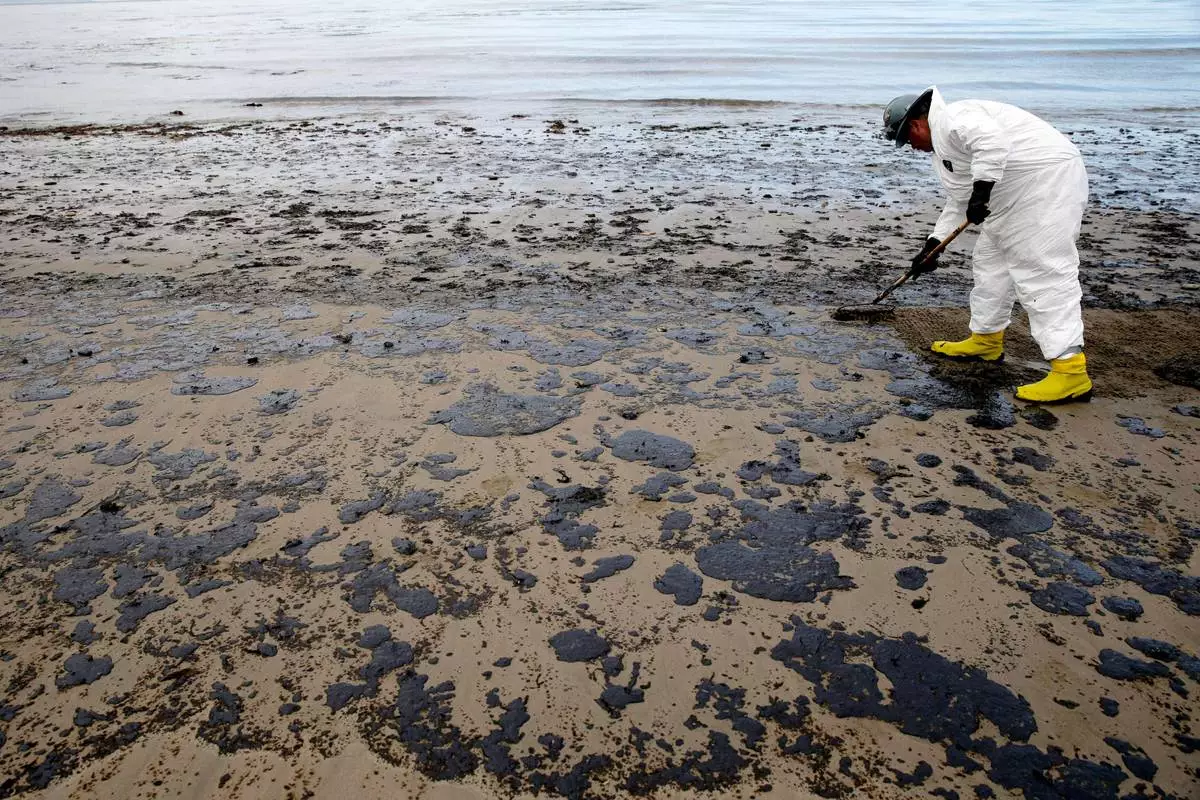
FILE - A worker removes oil from the sand at Refugio State Beach, north of Goleta, Calif., May 21, 2015. (AP Photo/Jae C. Hong, File)
FILE - A worker removes oil from the sand at Refugio State Beach, north of Goleta, Calif., May 21, 2015. (AP Photo/Jae C. Hong, File)

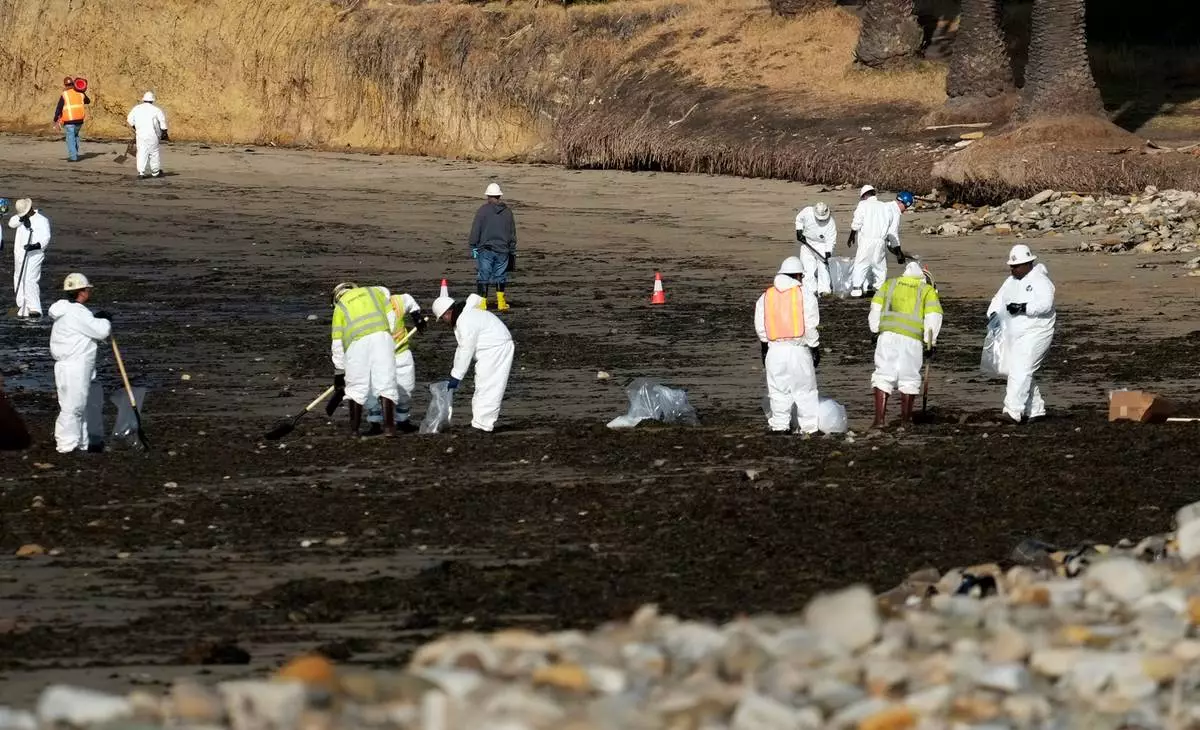
FILE - Clean up crews remove oil-laden sand on the beach at Refugio State Beach, site of an oil spill, north of Goleta, Calif., May 20, 2015. (AP Photo/Michael A. Mariant, File)
FILE - Clean up crews remove oil-laden sand on the beach at Refugio State Beach, site of an oil spill, north of Goleta, Calif., May 20, 2015. (AP Photo/Michael A. Mariant, File)

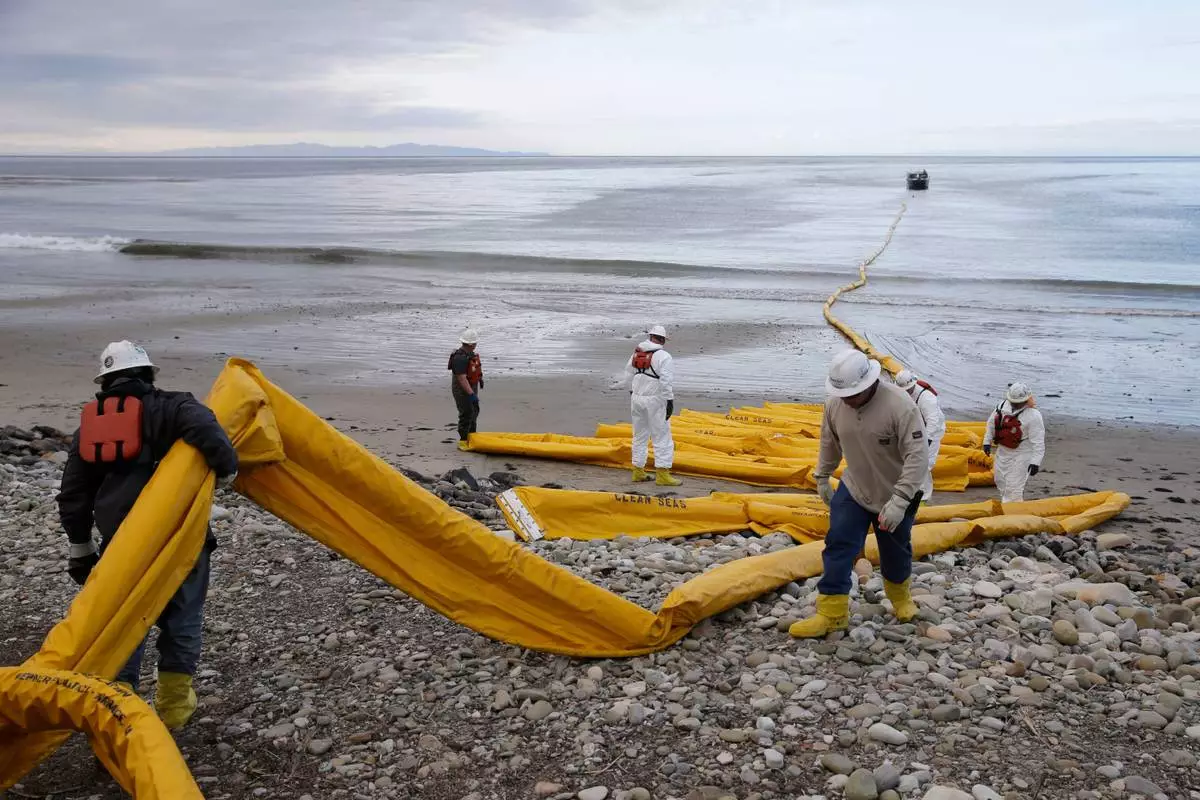
FILE - Workers prepare an oil containment boom at Refugio State Beach, north of Goleta, Calif., May 21, 2015. (AP Photo/Jae C. Hong, File)


FILE - Workers prepare an oil containment boom at Refugio State Beach, north of Goleta, Calif., May 21, 2015. (AP Photo/Jae C. Hong, File)

DUBAI, United Arab Emirates (AP) — Israel said it launched airstrikes against Iranian missile launchers and a nuclear research site Tuesday, and Iran struck back against Israel and across the Gulf region, targeting U.S. embassies and disrupting energy supplies and travel.

Four days into a war that President Donald Trump suggested would last several weeks but perhaps longer, nearly 800 people have been killed in Iran, including some Trump said he had considered as possible future leaders of the country.

Explosions rang out Tuesday in Tehran and in Lebanon — where Israel said it retaliated against Hezbollah militants — and the American embassy in Saudi Arabia came under drone attack. Iran has fired dozens of ballistic missiles at Israel, though most of the incoming fire has been intercepted. Eleven people in Israel have been killed since the conflict began.

The spiraling nature of the war raised questions about when and how it would end. Trump seemed to leave open the possibility for more extensive U.S. military involvement, telling the New York Post on Monday that he was not ruling out the possibility of boots on the ground.

The administration has given various objectives. While the initial U.S.-Israeli strikes killed Iranian Supreme Leader Ayatollah Ali Khamenei and Trump urged Iranians to overthrow their government, senior administration officials have since said regime change was not the goal.

Trump said Monday the military campaign’s four objectives were to destroy Iran’s missile capabilities, wipe out its navy, prevent it from obtaining a nuclear weapon and ensure that it cannot continue to support allied armed groups.

Trump said Tuesday that “someone from within” the Iranian regime might be the best choice to take power once the U.S.-Israel campaign is finished.

Speaking from the Oval Office Tuesday, Trump said Reza Pahlavi, the exiled son of Iran’s toppled Shah, is not someone that his administration has considered in depth to take over.

As far as possible leaders inside Iran, “the people we had in mind are dead,” Trump said.

“I guess the worst case would be do this, and then somebody takes over who’s as bad as the previous person, right? That could happen," Trump said. "We don’t want that to happen.”

Iran’s leaders are scrambling to replace Khamenei, who ruled the country for 37 years. It’s only the second time since the 1979 Islamic Revolution that a new supreme leader is being chosen. Potential candidates range from hard-liners committed to confrontation with the West to reformists who seek diplomatic engagement.

Information coming out of Iran has been limited because of poor communications, round-the-clock airstrikes and tight restrictions on journalists. But across Iran’s capital, aircraft were heard overhead and explosions rang out.

The Israeli military said it conducted a wave of airstrikes on sites that produce and store ballistic missiles, in Tehran and Isfahan. It also said it destroyed what it called Iran’s secret, underground nuclear headquarters. Without providing evidence, it said the site was used for scientific research “to develop a key component for nuclear weapons.”

“The regime attempted to rebuild its efforts and conceal them, thinking we wouldn’t notice. They were mistaken,” said Israeli military spokesman Brig. Gen. Effie Defrin.

Iran has said it has not enriched uranium since June, though it has maintained its right to and says its nuclear program is peaceful.

The United Nations’ nuclear watchdog said Iran’s Natanz nuclear enrichment site had sustained “some recent damage,” though there was “no radiological consequence expected.” The U.S. hit Natanz during the 12-day war in June, when Israeli and American strikes greatly weakened Iran's nuclear program.

New rounds of U.S. and Israeli airstrikes rattled Tehran and several other Iranian cities.

“Since midnight, I and my wife are hearing sound of explosions,” said Ali Amoli, an engineer living in north Tehran. “Sometimes from the west side of the city and sometimes from other directions.” Streets and gas stations appeared quieter than in recent days.

Local media published images of a damaged commercial plane at Bushehr airport that broke apart following an airstrike on Tuesday.

A north Tehran resident who spoke on condition of anonymity for fear of retaliation described growing fears in the capital as it comes under heavy bombardment. The resident said most stores in the normally bustling area of Tajrish were closed, though bakeries and supermarkets remained open.

An attack from two drones on the U.S. Embassy in Riyadh caused a “limited fire,” according to Saudi Arabia’s Defense Ministry, and the embassy urged Americans to avoid the compound. It followed an attack on the U.S. Embassy in Kuwait. U.S. Embassies in Saudi Arabia, Kuwait and Lebanon said they were closed to the public.

The U.S. State Department ordered the evacuation of non-emergency personnel and family in Kuwait, Bahrain, Iraq, Qatar, Jordan and the United Arab Emirates. The U.S. also urged citizens to leave more than a dozen Middle Eastern countries, though with much of the airspace closed many were stranded.

The State Department said Tuesday it’s preparing military and charter flights for Americans who want to leave the Middle East. Several other countries also arranged evacuation flights for their citizens.

The U.S.-Israeli strikes have killed at least 787 people in Iran, according to the Red Crescent Society. In Lebanon, where Israel launched retaliatory strikes on the Iranian-supported militant group Hezbollah, 40 people were killed, including seven children, in Lebanon, the health ministry said. The ministry had previously said 52 people were killed.

The U.S. military has confirmed six deaths of American service members. In addition, three people were killed in the United Arab Emirates, and one each in Kuwait and Bahrain.

Turkish Foreign Minister Hakan Fidan on Tuesday criticized Iran's attacks against Gulf neighbors that had worked to prevent war as an “incredibly flawed strategy” that threatened to widen the war if these states decide to retaliate.

This story has been updated to correct that communications in Iran are poor, but that the internet isn't shut down. It also clarifies that more than one drone hit the U.S. Embassy in Saudi Arabia. Some instances referred to just one drone.

Becatoros reported from Athens, Greece, and Magdy from Cairo. Seung Min Kim, Michelle Price and Konstantin Toropin in Washington, David Rising in Bangkok, Melanie Lidman in Tel Aviv, Israel, Hallie Golden in Seattle, Giovanna Dell'Orto in Miami, and Suzan Fraser in Ankara, Turkey, contributed to this report.

A firefighter extinguishes fire at a building that was hit by an Israeli airstrike in Dahiyeh, a southern suburb of Beirut, Lebanon, Tuesday, March 3, 2026. (AP Photo/Hussein Malla)

A firefighter extinguishes fire at a building that was hit by an Israeli airstrike in Dahiyeh, a southern suburb of Beirut, Lebanon, Tuesday, March 3, 2026. (AP Photo/Hussein Malla)

A woman crosses almost deserted square with a billboard at rear showing a portrait of the late Iranian Supreme Leader Ayatollah Ali Khamenei, who was killed in the U.S.–Israeli military campaign, in Tehran, Iran, Tuesday, March 3, 2026. (AP Photo/Vahid Salemi)

A woman crosses almost deserted square with a billboard at rear showing a portrait of the late Iranian Supreme Leader Ayatollah Ali Khamenei, who was killed in the U.S.–Israeli military campaign, in Tehran, Iran, Tuesday, March 3, 2026. (AP Photo/Vahid Salemi)

Smoke rises from a destroyed building that was hit by an Israeli airstrike in Dahiyeh, a southern suburb of Beirut, Lebanon, Tuesday, March 3, 2026. (AP Photo/Hussein Malla)

Smoke rises from a destroyed building that was hit by an Israeli airstrike in Dahiyeh, a southern suburb of Beirut, Lebanon, Tuesday, March 3, 2026. (AP Photo/Hussein Malla)

An Iranian flag is placed among the ruins of a police station struck Monday during the U.S.–Israeli military campaign in Tehran, Iran, Tuesday, March 3, 2026. (AP Photo/Vahid Salemi)

An Iranian flag is placed among the ruins of a police station struck Monday during the U.S.–Israeli military campaign in Tehran, Iran, Tuesday, March 3, 2026. (AP Photo/Vahid Salemi)

Smoke rises from Israeli airstrikes in Dahiyeh, a southern suburb of Beirut, Lebanon, Tuesday, March 3, 2026. (AP Photo/Hussein Malla)

Smoke rises from Israeli airstrikes in Dahiyeh, a southern suburb of Beirut, Lebanon, Tuesday, March 3, 2026. (AP Photo/Hussein Malla)

Jewish men covered in prayer shawls pray in an underground parking garage as a precaution against possible Iranian missile attacks, in Tel Aviv, Israel, Tuesday, March 3, 2026. (AP Photo/Oded Balilty)

Jewish men covered in prayer shawls pray in an underground parking garage as a precaution against possible Iranian missile attacks, in Tel Aviv, Israel, Tuesday, March 3, 2026. (AP Photo/Oded Balilty)

A group of men inspects the ruins of a police station struck Monday amid the U.S.–Israeli military campaign in Tehran, Iran, Tuesday, March 3, 2026. (AP Photo/Vahid Salemi)

A group of men inspects the ruins of a police station struck Monday amid the U.S.–Israeli military campaign in Tehran, Iran, Tuesday, March 3, 2026. (AP Photo/Vahid Salemi)

Smoke rises from Israeli airstrikes in Dahiyeh, a southern suburb of Beirut, Lebanon, Tuesday, March 3, 2026. (AP Photo/Hussein Malla)

Smoke rises from Israeli airstrikes in Dahiyeh, a southern suburb of Beirut, Lebanon, Tuesday, March 3, 2026. (AP Photo/Hussein Malla)

Smoke rises from Israeli airstrikes in Dahiyeh, a southern suburb of Beirut, Lebanon, early Tuesday, March 3, 2026. (AP Photo/Bilal Hussein)

Smoke rises from Israeli airstrikes in Dahiyeh, a southern suburb of Beirut, Lebanon, early Tuesday, March 3, 2026. (AP Photo/Bilal Hussein)

This image provided by U.S. Central Command shows a F-35C Lightning II preparing for launch on the flight deck of the USS Abraham Lincoln (CVN 72) in support of Operation Epic Fury on Monday, March 2, 2026. (U.S. Navy via AP)

This image provided by U.S. Central Command shows a F-35C Lightning II preparing for launch on the flight deck of the USS Abraham Lincoln (CVN 72) in support of Operation Epic Fury on Monday, March 2, 2026. (U.S. Navy via AP)

Mourners take cover while air-raid sirens warn of incoming missiles launched by Iran toward Israel during the funeral of Sarah Elimelech and her daughter Ronit who were killed in an Iranian missile attack, in Beit Shemesh, Israel, Monday, March 2, 2026. (AP Photo/Ohad Zwigenberg)

Mourners take cover while air-raid sirens warn of incoming missiles launched by Iran toward Israel during the funeral of Sarah Elimelech and her daughter Ronit who were killed in an Iranian missile attack, in Beit Shemesh, Israel, Monday, March 2, 2026. (AP Photo/Ohad Zwigenberg)

A worker instals a billboard on an overpass containing a portrait of the late Iranian Supreme Leader Ayatollah Ali Khamenei, who was killed during the ongoing joint U.S.-Israeli military campaign, in Tehran, Iran, Monday, March 2, 2026. (AP Photo/Vahid Salemi)

A worker instals a billboard on an overpass containing a portrait of the late Iranian Supreme Leader Ayatollah Ali Khamenei, who was killed during the ongoing joint U.S.-Israeli military campaign, in Tehran, Iran, Monday, March 2, 2026. (AP Photo/Vahid Salemi)

Smoke engulfs a street after a strike in Tehran, Iran, Monday, March 2, 2026. (AP Photo/Mohsen Ganji)

Smoke engulfs a street after a strike in Tehran, Iran, Monday, March 2, 2026. (AP Photo/Mohsen Ganji)

Recommended Articles