The European fishing fleet has long been a powerhouse at catching tuna, with a fleet of massive vessels known as purse seiners that can hold as much as 4 million pounds (1.8 million kilograms) of fish at a time. Dozens of them roam the Indian Ocean, fishing for skipjack, yellowfin and bigeye tuna destined for cans on grocery store shelves.
So when Jess Rattle began seeing purse seine ships fishing the Indian Ocean under the flags of Mauritius, Tanzania and Oman, she wondered whether European corporations might be involved.
“We wanted to understand who really owned these vessels,” said Rattle, head of investigations at the London-based environmental charity Blue Marine Foundation. “Were they owned by the coastal states whose quota they were now using, or in fact, were they owned by the EU?”
A new report released Thursday by the Blue Marine Foundation and Kroll, a global investigations firm, and shared with The Associated Press in advance reveals the extent of the European fleet’s access to Indian Ocean tuna stocks, finding that European companies have taken a third of the tropical tuna catch at a time when yellowfin and bigeye tuna are under pressure and still rebounding from being severely overfished.
They have done so in part by registering their ships under the flags of the Seychelles, Mauritius, Kenya, Tanzania and Oman to gain access to a greater catch limit, Rattle’s team found. The practice has allowed the European-owned fleet to expand to more than 50 purse seine ships and supply vessels and increase its catch of tropical tuna despite the European Union’s commitments to cutting back.
The finding comes ahead of an annual meeting of the Indian Ocean Tuna Commission in the Maldives, which brings together the EU and 28 countries with a stake in the tuna fishery.
While common in the fishing industry and not illegal, reflagging a vessel to a foreign country makes it difficult for observers and regulators to gauge the impact of European companies on the fishery. Parent company ownership is often obscured via layers of shell companies and foreign registries, which Rattle and the team at Kroll tracked down over the course of months.
“Europe’s opportunity to help stop overfishing is greater than first appears,” said Benedict Hamilton, a managing director at Kroll.
Though European companies have long fished under the Seychelles flag, Rattle said, their registering under the flags of Oman and Kenya is new. Europeche Tuna Group, which represents the European tuna industry, said in a statement that the industry’s relationship with coastal nations reflects its long-term investment in the region and strong local partnerships.
Spokesperson Anne-France Mattlet said the European industry benefits the economy of regional countries by paying taxes and fishing license fees, investing in local infrastructure, and unloading tuna and other fish in their ports and canneries.
Mattlet concurred with the report’s findings that Europeche has more than 50 purse seine and supply ships operating throughout the Indian Ocean, including with non-EU flags.
Maciej Berestecki, a spokesperson for the European Commission, said in a statement the reflagging of fishing vessels is a private business decision not influenced by public authorities, and that the EU does not defend or represent the interests of vessels flagged to other countries.
“The EU has done, and keeps doing, its utmost to promote and respect catch limits,” Berestecki said.
Despite Europe’s distance from the Indian Ocean, its fishing fleets have long played a dominant role there. Spanish and French tuna companies first introduced purse seine ships to the Indian Ocean in the 1980s, which allowed them to quickly increase their yearly catch. The ships get their name from their giant nets that encircle the tuna and close like a drawstring purse.
But the EU has occasionally butted heads with coastal nations that want a say over the fishing practices in the ocean at their doorstep.
Five years ago, with yellowfin tuna stocks in sharp decline, the Maldives accused the EU of not putting forth a serious proposal to lower tuna quotas at a contentious meeting of the tuna commission. In 2023, the EU objected to a proposal from Indonesia for a closure on purse seine fishing gear that passed with the support of 15 other countries.
In recent years, the tuna commission has put in place new management measures to rebuild the vulnerable yellowfin and bigeye tuna stocks, which are beginning to show signs of recovering. For instance, the EU agreed to reduce the yellowfin tuna catch for EU-flagged vessels by 21%.
Those new limits may be pushing European fishing companies to look to other countries’ quotas to maintain their catch, said Glen Holmes, senior officer with Pew Charitable Trusts.
Holmes and colleagues from Pew, Global Fishing Watch, and other environmental groups are advocating for greater ownership transparency among fishing fleets in the Indian Ocean.
Shipowners have long registered vessels under the flags of foreign countries, much to the dismay of transparency advocates, who say the practice limits oversight of those ships. Sanctioned oil tankers in the ‘ghost fleet’, for instance, frequently change their name and flags to conceal their ownership.
Certain flags have become known as ‘flags of convenience,’ offering companies low fees and lenient attitudes toward fishing or trade rules. Some countries may simply have fewer resources to enforce the laws of the sea.
A January report by the environmental group Oceana found European companies routinely register fishing vessels under the flags of foreign nations, including some countries the EU has accused of “turning a blind eye to illegal fishing activities.”
Oceana is calling on EU countries to begin collecting and publishing ownership data for their fishing fleet.
The change would help the EU better enforce its own laws, which prevent any European individual from benefiting financially from the practices of illegal fishing, said Vanya Vulperhorst, Oceana’s illegal fishing campaign director for Europe. And it would shed light on “the real EU fleet,” she said.
“What we found last year is that the real European fleet, if you add the non-EU flagged vessels, doubles,” Vulperhorst said.
—-
This story was supported by funding from the Walton Family Foundation. The AP is solely responsible for all content.
—-
Contact AP’s global investigative team at Investigative@ap.org or https://www.ap.org/tips/
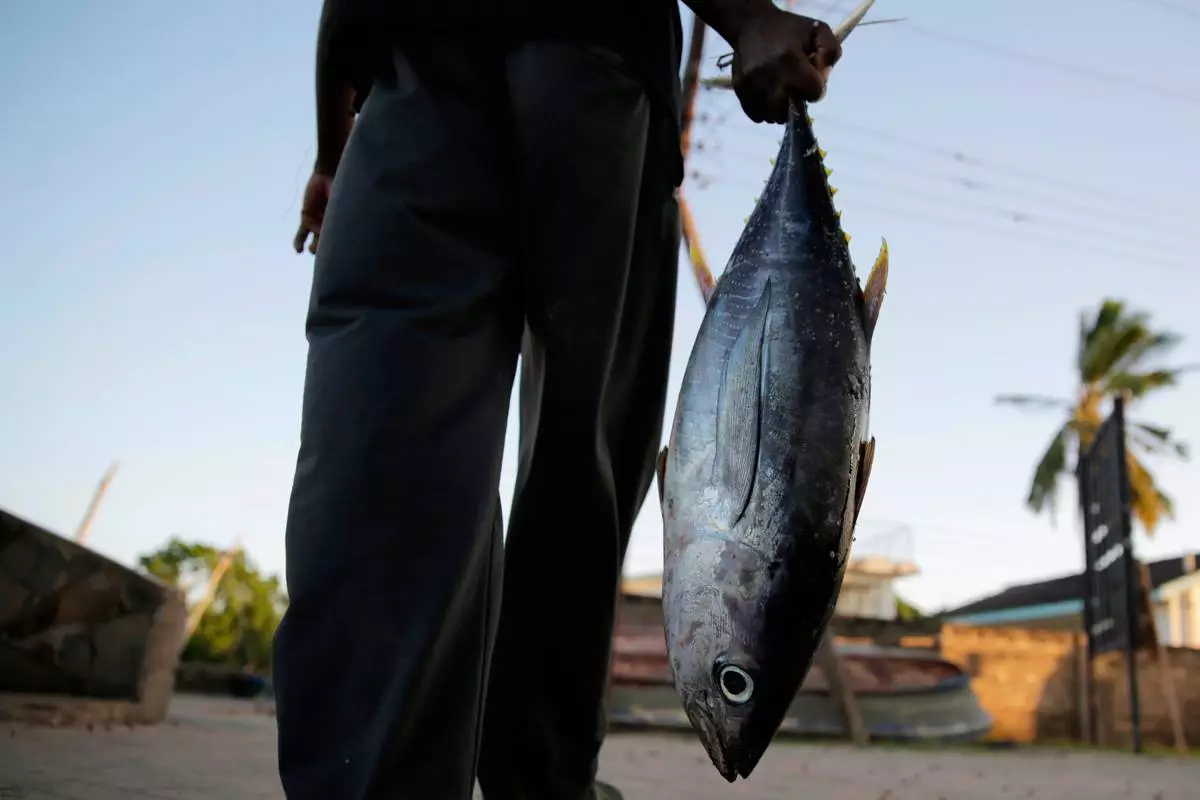
FILE - A fisherman holds a yellowfin tuna after a catch in Vanga, Kenya, June 14, 2022. (AP Photo/Brian Inganga, File)