Skip to Content Facebook Feature Image

China-Laos Railway transports over 600,000 cross-border passenger trips

China

China

China

China-Laos Railway transports over 600,000 cross-border passenger trips

2025-10-16 16:26 Last Updated At:17:07

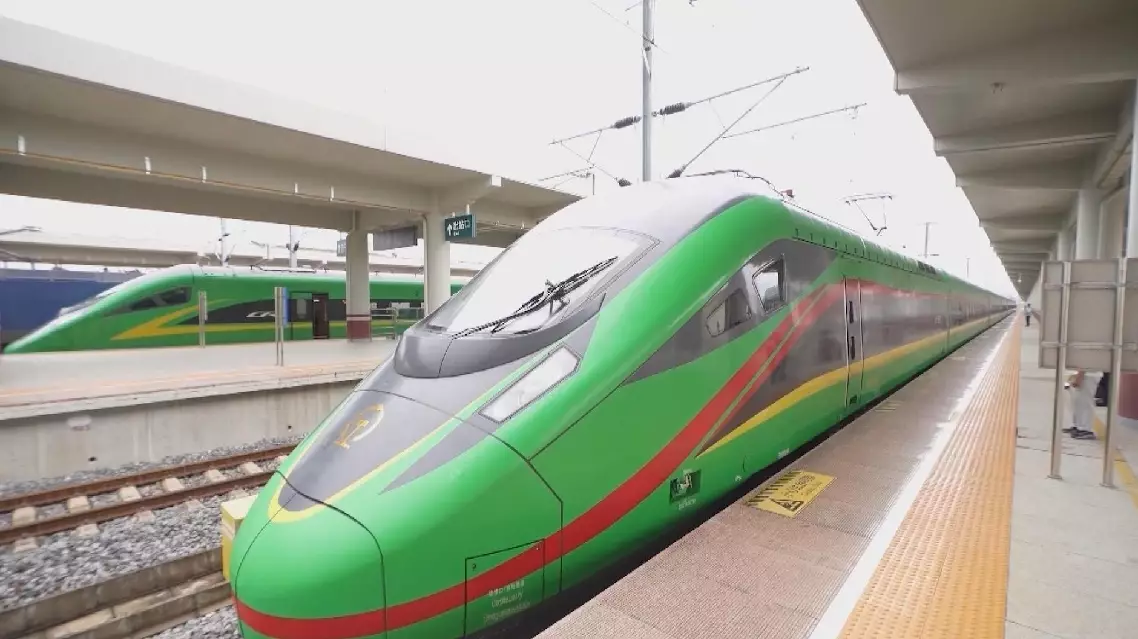
The China-Laos Railway had welcomed more than 600,000 cross-border passengers as of Wednesday, injecting new vitality into the tourism industry along the route and the regional economic development.

The China-Laos Railway officially opened in December 2021 and launched international services linking Kunming and Vientiane in April 2023. The international service has been continuously optimized by railway authorities of both countries to meet the rising demand for cross-border travel.

To meet growing demand, this railway service added a second pair of international trains between Kunming, capital of southwest China's Yunnan Province, and Vientiane,capital of Laos on July 18 this year, doubling the number of daily trains to four. Each train now offers up to 420 seats, with daily passenger numbers reaching over 1,400.

To date, travelers from 115 countries and regions, including Laos, Thailand, Malaysia, the United States and the United Kingdom, have taken the cross-border trains, fueling tourism, hotels and restaurants along the route. The accelerated flow of passengers, cargoes and information has injected new vitality into the regional economic development.
China-Laos Railway transports over 600,000 cross-border passenger trips

China-Laos Railway transports over 600,000 cross-border passenger trips

Key figures from Macao's policy and business communities shared their insights on the region's future development opportunities during a special panel discussion last month, where they assessed the promising prospects that greater alignment with China's national development strategies could bring to Macao.

The guests were speaking at the "Ask China" forum, which brought together some 200 delegates from the finance, tourism, commerce, and public policy sectors to share their views on how China's new socio-economic development plans will reshape opportunities for global investors and the Macao Special Administrative Region (SAR) alike.

The forum, held in late July, also touched on the anticipated opportunities presented by Macao's Third Five-Year Plan (2026-2030) -- which was officially released by the Macao SAR government on Tuesday.

The newly-unveiled plan, which sets out eight key development goals, serves as a comprehensive roadmap for Macao's next phase of growth, and aligns closely with the national 15th Five-Year Plan (2026-2030) adopted by the National People's Congress (NPC) back in March.

It also underscores the SAR government's commitment to promoting moderate economic diversification and strengthening Macao's role as a bridge connecting China with Portuguese-speaking countries and the broader global community.

Speaking at last month's forum, Jose Chui, a deputy to the NPC and president of the Association for Promotion of Science and Technology of Macao, highlighted the role of Macao's state key laboratories in commercializing research, as the plan includes building a 'university city' in the Hengqin area of the neighboring Zhuhai City.

"I think to have the 'university city' built is a very important step forward, and those three universities that will be built in Hengqin at the first phase are all under the government-controlled governance. And how do the four key labs play into it? Because all four key labs actually were part of the various universities. The key lab's main role is to do the research and development part. Research is the biggest concern for them, and that's why the government is building the Industrial Research and Development Park. It's to actually bring in more companies that will do the second phase of development," said Chui.

Another business leader pointed to the region's successful implementation of the "1+4" economic diversification strategy. This initiative aims to build on the foundations of Macao's strong tourism and leisure sector while promoting four other core industries, namely health and wellness, modern finance, high-tech, and a broader sector which includes exhibitions, commerce, culture and sports.

Lawrence Ho, who is also a member of the National Committee of Chinese People's Political Consultative Conference (CPPCC) and vice chairman of the All-China Federation of Industry and Commerce, particularly noted that the trend towards wellness tourism represents a key growth opportunity.

"We've been very lucky to be given this privilege under the 'one country, two systems.' So how do we leverage that even more? And, having the Macao government lead us in terms of the 'one plus four' industries, the one that I like to highlight a little bit more is probably wellness and longevity. I think the global wellness medical tourism industry right now is about 80 billion U.S. dollars and growing to an estimate of about 250 billion dollars by 2035. And I think that's a great opportunity for us. A lot of that global tourism, global medical tourism business resides in Asia. I think people talk about going to Thailand, Singapore, Korea, right? That industry already exists. And I think that's certainly an industry that has a lot of synergies with our industry," said Ho.

Frederico Ma, another CPPCC member and president of the board of directors of the Macao Chamber of Commerce, stressed how Macao's business-friendly zones are an attractive prospect for tech firms and other small- and medium-sized enterprises to tap into.

"To take an example, the Macao Science and Technology Park, it will draw more newcomers for high technologies and they will focus more on the biotech and integrated chips together with the four state key labs of Macao and deploy the technologies and also the research. And also, take the example of the Macao International Integrated Tourism and Cultural Zone, it is one of the biggest cultural developments in Macao, I believe, in the future. And I think these barriers for companies to enter are quite low, or not very high, and I think this area will be suitable for SME companies to enter this market," he said.

Meanwhile, another NPC deputy stressed the importance of aligning Macao's developments plans with that of the wider Greater Bay Area -- a major city cluster and vibrant economic region which comprises Hong Kong and Macao, and nine cities across south China's Guangdong Province.

Kevin Ho, who is also president of the Macao Federation of Industry and Commerce, stressed that due to its small size Macao cannot afford to "close its door" and go it alone, urging greater coordination as part of the Greater Bay Area.

"We need to grow together with our partnering cities and Greater Bay Area cities obviously are our natural match. We're the lucky ones because our neighboring cities -- namely Shenzhen, Guangzhou, Zhongshan, Foshan -- their 15th Five-Year Plan was built before our two sessions [back in March], so we already know their 15th Five-Year Plan. For us to merge into them and to grow together we can look into what they have planned and then we have our Third Five-Year Plan to coexist with them. We need to better utilize Hong Kong and Macao's internationalization to help our neighboring cities and to help ourselves, to merge together, to build together our Greater Bay Area," he said.

Key business figures share views on opportunities afforded by Macao's new development blueprint

Key business figures share views on opportunities afforded by Macao's new development blueprint

Recommended Articles