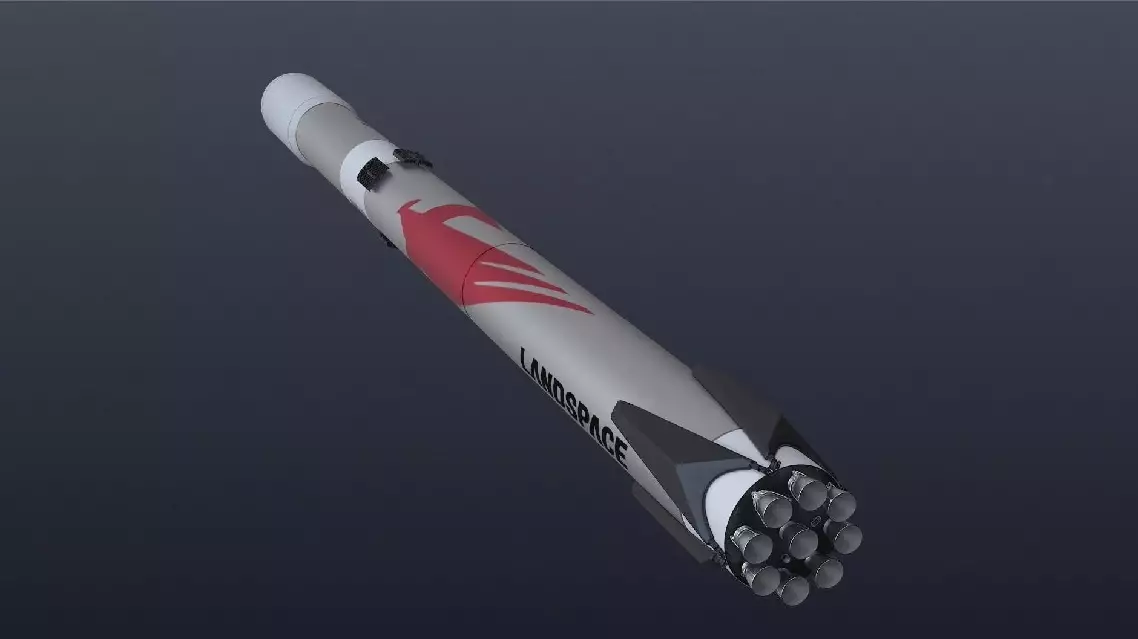
The Zhuque-3 Y2 rocket has undergone multiple technological upgrades, ranging from its nozzle to the landing legs, to boost its payload capacity, said Dai Zheng, chief commander of Zhuque-3.
The rocket blasted off at 07:35 Beijing Time Wednesday from the Dongfeng commercial space innovation pilot zone in northwest China.
Its land-based recovery was completed as planned, with the rocket's first stage touching down smoothly at the designated position in the recovery site, and the second stage sending the onboard Honghu-03 satellite into the preset orbit.
The flight mission was a complete success.
It marked China's first successful land-based controlled recovery of a rocket's first stage using deployable landing legs, highlighting a major breakthrough in the country's reusable rocket technology.
Compared with the Zhuque-3 Y1, the Zhuque-3 Y2 optimized its landing propulsion system and adopted a vacuum nozzle design with a larger area ratio, which improves engine performance and rocket payload capacity, said Dai.
"The second-stage vacuum nozzle is a large vacuum nozzle, whose area ratio has been increased from 50 in Y1 to 100 in Y2. What are the benefits of a larger area ratio? It increases the specific impulse of the second-stage engine, allowing for more complete convective expansion. A larger specific impulse also increases thrust, thus enhancing the overall payload capacity of the rocket," said Dai.
The landing legs are the main qualification focus for Y2, which had gone through numerous tests to ensure their performance and the mission success, said Dai.
"For the landing legs, we conducted numerous ground tests, including drop tests, deployment tests and locking tests. We also ran reliability verification to confirm they can perform their task at the very last moment," he said.
Zhuque-3 Y2 rocket undergoes technological upgrades to boost payload capacity: chief commander