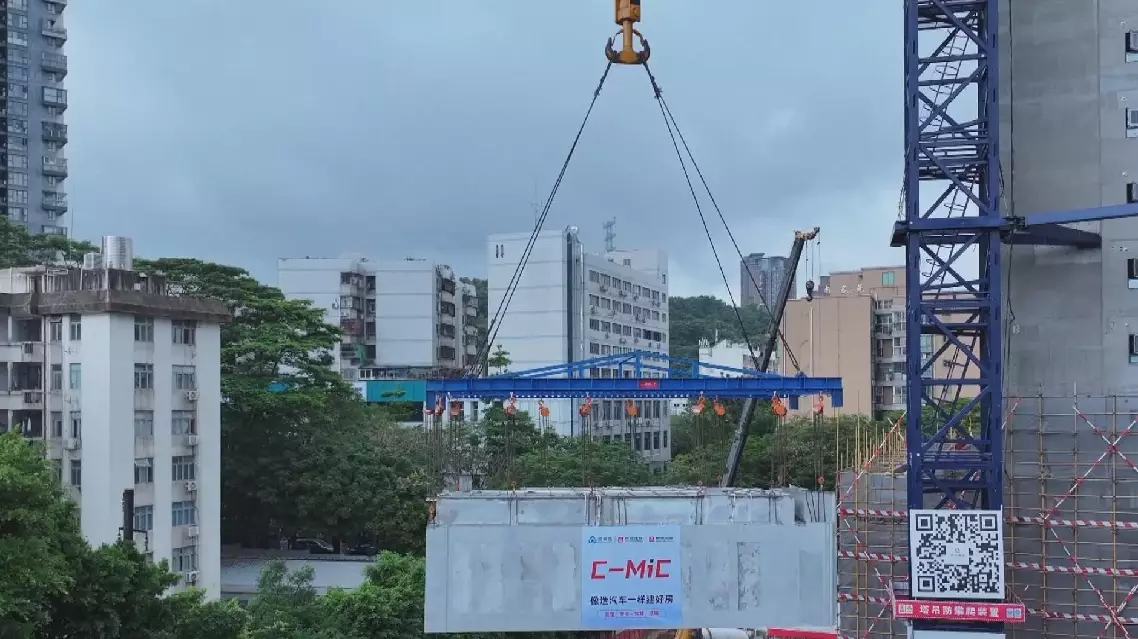
Prefabricated modular construction, working just like Lego blocks, is booming in Shenzhen City of south China's Guangdong Province, cutting overall construction time significantly.
With this approach, modular units of buildings are manufactured on an assembly line, with the walls, pipes, wiring and interior fittings all completed in the workshop. These finished units are then transported to the construction site for assembly.
It takes only around 20 minutes for a single module to be lifted from the ground to its installation position. After placement, workers just secure the screws and connect the cables, and the floor is completed.
"Previously, the construction period might have been two or three years, but now it can be completed in just a few months," said Chen Qinghai, a modular unit hoisting worker.
From hoisting the modules to placing them precisely, it takes an average of two days to assemble one building floor using such prefabricated modules.
A 16-story building is composed of 298 modules. From the first hoisting to a delivery-ready building, the whole process can be completed in about 120 days, cutting the construction schedule by 60 percent compared with traditional building methods.
"We can lift a dozen modular units every day. Compared with traditional construction sites, the working environment is cleaner, the impact on the nearby areas is much smaller, and the overall schedule is short and fast," said Chen.
So far, prefabricated buildings in Shenzhen have exceeded 150 million square meters, accounting for over 64 percent of newly started projects in 2026.
The rapid development of China's prefabricated building industry has benefited from strong government support.
According to a notice issued by Chinese authorities in 2025, city and district-level governments should promote new industrialized construction methods such as prefabricated and smart technologies, and establish long-term mechanisms to support the green and low-carbon transformation of the construction sector.
China's prefabricated building exports have also increased rapidly in recent years, rising from 1.47 billion U.S. dollars in 2015 to about 4.34 billion U.S. dollars in 2025. In the first quarter of 2026, the figure continued to increase, with a year-on-year growth of 45 percent, according to China's General Administration of Customs.
Prefabricated modular methods cut construction time in Shenzhen