
Skip to Content Facebook Feature Image

Obesity remains high in the US, but more states are showing progress, a new report finds

News

Obesity remains high in the US, but more states are showing progress, a new report finds
News

News

Obesity remains high in the US, but more states are showing progress, a new report finds

2025-10-16 22:46 Last Updated At:22:51

For the first time in more than a decade, the number of states with rates of obesity of 35% or more has dropped, an encouraging sign that America's epidemic of excess weight might be improving. But cuts to federal staff and programs that address chronic disease could endanger that progress, according to a new report released Thursday.

Nineteen states had obesity rates of 35% or higher in 2024, down from 23 states the year before, according to an analysis of the latest data collected by the U.S. Centers for Disease Control and Prevention. The CDC data was analyzed by the nonprofit group Trust for America's Health.

The group’s analysis follows a CDC report last year that found that the overall rate of obesity in the U.S. is high but holding steady, affecting about 40% of the population.

While the decline is positive, “it's too soon to call it a trend,” said Dr. J. Nadine Gracia, president and chief executive for TFAH.

And with recent federal funding cuts, staff layoffs and eliminated programs, “this potential progress is also at risk,” Gracia said.

A U.S. Health and Human Services Department spokesman said in an email that the administration is “encouraged by the new data showing progress in the fight against obesity."

“We are restructuring public health programs to eliminate waste, reduce bureaucracy, and redirect resources toward real prevention,” said spokesman Andrew Nixon.

The latest report analyzed data from the CDC's 2024 Behavioral Risk Factor Surveillance System, which uses annual telephone surveys to collect data on health behaviors and chronic conditions in U.S. states and territories.

It showed that 19 states had obesity rates among adults of 35% or higher, 22 states had rates between 30% and 35% and nine states had obesity rates of below 30%. The rates varied from a low of 25% in Colorado to a high of more than 40% in West Virginia.

Between 2023 and 2024, no state had statistically significant increases or decreases in their obesity rates, after 18 states saw significant increases in the previous five years, the report found.

Before 2013, no state had an adult obesity prevalence at or above 35%, By 2019, a dozen states had rates that high — and the number continued to climb.

In adults, obesity is defined as having a body mass index of 30 or higher. Body mass index is a calculation based on height and weight. Obesity is a chronic disease linked to a host of serious health problems including diabetes, stroke, cancer and heart disease.

It's not clear exactly what may be driving the apparent improvements in obesity. Wider use of drugs such as Wegovy and Zepbound — which target appetite and slow digestion — could be starting to show up in reported data, said Aviva Musicus, a science director for the Center for Science in the Public Interest, an advocacy group. Increased support for nutrition assistance programs during the COVID-19 pandemic might also be a factor, she suggested.

The report also details a broad range of federal, state and local efforts that focus on improving nutrition and boosting physical activity, said Solveig Cunningham, an Emory University global health expert who specializes in obesity.

“I think the report would argue that some of these interventions may actually be successful,” said Cunningham, who was not involved with the research. “That would suggest that there are possibly ways in which we could prevent obesity at the population level, which would be a really, really big deal.”

The Associated Press Health and Science Department receives support from the Howard Hughes Medical Institute’s Department of Science Education and the Robert Wood Johnson Foundation. The AP is solely responsible for all content.
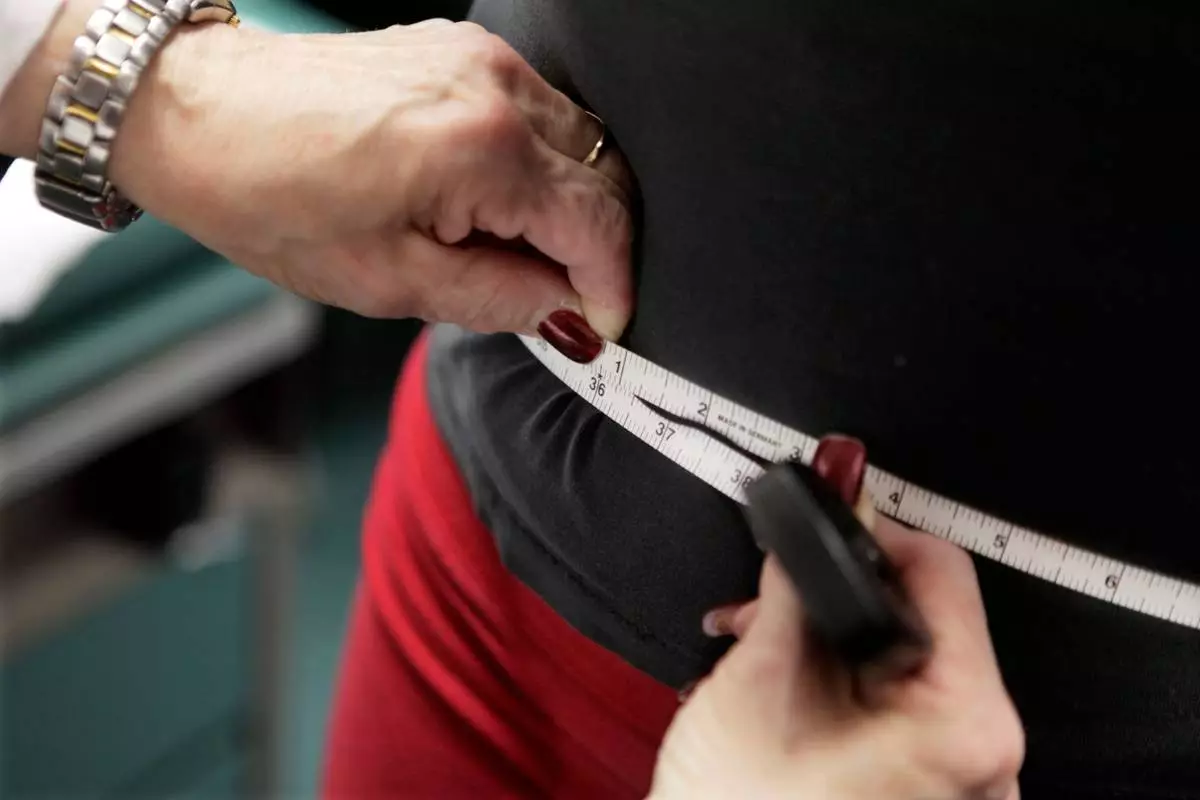
FILE - A subject's waist is measured during an obesity prevention study in Chicago on Jan. 20, 2010. (AP Photo/M. Spencer Green, File)

FILE - A subject's waist is measured during an obesity prevention study in Chicago on Jan. 20, 2010. (AP Photo/M. Spencer Green, File)

CHARLOTTE, N.C. (AP) — The Carolina Panthers are slowly getting healthier following a rash of injuries in the first half of the season.

Panthers coach Dave Canales said cornerback Mike Jackson, running back Jonathon Brooks and offensive lineman Brady Christensen were full participants in practice Wednesday and proclaimed them “ready” to return from injured reserve in time for Sunday’s home game against the Baltimore Ravens.

All three players remain in the 21-day practice window, so the Panthers would first need to make room for them on the 53-man roster.

“These guys are hungry to get back out there, so we are going to try to find a way for them to help us,” Canales said.

Cornerback Will Lee III is also set to return this week from a nagging hamstring injury.

Canales also remains optimistic that two-time Pro Bowl cornerback Jaycee Horn and starting left tackle Ickey Ekwonu will return at some point this season, although he hasn't given a precise timetable.

The news comes one week after outside linebacker Jaelan Phillips returned from a three-game absence because of a hamstring injury to earn NFC Defensive Player of the Week following Carolina’s 20-17 win over New Orleans.

Also, wide receiver Xavier Legette returned from IR last week, although he played sparingly.

All of that is good news for a Panthers (4-5) team that is clinging to first place in the NFC South despite their losing record.

“We have a lot of special guys ... that have done a lot of work trying to come back, and this is an opportunity to rally with our teammates,” quarterback Bryce Young said.

The return of Jackson could be a tremendous lift for the Panthers as they prepare to face Baltimore wide receiver Zay Flowers.

Jackson led the NFL in pass breakups last season with 19 and would give Carolina's cornerback room some needed experience.

Jackson and Horn have been out since Week 4, and backups Lee and Akayleb Evans went down with injuries in the weeks that followed. That forced the Panthers into playing their fifth and sixth cornerbacks the past few weeks, resulting in several pass interference and defensive holding penalties.

Canales said it's “going to be awesome" to get Jackson back on the field.

“With Mike out there, there is the leadership complement,” Canales said. “He's a guy that we have been counting on this whole time. And he's excited. He sees people making plays and he wants to be out there making plays.”

Brooks would be a welcome addition to the Panthers backfield.

Carolina has been relying almost exclusively on Chuba Hubbard to carry the load in the running game. He ran 27 times for 92 yards and two touchdowns against the Saints and also caught five passes for 80 yards.

He has at least 19 carries in five of Carolina's past seven games.

The Panthers haven't given many carries to Trevor Etienne or A.J. Dillon to help spell Hubbard. However, Canales has always been high on Brooks, whom he views as a “home run threat” on any given play.

Canales will have to keep an eye on new injuries to tight ends Darren Waller and Tommy Tremble this week. Both sat out practice Wednesday with knee injuries, and Canales said the team won't know much on their status until later in the week.

See AP’s full NFL coverage here

FILE - Carolina Panthers defensive back Mike Jackson warms up before an NFL preseason football game against the Jacksonville Jaguars, Aug. 21, 2026, in Jacksonville, Fla. (AP Photo/Phelan M. Ebenhack, File)

FILE - Carolina Panthers defensive back Mike Jackson warms up before an NFL preseason football game against the Jacksonville Jaguars, Aug. 21, 2026, in Jacksonville, Fla. (AP Photo/Phelan M. Ebenhack, File)

Recommended Articles