Palestinian Prime Minister Mohammad Mustafa on Thursday unveiled a three-phase recovery and reconstruction plan for war-torn Gaza, which is estimated to cost 67 billion U.S. dollars and spans five years.
Speaking at a meeting with international partners at the cabinet headquarters in the West Bank city of Ramallah, Mustafa said the Palestinian government has established a unified framework for reconstruction through the Gaza Recovery and Reconstruction Implementation Program, based on the Arab Plan for Recovery, Reconstruction, and Development in Gaza adopted at the Extraordinary Arab Summit in Cairo in March.
International assessments estimated that damages and losses from the two-year war in Gaza have exceeded 67 billion U.S. dollars, Mustafa said.
The rebuilding program sets a five-year timeframe of 67 billion dollars, encompassing 56 sub-programs in 18 sectors, including housing, social services, and infrastructure, and will be implemented in close coordination with Palestinian ministries, institutions and international partners, said Mustafa.
According to Mustafa, the five-year program is divided into three phases: the first, a six-month emergency phase focusing on early recovery, valued at 3.5 billion dollars; the second, a three-year reconstruction and recovery phase, valued at approximately 30 billion dollars; and the third, the reconstruction phase.
With the Gaza ceasefire agreement taking effect, a Gaza reconstruction meeting will be held in November in Cairo, the capital of Egypt, with an aim to build a central platform to effectively mobilize international resources, build a framework for multilateral cooperation, and advance the rebuilding of Gaza, said Mustafa.
He emphasized that all these efforts must be led and coordinated by the Palestinian Authority, with the supervision of international partners.
The reconstruction process will also strengthen integration between the Gaza Strip and the West Bank, so as to contribute to the restoration of a unified Palestinian governance framework, said Mustafa.
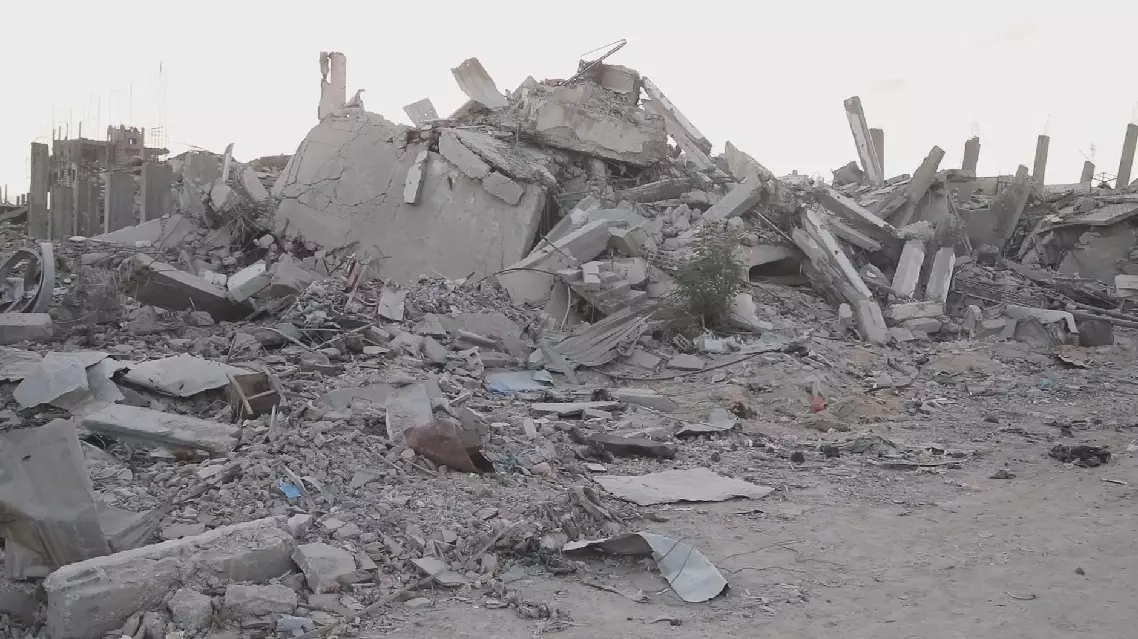
The two-year war in Gaza have left about 55 million tons of rubble scattered across the region, equivalent to the combined mass of 13 Giza pyramids in Egypt, said Jaco Cilliers, special representative for the UNDP (United Nations Development Program) Program of Assistance to the Palestinian People.
The first step is to clear the rubble for any reconstruction effort and the immediate priority is to clear roads to facilitate the delivery of humanitarian aid, he said.
However, the debris removal process faces significant challenges, including the need to safely dispose of unexploded ordnance to protect workers and civilians, the special representative said.
Palestinian PM unveils 67 bln US dollars, five-year plan for Gaza reconstruction
Major Chinese commercial banks reported steady profit growth and low non-performing loan ratios in 2025, while signaling strong lending intentions for emerging industries outlined in the country's 15th Five-Year Plan, including integrated circuits, artificial intelligence and robotics.
The six largest state-owned banks, including Industrial and Commercial Bank of China (ICBC), Agricultural Bank of China, Bank of China, China Construction Bank, Bank of Communications and Postal Savings Bank, posted combined operating revenue of 3.6 trillion yuan, up 2.44 percent year on year, with net profit reaching 1.42 trillion yuan, a 1.65 percent increase. Prominently, ICBC became the world's first bank to exceed 50 trillion yuan in total assets.
"In 2025, Bank of Communications saw positive growth in core indicators such as net profit attributable to shareholders, net operating revenue, net interest income and net fee and commission income — the best performance in recent years," said Zhang Baojiang, president of Bank of Communications. "We have developed 43 bank-wide products and 208 region-specific products, ensuring that every key area of rural revitalization has a dedicated product offering," said Wang Zhiheng, president of Agricultural Bank of China.
Among the 10 listed joint-stock banks, including China CITIC Bank, asset scale grew steadily and operating indicators improved last year. Most banks maintained low non-performing loan ratios.
Loan allocation serves as a key economic indicator. While releasing their 2025 results, many banks also identified priority sectors for lending this year, with development opportunities under the 15th Five-Year Plan (2026-2030) drawing the most attention. Multiple banks have pledged to ramp up loan disbursements to support the real economy.
"In the first two months of this year, corporate loans exceeded 2 trillion yuan, with cumulative lending of over 60 billion yuan to projects supporting major national strategies and key security capacity building," said Wang Jingwu, senior executive vice president of ICBC. "Under the 15th Five-Year Plan, serving emerging industries like integrated circuits, AI and robotics could unlock multi-trillion-yuan opportunities, perhaps as much as 10 trillion yuan, for banks like ours," said Luo Feng, vice president of China Zheshang Bank.
Several banks also said they will increase support for technology finance, green finance, inclusive finance, pension finance, digital finance and consumer credit this year, while optimizing lending structures and accelerating the application of "AI Plus" in banking operations.
"Since the beginning of this year, our quota-based consumer loans have maintained rapid growth, with new loans exceeding 20 billion yuan, an increase of over 80 percent year on year," said Liang Shidong, retail business director of Postal Savings Bank of China.
"We will advance the 'AI Plus' initiative, developing AI application models for key areas such as credit, marketing and operations. We will also accelerate branch transformation and smart operations to provide one-stop, comprehensive services that meet the diverse needs of our customers," said Zhang Hui, president of Bank of China.
Chinese banks post steady profit growth, eye opportunities from 15th Five-Year Plan