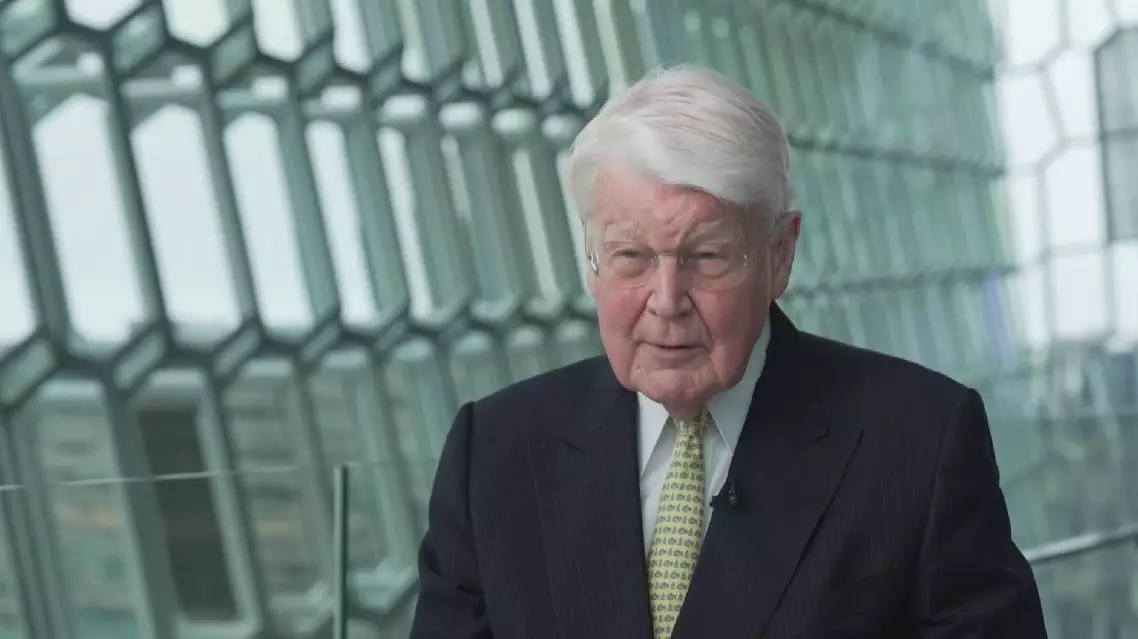
Arctic Circle Chairman Olafur Ragnar Grimsson has sounded that alarm that climate and energy tipping points are fast approaching, urging global cooperation and praising China's scientific leadership as the 2025 Arctic Circle Assembly opened Thursday in Iceland's capital Reykjavik.
Founded in 2013, the annual assembly is the world's largest forum on Arctic affairs, drawing governments, researchers, organizations, and other stakeholders into a wide-ranging dialogue on the region's future.
In an interview with China Global Television Network on the sidelines of the three-day assembly, Grimsson, also former president of Iceland, stressed that the Arctic's fate is now inseparable from global dynamics.
"We now live in a world where there is a strong interrelationship between the future of Asia, Africa, Europe, the Americas and the future of the Arctic. And what we have succeeded in is creating this annual global gathering to bring together all the major stakeholders and let them do their own thing. And of course, from the very beginning, China has played a big role in this, both the scientific institutions, the Chinese Polar Research Institute, the Tibetan Plateau Institute, as well as the Foreign Ministry and the climate leadership, as well as other prominent leaders from your country," he said.
Grimsson noted China's growing role since gaining observer status at the Arctic Council in 2013, adding that Asian countries have become key players in Arctic affairs, even as the Russia-Ukraine conflict continues to cast a shadow over regional cooperation.
"It was not only China, it was also India, Singapore, Japan, Korea. There was a number of Asian states. So the contribution by the scientific institutes in Asia, including the Polar Research Institute in China, has been very, very important. The problem is that after the war in Ukraine, and the isolation of Russia from Western Europe and the United States, the Arctic Council, the intergovernmental body, is just limping along," said the chairman.
He then pointed to the urgent climate crisis facing the Arctic, emphasizing that the region is warming at three times the global average.
"We are close to the tipping point, definitely, because if you take Greenland, which is our neighbor, the huge ice sheet in Greenland - Greenland is the largest island in the world mostly covered by ice - is already melting big time. And if only a quarter of the Greenland ice sheet melts, it will lead to two meters rise in sea level everywhere in the world," he said.
Beyond climate concerns, Grimsson highlighted the energy challenges posed by technological advancements when asked about his view on renewable energy powering data centers for artificial intelligence development.
"That is a very important question, because unfortunately, this growing discussion about artificial intelligence almost always leaves out the question of the energy. So, I think, or at least I hope, that in the next few years, because it has to be in the next few years, the energy question will be brought into the artificial intelligence debate. And if we cannot run this monumental operation that artificial intelligence will include on clean energy, then the tipping points will arrive very early and the future of cities and regions all over the world will basically be disastrous," he said.
Arctic Circle chair urges global cooperation to avert climate, energy tipping points