China has leveraged high-level opening-up to foster deep-seated reforms and high-quality development during the 14th Five-Year Plan period (2021-2025). This strategy is not only expanding the horizons for Chinese modernization but also creating new opportunities for the global economy.
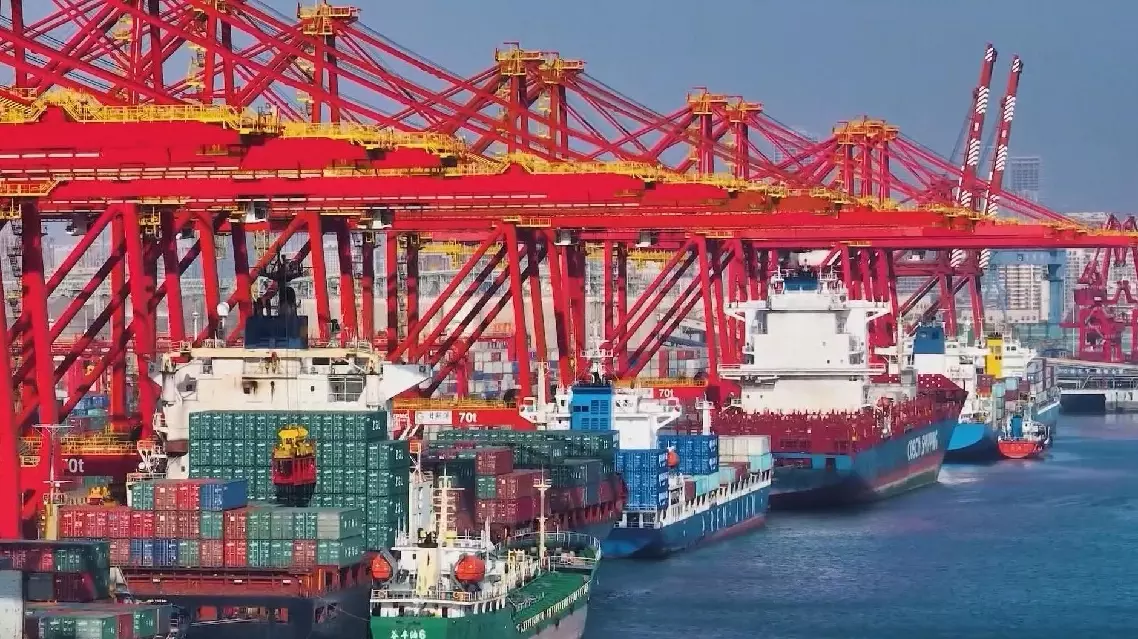
Recent developments across the country illustrate this momentum. In Zhangjiagang City in east China's Jiangsu Province, a new shipping route to Chancay Port in Peru was launched in September, with a shipment of green products like energy storage cabinets set to enter the Peruvian market.
In Xi'an in northwest China's Shaanxi Province, the first China-Europe Railway Express train using a trans-Baltic Sea-Rail intermodal route successfully departed, cutting the journey to Hamburg, Germany, to just 17 days.
Today, trade between China and Belt and Road Initiative (BRI) partner countries accounts for over 50 percent of its total trade volume.
Meanwhile, in Hainan Province, stress tests for the island-wide customs closure of its free trade port are progressing. After the closure, the proportion of "zero-tariff" goods will increase by nearly 53 percentage points.
Across the nation, a network of 22 pilot free trade zones (FTZs) is rapidly emerging as a highland of openness.
Throughout the 14th Five-Year Plan period, President Xi Jinping has stressed the need to integrate reform with opening-up and steadily expand institutional openness, issuing a series of major directives to build a new, higher-level open economic system. From enhancing the strategy for pilot FTZs to improving platforms like the China International Import Expo (CIIE) and promoting the high-quality development of the BRI, these efforts have quickened the pace of China's high-level opening-up and expanded win-win cooperation.
"Since the 14th Five-Year Plan period began, General-Secretary Xi Jinping, with his superb political wisdom and broad strategic vision, has set the direction for high-level opening up. China has implemented a more proactive opening up strategy, achieving a higher overall level of openness, stronger resilience, and more stable growth, opening up a brand-new situation with unprecedented intensity," said Wang Xuekun, president of the Chinese Academy of International Trade and Economic Cooperation at the Ministry of Commerce.
The 14th Five-Year Plan outline calls for opening-up on a larger scale, in broader areas, and at a deeper level. By leveraging its vast domestic market, China aims to promote international cooperation for mutual benefit and ensure the steady, long-term progress of the Belt and Road Initiative.
During this period, the negative list for foreign investment has been shortened to 29 items, with all restrictions in the manufacturing sector eliminated. Pilot programs for opening up the service sector are advancing, with 155 tasks covering fields like telecommunications, healthcare, and finance. The catalogue of industries encouraged for foreign investment has been revised multiple times to guide investment toward advanced manufacturing and modern service industries.
From 2021 to May of this year, cumulative foreign direct investment in China reached 4.7 trillion yuan (about 657 billion U.S. dollars), surpassing the total for the entire 13th Five-Year Plan period (2016-2020).
The framework for institutional opening-up has also been continuously refined. The 22 pilot FTZs have proactively aligned with high-standard international economic and trade rules, launching over 110 pilot measures in key areas like trade, investment, and intellectual property. This has resulted in nearly 200 institutional innovations, steadily releasing the dividends of institutional openness.
"During the 14th Five-Year Plan period, China has fully utilized the pioneering role of its pilot free trade zones and the (Hainan) Free Trade Port. The country has carried out groundbreaking and integrated explorations in broader and deeper areas, creating a transparent, stable, and predictable institutional environment and further elevating the development of its open economy," said Jing Qin, deputy director of the Department of Foreign Capital and Overseas Investment at the National Development and Reform Commission.
Cooperation under the BRI has also expanded in scope, scale, and depth. China has signed investment cooperation memorandums of understanding in digital, green, and blue economies with over 50 partner countries, alongside practical cooperation in green infrastructure and clean energy.
Today, the BRI has attracted more than 150 countries and over 30 international organizations. China's trade in goods with BRI partner countries grew from 2.7 trillion U.S. dollars in 2021 to 3.1 trillion U.S. dollars in 2024. From 2021 to the first half of this year, two-way investment between China and partner countries exceeded 240 billion U.S. dollars.
In Indonesia, the Jakarta-Bandung High-Speed Railway has become a shining example of modern transportation. Since its launch in October 2023, it has cut travel time between the two cities from over three hours to just 46 minutes.
"As part of the Belt and Road Initiative, the Jakarta-Bandung High-Speed Railway has not only improved our infrastructure but also enhanced our nation's competitiveness. My personal destiny has been changed because of it," said Wawan Setiyawan, an Indonesian train driver on the railway.
During the 14th Five-Year Plan period, China has also expanded its global network of high-standard free trade areas. It promoted the signing and implementation of the Regional Comprehensive Economic Partnership (RCEP), completed negotiations for the China-ASEAN Free Trade Area 3.0, and signed eight bilateral free trade agreements or upgraded protocols, bringing its total number of FTAs to 23.
An open China is demonstrating powerful vitality. During the 2021-2025 period, China's trade in goods surpassed the 5 trillion U.S. dollars and 6 trillion U.S. dollars milestones, ranking first globally for eight consecutive years. Its trade in services exceeded 1 trillion U.S. dollars for the first time last year, ranking second globally.
On its new journey, China remains committed to comprehensively deepening reform and expanding high-level opening-up, continuously injecting momentum into its high-quality economic development while making greater contributions to the world economy.
Reform, opening-up strategy powers China's progress in 2021-2025 period