Units of the Chinese People's Liberation Army (PLA) have recently conducted a series of actual combat-oriented drills featuring coordinated operations between manned and unmanned systems, as part of the efforts to boost combat capabilities and enhance troops' safety and efficiency in modern warfare.
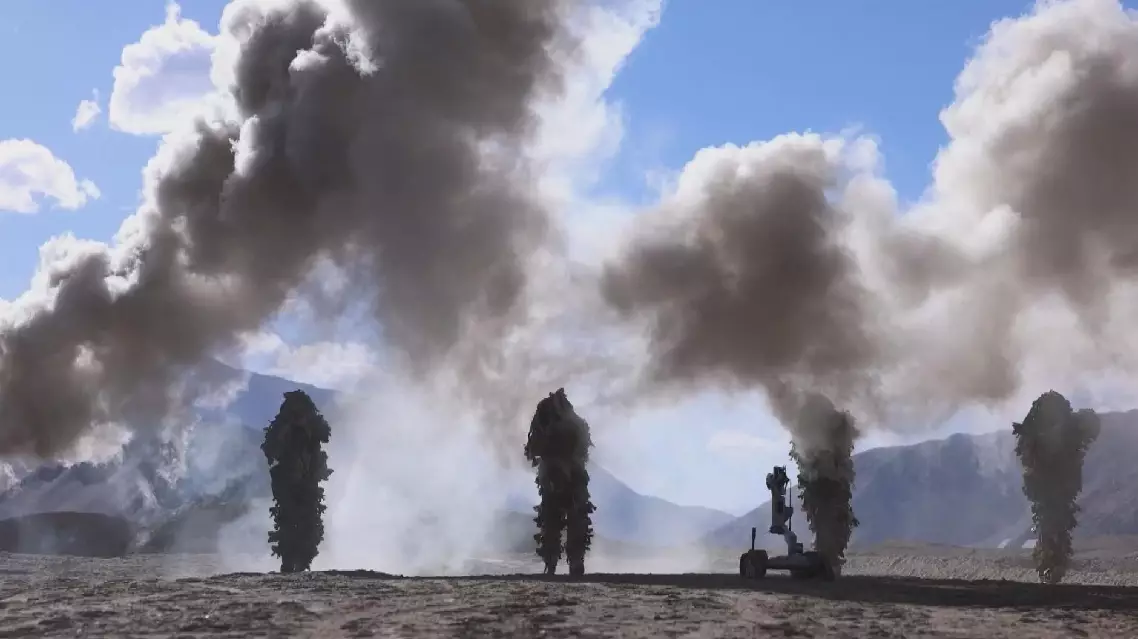
At a training range in northwest China's Xinjiang Uygur Autonomous Region, a live obstacle-breaching drill employing manned-unmanned coordination was carried out in recent days.
At the drill, multiple drones rose to survey forward enemy positions and relay real-time data. Fire teams deployed smoke screens to conceal advancing personnel, who, supported by small tracked vehicles, suppressed identified enemy fire points.
Meanwhile, unmanned ground vehicles approached to cut the barbed wires, while manual demolition teams removed residual obstacles, with the equipment and troops operating in close coordination to rapidly open a lane.
"Through the tactic of manned and unmanned coordination, we have formed a combined strike supported by the overall combat system, enabling us to have eyes in the sky and shields on the ground at the same time. This greatly enhances both the operational efficiency and safety of obstacle-breaching troops," said a commander of the participating troops named Lyu Hui.
Unmanned systems are also widely used for explosive-ordnance disposal.
In a joint logistic support unit's actual combat-oriented drill, a mine-detection team, guided by drone reconnaissance, searched around a simulated-attacked convoy.
Two reconnaissance teams, directed by drones, verified the hazardous ordnance found.
Meanwhile, operators marked unexploded ordnance locations and high-risk areas through live footages transmitted by equipment from the reconnaissance team, and built a 3D EOD map. Two tracked EOD (explosive ordnance disposal) robots then advanced in sequence, using robotic arms to clear the covering soil, identify the types and assess the safety levels of unexploded devices.
Under the protective surveillance ring formed by drones and robots, EOD technicians in bomb suits approached to work at close ranges.
For subterranean and semi-buried munitions, a shaped-charge EOD team employed quad-rotor drones carrying sacrificial demolition vehicles equipped with focused detonation systems to complete precise disposal.
"Next, we will continue to optimize our training models in line with the requirement of actual combat, upgrade the battlefield adaptability and intelligence level of unmanned equipment, and strengthen collaborative training between personnel and machinery. The manned and unmanned collaboration mode will become more battlefield-oriented and combat-ready, providing a solid defense for troop operations and minimizing non-combat casualties," said Zhou Hang, officer of an ammunition disposal battalion.
Manned, unmanned collaboration sharpens battlefield edge, boosts safety, efficiency