Hong Kong's film industry serves as a crucial bridge of culture and commerce under an increasingly open service trade environment with neighboring cities, according to Peter Lam Kin-ngok, chairman of Media Asia Group Holdings Limited.
In May, the China Film Administration issued a new set of rules to invite Hong Kong and Macao service suppliers to establish film production companies on the Chinese mainland and engage in film production.
According to Lam, increased openness under the rules will help foster a thriving cross-city film industry within the Guangdong-Hong Kong-Macao Greater Bay Area (GBA) as the region rapidly develops into a world-class city cluster.
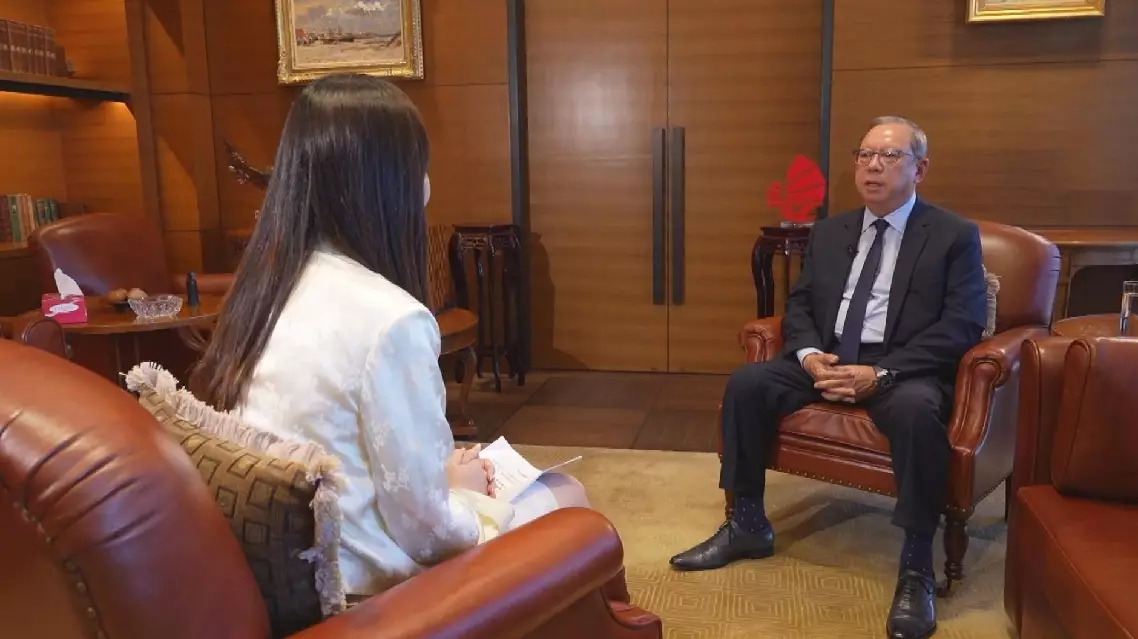
"Hong Kong has long emphasized its role as a pivotal bridge between markets and a catalyst adding substantial value to projects. How should we embody this role? First, what are our advantages under the 'one country, two systems' principle? Primarily, advantages in legal and tax aspects. Second is the advantage of the Closer Economic Partnership Arrangement (CEPA) between the Chinese mainland and Hong Kong. Over the more than 20 years since CEPA's implementation, nearly 750 co-produced films have been made, demonstrating that the advantages of Hong Kong-mainland film co-productions have been consistently maintained," said Lam, speaking in an interview with China Media Group (CMG) in Hong Kong.
The Chinese mainland signed the CEPA with the Hong Kong and Macao governments respectively in 2003. As a win-win trade agreement, CEPA fully reflects the close relationship of complementary advantages and common development between the mainland and Hong Kong.
The rules issued in May aim to implement recent revisions to the agreement, which called for more openness across a range of service sectors.
Lam also stressed the importance of building a cultural ecosystem among cities in the GBA based on the shared cultural history of the region, which has long been known to the Chinese as Lingnan, meaning "south of the Nanling mountains."
"To jointly build a full film-industry ecosystem between Hong Kong and mainland cities in the GBA, I think promoting Lingnan culture is important. What is Lingnan culture? You know, in many places around the world, such as among older overseas Chinese in the United States, in Southeast Asia, Malaysia, people speak Cantonese more often. This is where the advantage of Hong Kong and the GBA emerges, because many Hong Kong films are made in Cantonese, many overseas Chinese grew up watching them," said Lam.
"We also hope to showcase more of Hong Kong's diverse locations in films, and we also want to include tourist attractions from the GBA in some films. Every place has different cuisines and distinctive cultural characteristics. We also hope some films can promote their culture externally, for example, driving tourism, culture, creativity, and food, I think this is very important," he added.
On the future of Hong Kong's film industry, Lam underscored that even as productions become increasingly complex, high-quality screenwriting remains foundational to success.
"I think the most important breakthrough is a good script, because no film without a good script can succeed internationally. We currently lack some talent. We believe we need to cooperate with mainland universities to cultivate new talent, leverage the strengths of both places for talent exchange in directing and production, and utilize the advantages of CEPA to cultivate talent," he said.
Hong Kong film industry to flourish under open trade with Chinese mainland: media magnate