The third Guangdong-Hong Kong-Macao Greater Bay Area College Student Film Week opened in Shenzhen, south China's Guangdong Province, on Sunday, serving as a bridge for young film professionals to exchange ideas and gain practical experience.
Featuring high-tech imagery and diverse screenings, the event opened with screening of the "SHENZHOU 13," China's first space documentary filmed in 8K ultra-high-definition cameras by its astronauts.
The "SHENZHOU 13," or "Blue Planet Outside the Window," chronicles the Shenzhou-13 mission featuring China's first six-month manned space station stay and the first spacewalk by a Chinese female astronaut.
The 90-minute documentary offers unprecedented, spectacular views of the Earth from about 400 kilometers above and gives intimate glimpses into life aboard the station.
The film's director Zhu Yiran joined 1,800 students from Guangdong, Hong Kong and Macao -- the three places constituting the Greater Bay Area city cluster in south China -- at the opening ceremony to discuss the filmmaking process and China's recent achievements in space exploration.
"This represents an immense challenge for both the director and our space photographers, that is, our astronauts. From both ground-based and space perspectives, it's a very bold attempt and creation," said Ch'en Haichien, a student from Macao.
The film week will screen 55 films of diverse themes, including the "The Dumpling Queen," a fact-based drama about a street food vendor's rise to frozen food mogul, Hong Kong action crime thriller "Twilight of the Warriors: Walled In", and the animated film "I Am What I Am."
"Over 100 screenings will take place at Shenzhen University, Southern University of Science and Technology, and other universities as well as partner cinemas, which is expected to cover 100,000 students. An exhibition featuring posters of more than 100 classic films produced in Guangdong Province will also tour campuses in Shenzhen, in commemorating the 120th anniversary of Chinese cinema," said Zeng Xiaomin, vice chairwoman of the Guangdong Federation of Literary and Art Circles.
The film week also features a special section, inviting production teams and post-production experts from multiple popular films to visit campuses for on-site teaching, technical sharing, and dialogues, giving students hands-on contact with industry frontlines.
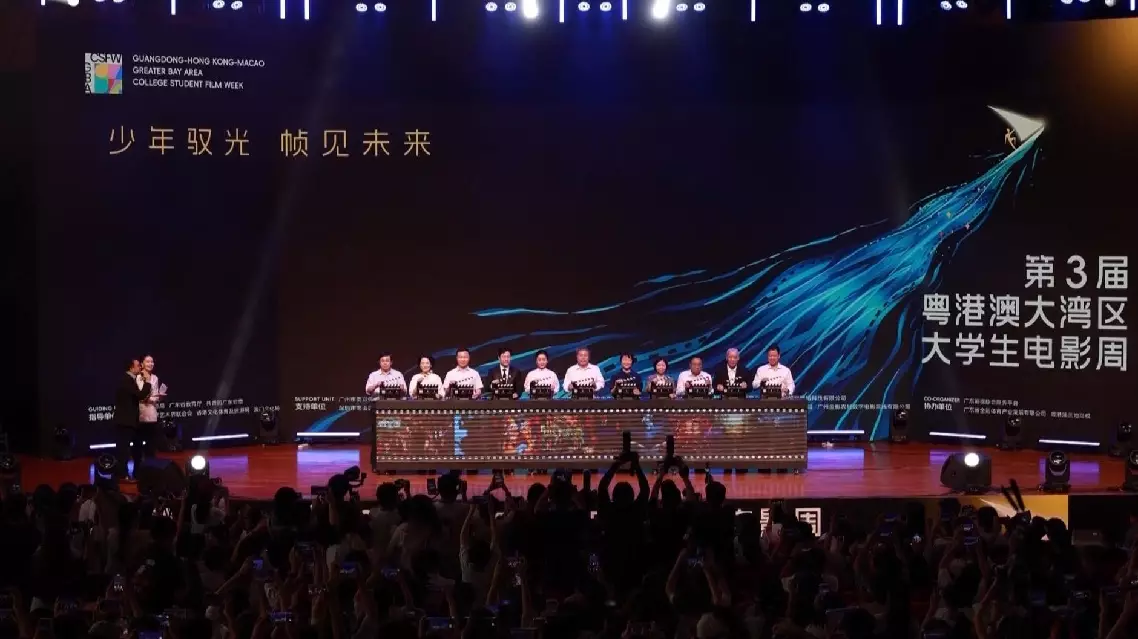
Greater Bay Area College Student Film Week opens in Shenzhen
A former television host from Taiwan, Zhai Xuan, has made a pivotal decision to leave mainstream broadcasting in order to create content that provides a better understanding of the Chinese mainland and cross-strait relations.
Zhai, a seasoned television host with over a decade of experience in Taiwan's media landscape, recently addressed an audience at an event in Beijing, where she revealed her complete transition into independent online media.
In her remarks, she articulated her aspiration to bridge what she perceives as a significant information gap between audiences on both sides of the Strait, highlighting her commitment to fostering a deeper understanding and connection through her new endeavors.
"I was really surprised by all the fake news. There were stories saying people on the mainland can't afford tea eggs or that they live in mud houses and in Taiwan, this was the main information many people received," said Zhai.
Zhai said she initially began producing online videos to challenge such perceptions while continuing her work as a television host.
In April 2025, she travelled to the mainland with her father to fulfill her late grandfather's wish to return to his hometown. The trip, which reunited family members separated since 1949, was recorded in a video series titled "Journey to Find Our Roots", drawing attention from viewers in both Taiwan and the mainland.
"Many people in Taiwan told me that after watching, they wanted to apply for a mainland travel permit immediately and go looking for their relatives. Some had long forgotten these things, but after seeing my story, they began thinking about their hometowns and family members they had never met and decided to search for their roots," Zhai shared her story at the event.
By mid-2025, Zhai said she began to feel increasing pressure amid rising political tensions and a tightening atmosphere around cross-Strait exchanges in Taiwan.
After more than 12 years in the industry, Zhai resigned from her position, believing it was the right thing to do.
"At that moment, I felt this was a major issue,not just for me, but for Chinese people on both sides of the Strait. If I backed down then, I wouldn’t be standing on the right side," said Zhai.
Since leaving television, Zhai has broadened her online programming to encompass a range of daily-life topics, including practical guidance on applying for a mainland travel permit and using commonly employed mobile applications, in addition to content that delves into historical memory and cultural connections across the Strait.
As the debate over cross-Strait relations continues in Taiwan, Zhai said she remains committed to her current path.

Former Taiwan TV host bridges cross-Strait divide via online media