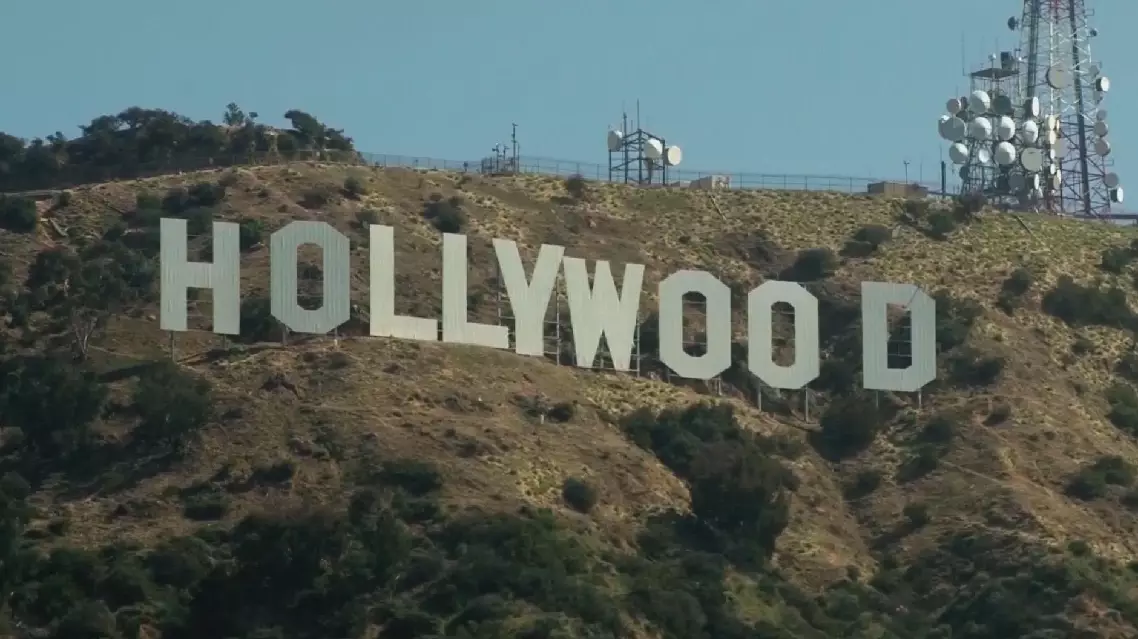
Analysts warn that the curtain is falling on Hollywood's century-long cultural dominance as global film power shifts eastward towards Asian countries like China, driven by the country's thriving domestic market and international concerns over recent U.S. tariffs on foreign film productions.
Once deemed as the heart of global entertainment, Hollywood is known for its big budget, star-studded productions which have thrilled film fans for decades.
However, its long-standing reputation as the world's top movie-making district is now under serious threat.
American studios used to view China as a source of blockbuster profits, a pursuit that at its peak yielded hundreds of millions of dollars per release. However, this is now rapidly fading as Chinese-made films now prove increasingly popular among moviegoers and begin to dominate the domestic market.
Earlier this year, the Chinese-produced animated sequel 'Ne Zha 2' shattered box office records and took in well over two billion U.S. dollars, becoming the most-watched and highest-grossing film ever released in China.
"China now is a huge film market, so Chinese filmmakers actually don't need to make films for an overseas market. There are films like 'Ne Zha' and 'Ne Zha 2', that were just box office smash hits, tremendously profitable, and they show the kind of the might of the Chinese filmgoer right now. So, they don't really need America," said Christopher Ray, professor of Chinese at the University of British Columbia.
American movies' share of China's annual box office revenue has plunged from 36 percent in 2018 and 30 percent in 2019 to just 14 percent in 2024, according to figures from Chinese box office tracker Maoyan.
In a further blow, China has restricted imports of Hollywood films in response to recent U.S. tariffs.
Analysts say these developments represent a seismic shift, as the U.S. film industry may have to relinquish its long-held crown at the top of the global movie industry.
"We're in a moment in time where I think the American century is over. The period of 100 years of Hollywood dominance over global popular culture is definitively closed. And what we're going to see in the next decades is a battle between Asian and particularly East Asian superpowers for the global marketplace and for the imagination of people around the world," said Henry Jenkins, provost professor of Communication, Journalism, Cinematic Arts and Education at the University of Southern California.
Long considered as the world's leading entertainment hub, Hollywood has witnessed a gradual relocation of film productions in recent years to countries such as Canada, New Zealand, and the UK, attracted by appealing tax incentives and lower production costs.
In a move designed to counter this trend, California Governor Gavin Newsom more than doubled the state's film and TV tax credit program to 750 million U.S. dollars during the summer, aiming to safeguard Hollywood's economic base.
A further development came late last month when U.S. President Donald Trump declared on social media that he would impose a 100 percent tariff on all movies produced outside the U.S., escalating his protectionist trade policies into the cultural sector.
The announcement followed a threat made by Trump against foreign film production back in May, though he provided no specifics at that time. The latest detailed declaration marks a significant escalation that could fundamentally disrupt Hollywood's business model, which relies heavily on international co-productions and offshore filming.
Hollywood's movie-making dominance under threat as new film power rises in East