Michelino Sunseri climbed past boulders on his way to a record-breaking feat: The extreme runner reached the summit of Grand Teton, one of the highest mountains in the American West, and then rushed back down, all in less than three hours.
The National Park Service, however, didn’t celebrate. Instead, it charged him with a crime.
Sunseri was found guilty of a misdemeanor for spending just two minutes during the run on a prohibited trail in Grand Teton National Park in Wyoming.
The remarkable solo triumph in 2024 has been overshadowed by his legal saga. “Free Michelino” stickers are on posts and benches in Jackson, Wyoming. Sunseri’s supporters, including members of Congress, are appalled by what they consider to be a glaring example of excessive enforcement by the government.
But Sunseri, 33, may be getting a break. His lawyer, Alex Rienzie, said prosecutors have agreed to seek a dismissal if the runner completes 60 hours of community service and a course on wilderness stewardship. A judge expressed concern about the shift Tuesday and still would need to sign off. Another hearing was set for Nov. 18.
“It is an evolution of what is right and was made to preserve prosecutive and judicial resources while upholding the best interests of the public and the justice system,” the U.S. Attorney's Office in Wyoming said.
Sunseri said he's hopeful for a “rational and reasonable agreement” that puts the matter behind him.
Prosecutors had repeatedly said the ban on shortcutting designated trails is on the park’s website, the park map and in other places. They insisted on pressing ahead with a two-day trial last May, despite a lack of support from officials in the new Trump administration.
Joey Wilson of Salt Lake City, an ultramarathoner who designs training programs for athletes, said the significance of Sunseri’s achievement sometimes gets lost.
“It’s an unbelievable thing that he accomplished — world class,” Wilson said.
Sunseri defended himself by saying he took the same route as many previous record holders on Grand Teton, including Kilian Jornet, one of the world's greatest mountain athletes, in 2012, without any blowback from the Park Service.
He set out on Sept. 2, 2024, sharing the mountain with Labor Day holiday hikers. The path starts flat and wide before becoming extremely rocky on the way up.
“There are boulders the size of small houses,” said Wilson, whose father was a park ranger. “You've got to use your hands. If your hands were to pop off in a couple of places, you're going to fall a long way down.”
Sunseri also had to confront a series of switchbacks as the Garnet Canyon Trail zigged and zagged like a maze. On his way down, shirtless and wearing a hat backwards, he made a split-second decision that would later land him in court: He left a switchback to avoid casual hikers and possible injury, taking a path known as the Old Climber's Trail for two minutes.
“I was ahead of pace,” said Sunseri, who had trained by running the mountain more than 40 times. “I knew I was going to get the record regardless of which trail I took. I didn't want to be yelling at people to get out of my way.”
A small sign where he entered the trail says, “Short Cutting Causes Erosion,” while another at the other end says, “Closed For Regrowth.” Sunseri said there was no vegetation to destroy on the steep, narrow, hard-packed ground.
Later, Sunseri dropped to his knees in exhaustion at the base of the mountain. He had set a new fastest-known time on Grand Teton — “FKT” in the running community — of 2 hours, 50 minutes, 50 seconds.
Sunseri had run a total of 13.3 miles (21.4 kilometers) while gaining an elevation of 7,000 feet (2,133 meters) on his way up the mountain. The summit rests at 13,775 feet (4,198 meters).
“I was stoked," he recalled. “It's one of those things where every single thing has to go right — and everything did go right.”
Andy Anderson didn’t bypass switchbacks during his record run in 2012, but Sunseri said he still had his blessing. They had dinner in Truckee, California, and Anderson handed over the prize: a handmade box bearing a commemorative belt buckle and listing the names of past Grand Teton record holders.
Sunseri wrote about his epic run on social media. Those words doomed him. Federal investigators used search warrants to get access to the posts, which led to a misdemeanor charge of shortcutting a designated trail in the national park.
U.S. Magistrate Judge Stephanie Hambrick found him guilty in a 51-page opinion released in September. She noted the testimony of Park Service Ranger Michelle Altizer, who said Sunseri's “actions were high profile” and that the potential to deter others was “very high and an important consideration” in citing him.
Sunseri's lawyers argued that the signs on Old Climber's Trail did not explicitly prohibit entry.
“The trail has been sitting in its current state for decades,” Wilson told The Associated Press. “If they really wanted to close that trail they could plant seeds over it and put a log down. Trail closed. Do not cross.”
After the spring trial, emails obtained by the defense team revealed that Park Service officials in Washington had told prosecutors on the eve of trial that they were withdrawing their support. A U.S. Interior Department lawyer referred to President Donald Trump's order “fighting overcriminalization” in federal regulations.
“We're continuing with the prosecution,” Assistant U.S. Attorney Nicole Romine in Wyoming wrote back.
Because of the court case, Sunseri's performance on Grand Teton is not being recognized by fastestknowntime.com, a website for the best times on routes considered to have remarkable scenery or historical and cultural value around the world.
In Congress, U.S. Rep. Andy Biggs, R-Ariz., is sponsoring a bill that would make willful intent a requirement for prosecuting certain crimes like Sunseri's trail-cutting misdemeanor. He called the case a “prime example of the problem of overcriminalization.”
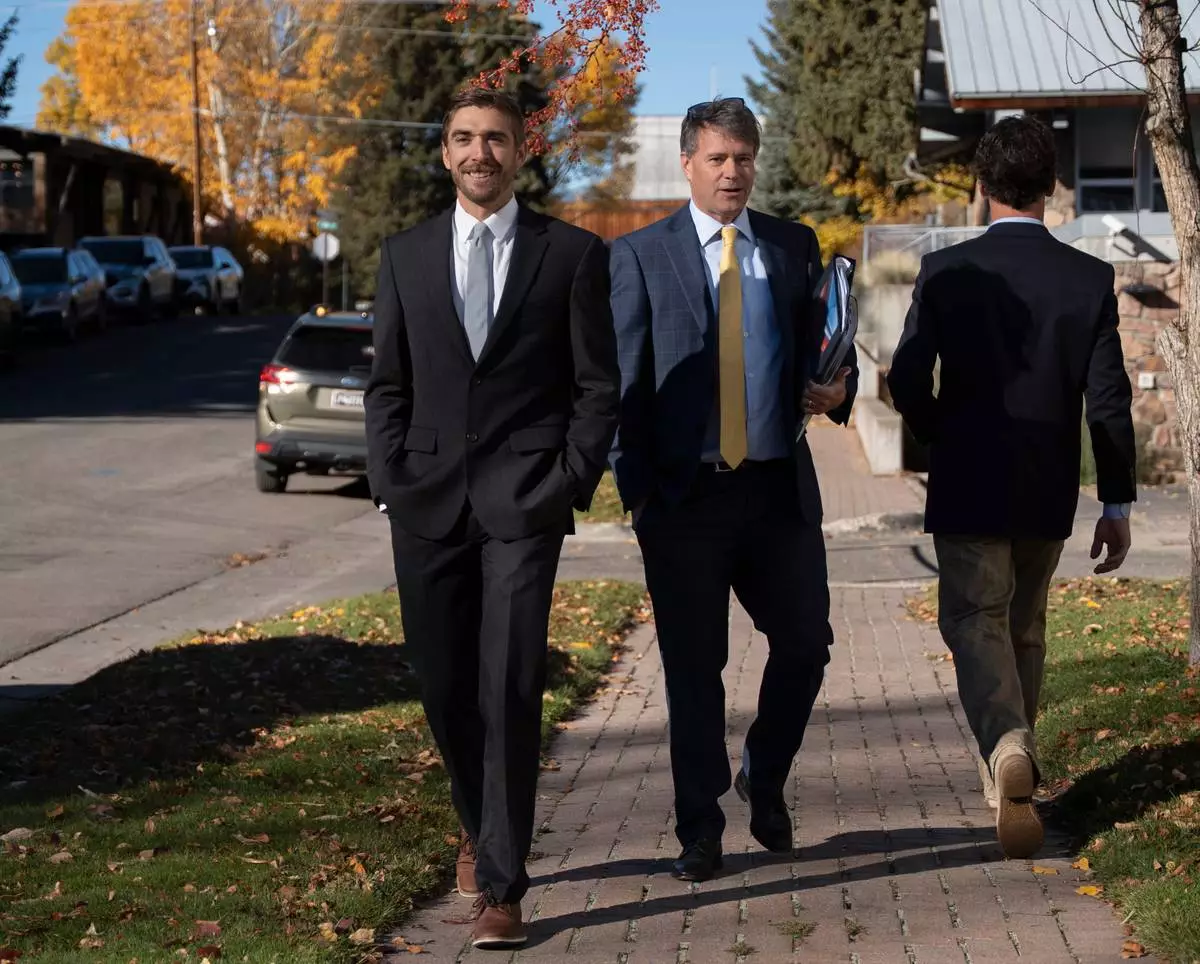
Michelino Sunseri, left, and his attorney Ed Bushnell walk toward the Clifford P. Hansen Courthouse Tuesday, Oct. 21, 2025, in Jackson, Wyo. (Kathryn Ziesig/Jackson Hole News & Guide via AP)
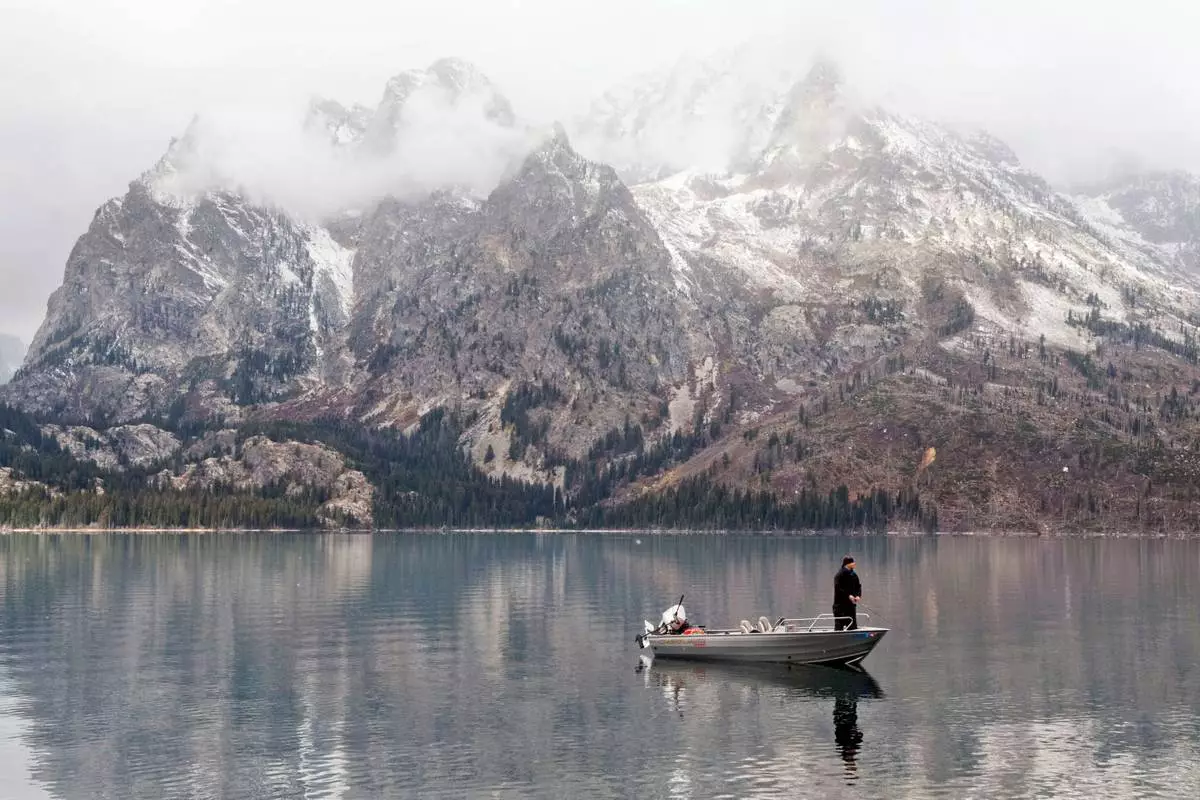
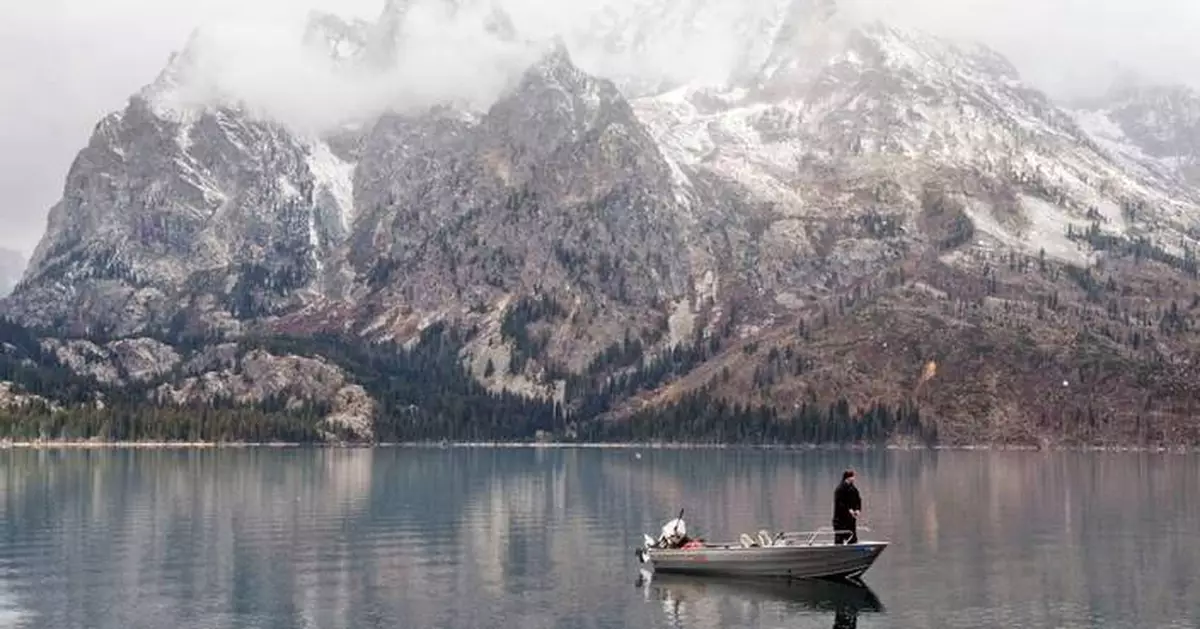
FILE - An angler fishes on Jenny Lake in Grand Teton National Park on Oct. 17, 2013. (Bradly J. Boner/Jackson Hole News & Guide via AP)