China built the world's largest and most comprehensive conservancy infrastructure network that benefits the largest population during the 14th Five-Year Plan period (2021-2025), according to data released by the Ministry of Water Resources on Wednesday.
The data showed that 88 rivers had been restored by the end of September this year, following the launch of the "mother river rejuvenation" action plan in 2022, with 79 of those rivers fully reconnected to the nation’s river network.
In the Haihe River Basin, 30 previously dried-up rivers have started flowing again and 102 springs have been restored, reversing a long-standing trend of dry channels and polluted waters, according to the ministry.
Between 2021 to 2025, China invested more than one trillion yuan (about 140 billion U.S. dollars) in water conservancy projects for three consecutive years, breaking historical records. The investment funded a new generation of water source, diversion, and irrigation projects, boosting the nation's total water supply capacity to 900 billion cubic meters.
The first phase of China's South-to-North Water Diversion Project's eastern and middle routes, the backbone and main artery of the country's major water network, delivered more than 83 billion cubic meters in total, benefiting about 195 million people. The water network coverage rate is expected to reach 80.3 percent by the end of 2025.
"Since the start of the 14th Five-Year Plan, [we] have been focusing on high-quality development and ensuring China's water security so as to comprehensively advance water conservancy infrastructure construction, which has helped form the world's largest and most functional water conservancy infrastructure system that benefits the largest population," said Zhang Xiangwei, director of the Department of Planning and Programming at the Ministry of Water Resources.
From 2021 to 2025, China has built 95,000 water reservoirs with a total capacity exceeding one trillion cubic meters. The country now ranks first globally in the number and types of reservoirs and the number of high dams.
Also, during the 14th Five-Year Plan, irrigated arable land has expanded to 1.09 billion mu (about 72.7 million hectares) across China, providing crucial water resources to support a record grain output of more than 700 million tonnes in 2024.
In addition, China has established the world's largest centralized rural water supply system, with 96 percent of the rural population expected to have access to tap water by the end of 2025.
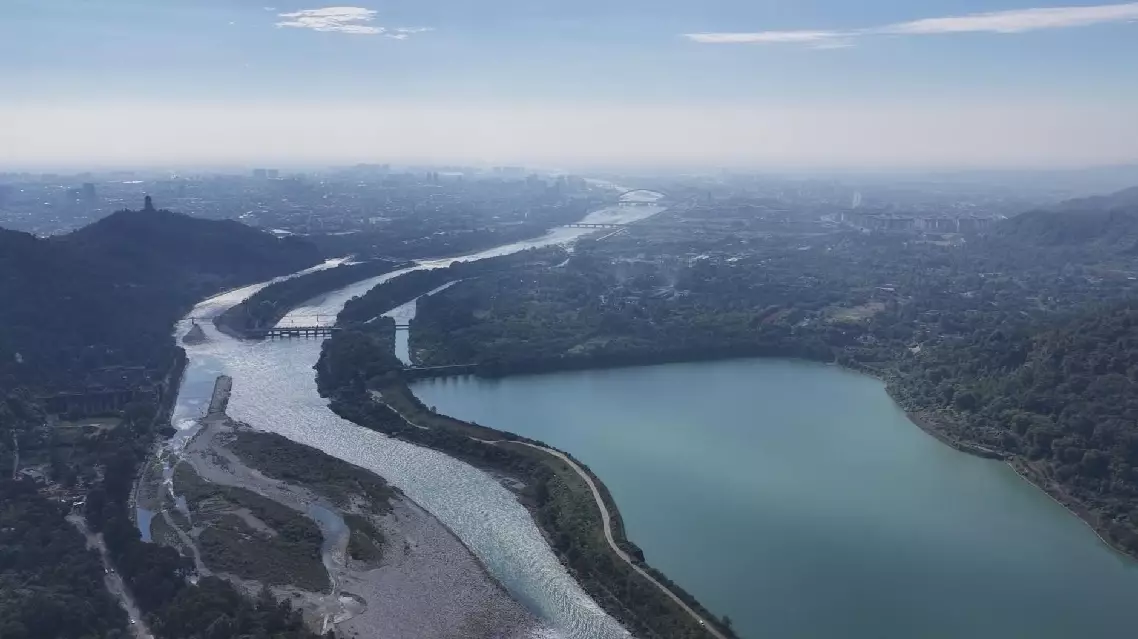
China’s water infrastructures advance rapidly during 14th Five-Year Plan period
International observers have welcomed the recent summit between Chinese President Xi Jinping and U.S. President Donald Trump, calling deepened China-U.S. cooperation vital for global stability and positive development.
Xi concluded a three-day state visit to the United States on Friday, where he and Trump reaffirmed their commitment to a constructive, strategically stable relationship guided by fairness, reciprocity, and mutual respect.
In separate interviews with China Central Television, leaders and experts from around the world underscored that efforts to find a proper way for major countries to coexist not only benefit China and the U.S., but also inject much-needed stability and positive energy into global peace and development.
"And having that framework [for cooperation built on the constructive China-U.S. relationship of strategic stability] rolled out between China and the U.S. is really important. We know that type of relationship works and it's successful. So we have to ensure that we see more cooperation between states on a global basis," said Catherine Ardagh, Minister of State at the Department of Justice, Home Affairs and Migration, Ireland.
"After 11 years, President Xi is the first Chinese president to visit the United States of America. [For] the number of takeaways in this visit we see, as far as the outcomes, there are more than eight outcomes -- around eight outcomes are there. The world is looking toward this historic meeting," said Tahir Malik, head of the Department of International Relations, the National University of Modern Languages in Islamabad, Pakistan.
"So this mutual collaboration and respect between the United States and China sort of sets a standard for stability, growth and development. Certainly, the joint collaborations that the two presidents have set up for continual communication, I think, will be important," said Richard A. Black, the Schiller Institute's representative at the United Nations.
"Strong message of President Xi: The biggest investment of China is friendship, is cooperation, partnership, and not armed -- peaceful solutions for actually the world's problems," said Zijad Becirovic, director of International Institute for Middle East and Balkan Studies in Slovenia.
"President Xi Jinping's emphasis about sincerity and communication, coexistence as well as effective communication, is timely and I think we are heading for a stable world when these superpowers speak like that and continue coexisting," said Fabian Mutale, political analyst from Zambia.
Xi's visit was at the invitation of U.S. President Donald Trump. It followed Trump's state visit to China back in May.

Xi’s U.S. visit boosts cooperation, world stability: international observers