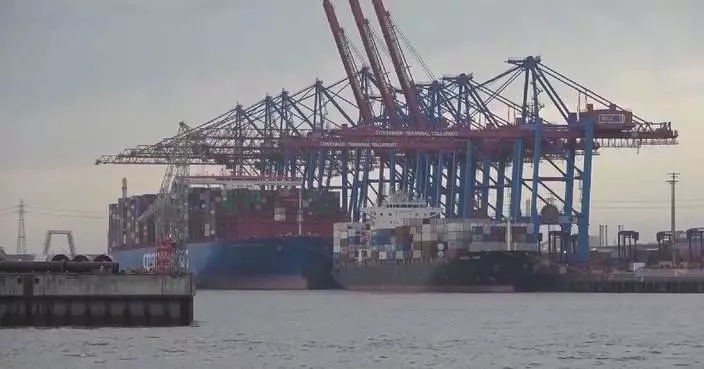
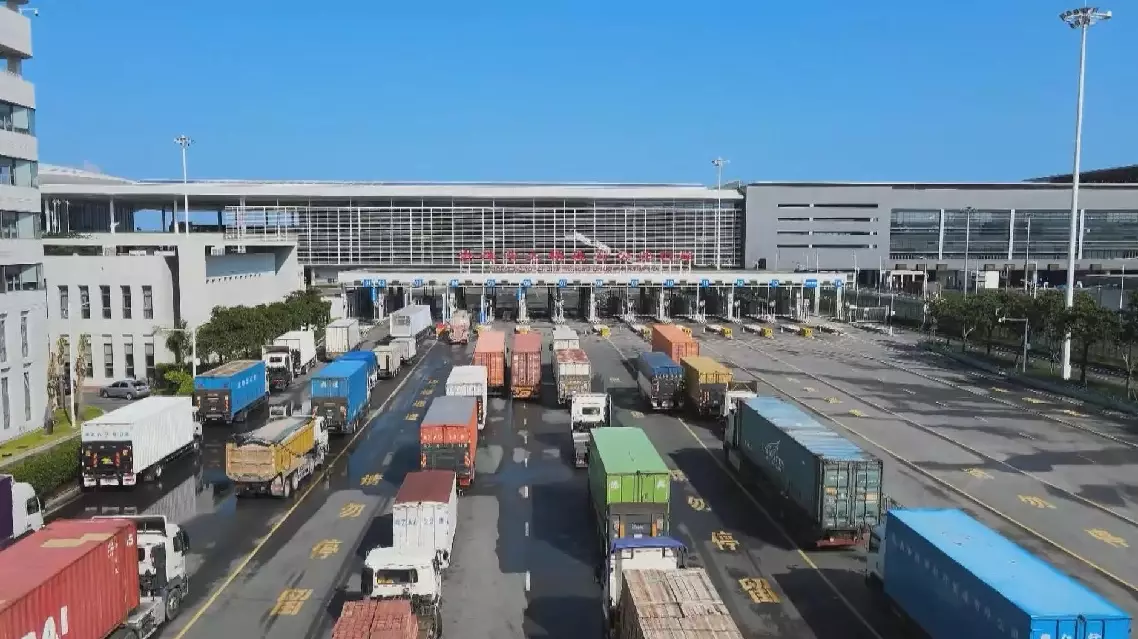
The average monthly import and export value of goods passing through the Hong Kong-Zhuhai-Macao Bridge's Zhuhai Port has hit 25.4 billion yuan (about 3.56 billion U.S. dollars), a more than fivefold increase from the 4.1 billion yuan (about 580 million U.S. dollars) when the bridge started operation seven years ago, according to Gongbei Customs in south China's Guangdong Province.
High-tech products have been a particularly strong performer in this growth. In the first nine months of this year, high-tech product imports and exports via the Zhuhai Port reached 65.75 billion yuan (about 9.23 billion U.S. dollars), up 32.2 percent year on year.
As the only land port in the Chinese mainland with direct road access to the Hong Kong International Airport, the port has significantly streamlined freight transport by offering 24/7 clearance and "two-step declaration" services.
For example, on Oct 12, when a batch of medical equipment worth about 90,000 yuan (about 12,629 U.S. dollars) exported by a Guangdong-based medical technology company arrived at the Zhuhai Port, the export procedures were completed in less than five minutes, allowing the truck to depart swiftly.
"Since the Hong Kong-Zhuhai-Macao Bridge opened, our delivery efficiency has improved dramatically. The whole process -- from loading at the warehouse to clearing the port -- now takes only about two hours," said Zhou Guojun, general manager of the company.
"High-tech products are prone to damage when unpacked in non-clean environments. To address this, we have introduced large-scale container and vehicle inspection systems, and X-ray equipment for non-intrusive inspection, as well as artificial intelligence (AI)-powered algorithmic models for smart review. This has increased the proportion of non-intrusive inspections for high-tech imports and exports while minimizing product loss," said Li Qi, head of the third supervision section at the Zhuhai Port of the Hong Kong-Zhuhai-Macao Bridge under the jurisdiction of Gongbei Customs.
To date, the types of goods moving across the bridge continue to diversify -- from precision electronic components and high-end medical devices to new energy products and smart terminals. This wave of high-tech dynamism is injecting powerful vitality into the port's development.
Hong Kong-Zhuhai-Macao Bridge sees over 5-fold foreign trade jump in 7 years
Panchen Erdeni Chos-kyi rGyal-po, more commonly known as Panchen Rinpoche and a leader of Tibetan Buddhism, has completed a six-month tour of southwest China's Xizang Autonomous Region, during which he performed regular duties, conducted research and surveys, and participated in various Buddhist and social activities.
During his tour, Panchen Rinpoche, a member of the Standing Committee of the National Committee of the Chinese People's Political Consultative Conference and vice president of the Buddhist Association of China, attended celebrations marking the 60th anniversary of the founding of the Xizang Autonomous Region in the regional capital Lhasa in August.
He then visited the prefecture-level cities of Qamdo, Nagqu, and Xigaze to conduct field research, gaining insights into rural revitalization, the development of harmonious and beautiful highland villages, and the advancement of Tibetan medicine.
He also traveled to Dingri County in Xigaze to learn about post-quake reconstruction progress and assess local residents' living conditions after a 6.8-magnitude earthquake hit the county in January.
At the Tashilhunpo Monastery in Xigaze, his traditional seat, Panchen Rinpoche presided over the Kalachakra (wheel of time) ritual and attended both the 30th-anniversary commemoration of his enthronement and a symposium on the reincarnation system of Tibetan Buddhist Living Buddhas.
Over the past three decades since his enthronement, Panchen Rinpoche has upheld Tibetan Buddhism's proud tradition of patriotism and devotion to faith. His Buddhist scholarship has grown ever more profound, earning him deep affection and respect from monastics and devotees alike.
He has made significant contributions to promoting ethnic unity, religious harmony, and Xizang's social stability and development.
As president of the Xizang branch of the Buddhist Association of China, Panchen Rinpoche also convened a series of work meetings of the branch, visited major monasteries including the Jokhang Temple in Lhasa, and held extensive discussions with leaders and practitioners across the Tibetan Buddhist community.
He encouraged monastics to actively engage in the new journey toward Chinese modernization, and to play a greater role in advancing the adaptation of Tibetan Buddhism to socialist society, fostering a stronger sense of the Chinese nation as one community, and jointly writing a new chapter for a more beautiful Xizang.
Panchen Rinpoche concludes six-month tour of Xizang