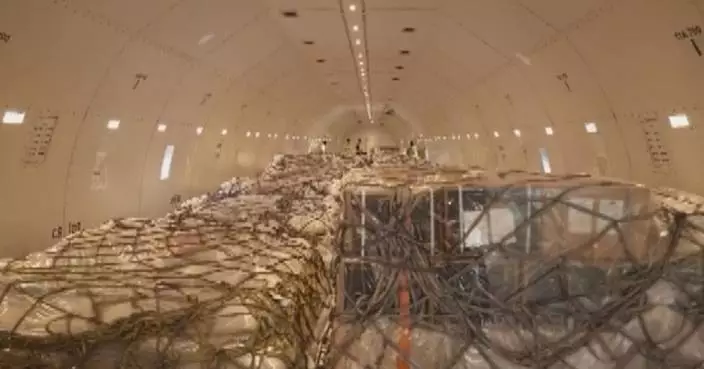
Three fluffy panda cubs born this year were spotted lying on their backs, with their tiny bellies facing the sky, footage from the Star Giant Panda Nursery House in the Chengdu Research Base of Giant Panda Breeding in southwest China's Sichuan Province shows.
In the newly released video, keepers gently roll the chubby cubs over so they're facing up. The baby bears wiggle their paws and kick their little legs in the air, looking adorably clumsy and full of life — a perfect dose of panda joy from Chengdu.
The Chengdu base is a world-renowned center for the ex-situ conservation of giant pandas. It also serves as a hub for scientific research, public education and ecotourism. The institution is internationally recognized for its efforts to protect and breed giant pandas, red pandas and other endangered wildlife species native to China.

3 adorable panda cubs melt heart at Chengdu breading base

3 adorable panda cubs melt heart at Chengdu breading base
People in Yemen are struggling for survival as the country continues to grapple with a deepening labor crisis after more than a decade of war, with many lamenting the lack of opportunities which are leaving the livelihoods of many hanging in the balance.
As the world marks International Workers' Day on Friday, the situation in Yemen seems all the more poignant as millions of people are finding it increasingly hard to find any work at all.
In the crowded streets of the capital Sana'a, workers gather on street corners, waiting for jobs that may never come. Ahmed Muawadah is one of the many who are sitting here, watching passing cars, desperately hoping that one will stop and offer work.
"Our suffering is that we sit here without work. Sometimes we spend a whole month without working, except for one day, or just one day every two weeks. Work is very limited, almost non-existent. I have nine children, and I only work one day a month. I cannot support them. Jobs have completely disappeared. If opportunities were opened for us, I and all the workers would work," said Muawadah.
This individual story reflects a broader reality affecting an estimated eight million workers across Yemen. Many of them are hoping to receive a daily wage, but the challenges are mounting in an increasingly strained labor market.
Activity in key sectors such as construction and services has dropped sharply, largely due to the suspension of several international initiatives, including those backed by the World Bank. As a result, income opportunities have narrowed for those who rely primarily on daily wages.
Meanwhile, the widening impact of the U.S.-Israeli war on Iran and the disruption caused along the key Strait of Hormuz -- a key shipping route for global trade -- has brought more misery in recent weeks.
"There has been a significant decline in business activity as a result of the war, the blockade, and the disruption of work. Foreign capital has also left the country, and large companies have moved out of Yemen and stopped their operations. This is one of the main reasons," said Abdul Karim Al, secretary general of the General Federation of Trade Unions in Sana'a.
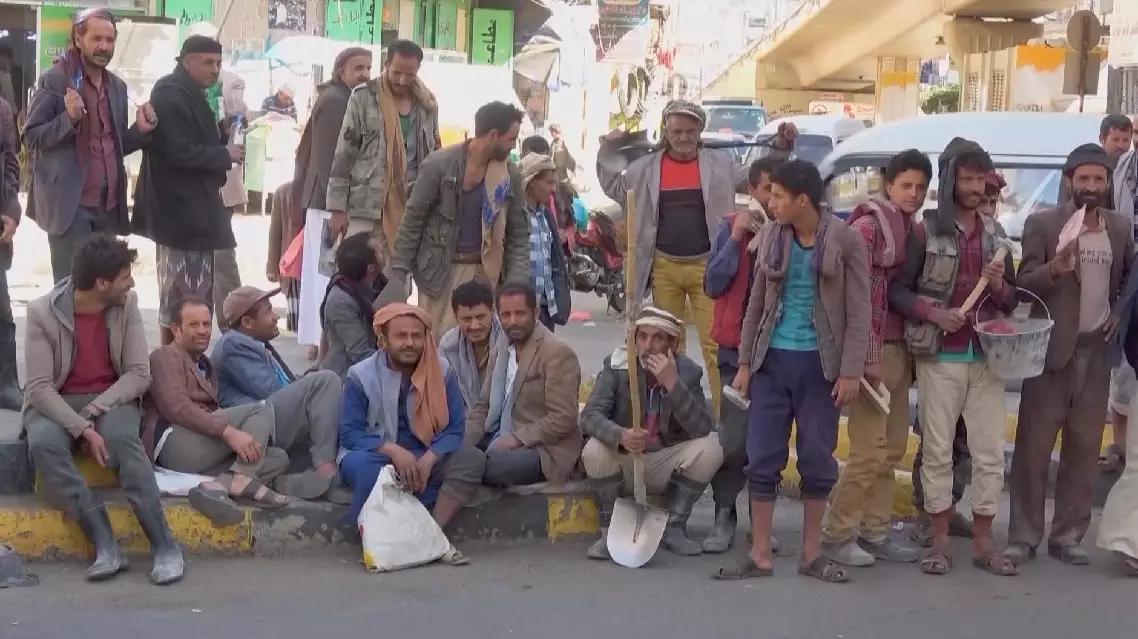
Yemen residents struggling to survive as work dries up amid deepening labor crisis