Across Shanghai, communities are expanding services for the elderly as China moves from traditional family-based care toward a model of collective responsibility.
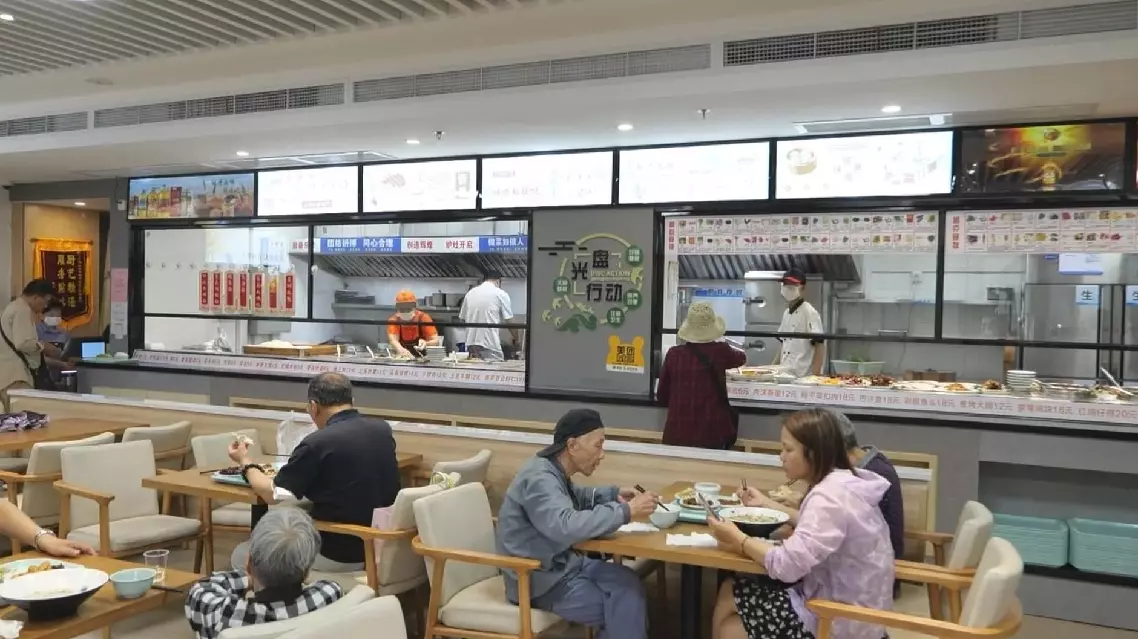
Among those benefiting from these community services is Yin Yi, a 72-year-old resident of Shanghai's Shanggang Community, who now dines daily at a canteen for seniors just 500 meters from her home.
"I'm 72 years old and have lived in this community since 1984, over 40 years now. I've seen many changes here. There's a three-building elderly care complex nearby, and I plan to enjoy my retirement here," Yin said.
"We seniors don't want to shop and cook every day. Here, the meals are varied and soft, like eating at home, and we even get discounts," she said.
A nutritious meal at the canteen costs about 15 yuan (about 2.1 U.S. dollars) for those over 60. In addition to providing meals, the complex offers activities such as exercise and reading.
"These fitness machines are designed for sitting to protect seniors' backs, so they don't strain. We suggest 30 minutes to an hour of exercise daily. Muscle training helps them stand steady and prevent falls," said Shen Yiqing, an employee at the Shanggang Community Elderly Sports Center.
The community has also built a health service center for elderly care.
"Shanggang neighborhood is in Shanghai's old urban area, with about 100,000 residents and an aging rate of more than 49 percent. We built a comprehensive health service center covering 47,000 square meters, serving over 40,000 people," said Xie Ni, deputy director of the Shanggang Neighborhood Office.
As a result, some seniors have begun attending day care centers for daily care and social activities.
"We come here at 9:00 and leave at 15:30. After lunch, we nap, then have snacks. Teachers teach us crafts and games. We see this as our second home," said Zhang Fengju, a 77-year-old resident.
People over 80 can stay in community nursing homes for round-the-clock care, with immediate access to community hospitals.
"After my husband died, I was almost mentally broken and had heart problems. I feared dying alone at home. My daughter noticed and helped me move here. Now my appetite is better, and I've gained weight from 35 kilograms to 45 kilograms," said Zhong Yingdi, an 85-year-old resident.
"Our ward has about 100 beds for elderly medical care, rehabilitation, and palliative care. Last year, we received 540,000 outpatient visits, mostly elderly people," said Cui Di, deputy director of the Shanggang Community Health Service Center.
According to the Ministry of Civil Affairs, China's population aged 60 and above reached 310 million in 2024, representing 22 percent of the total and signaling the country's entry into an aging society.
The country is projected to become a severely aging society by 2050, when the elderly population is expected to exceed 500 million, accounting for more than 40 percent of the total.
The China Electronics Information Industry Development Institute reported that the silver economy reached 8.3 trillion yuan (about 1.165 trillion U.S. dollars) in 2024 and is expected to exceed 25 trillion yuan (about 3.51 trillion U.S. dollars) by 2030.
"Many old Shanghai homes have small bathrooms, but we can renovate them -- replacing bathtubs with showers, adding folding chairs, and L-shaped handrails," said Xi Yueqin, head of the Chengshan Road Elderly Service Center in Shanggang.
Shanghai is offering financial subsidies for these adaptations, including 100 percent discounts for low-income seniors and 30 percent discounts for others.
"Aging isn't just about adapting to old age but enjoying care at home and in communities. Aging-friendly renovations generally boost seniors' subjective well-being. However, current renovations focus on infrastructure; we need more soft investments -- policy research to clarify roles for civil affairs, community workers, and care staff," said Peng Xinyue, a lecturer in the Department of Social Work at Kunming Medical University.
Shanghai communities expand elderly services amid shift toward community care