NEW DELHI (AP) — Cyclone Montha started making landfall along India’s eastern coast, the weather office said late Tuesday, with the storm due to bring torrential rains and strong winds.
Montha, swirling over the Bay of Bengal, intensified into a severe cyclonic storm that threatens flooding of low-lying areas in southern Andhra Pradesh and neighboring states through the night.
Click to Gallery
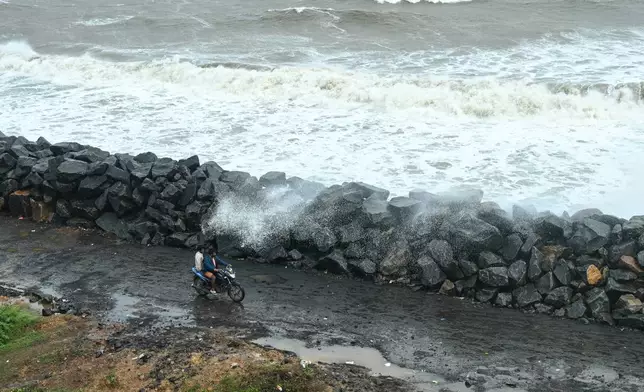
A motorist drives past boulders recently installed along the coastline to protect against high tides during Cyclone Montha, in Kakinada district of Andhra Pradesh, India, Tuesday, Oct. 28, 2025. (AP Photo)

Evacuated Indian villagers of Uppada eat food in a temporary relief centre as Cyclone Montha, in Kakinada district of Andhra Pradesh, India, Tuesday, Oct. 28, 2025. (AP Photo)
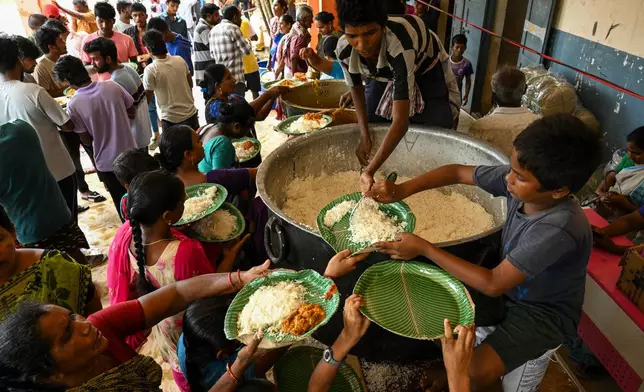
Evacuated Indian villagers of Uppada collect food to eat in a temporary relief centre as Cyclone Montha, in Kakinada district of Andhra Pradesh, India, Tuesday, Oct. 28, 2025. (AP Photo)
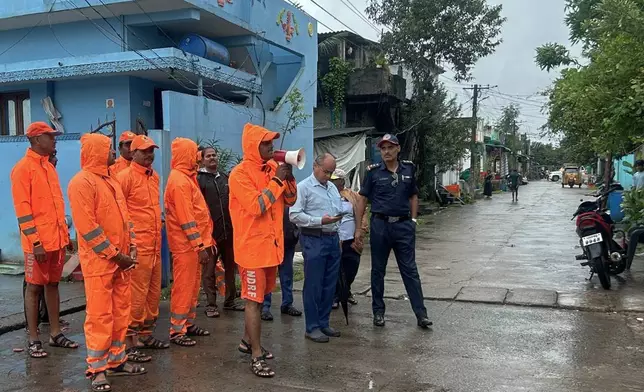
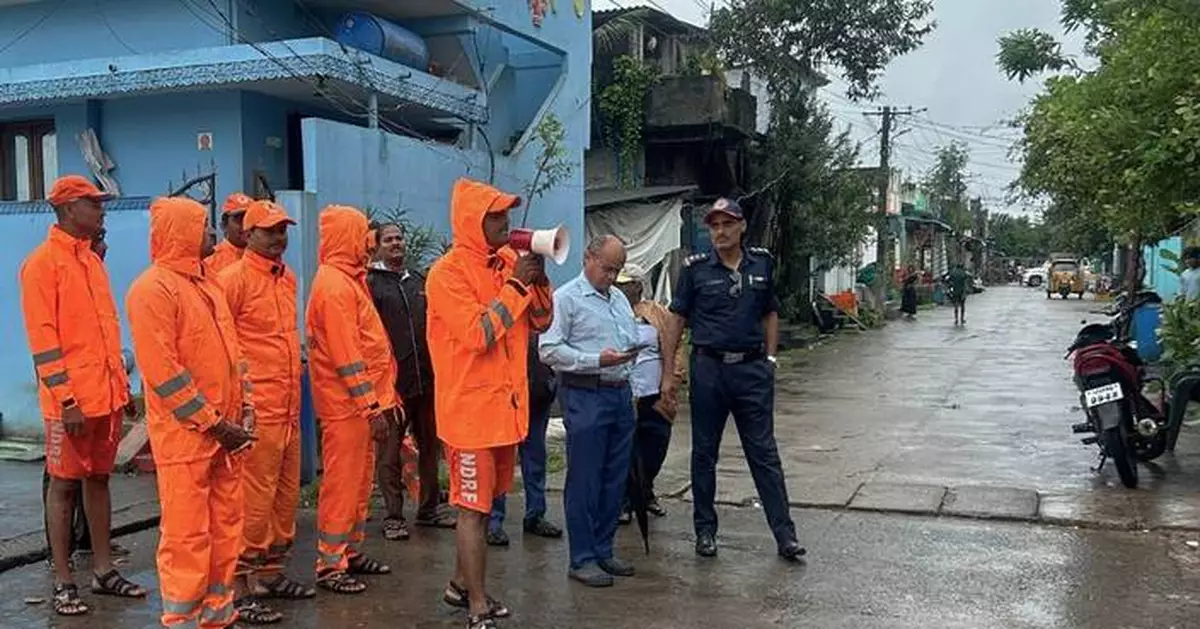
In this handout photo released by the National Disaster Response Force (NDRF), NDRF personnel warn residents of Cyclone Montha, in Yanam, in the Indian state of Andhra Pradesh, Monday, Oct. 27, 2025. (NDRF via AP)
“Latest observations indicate that the landfall process has commenced,” the Indian Meteorological Department said in its latest bulletin. The process was expected to continue for the next three to four hours.
The storm was hovered around 100 kilometers (62 miles) south of the port city of Kakinada in southern Andhra Pradesh state as it makes landfall. The weather system is expected to intensify, bringing winds of 90-110 kph (55-68 mph) as the cyclone pushes toward the country’s eastern coastline.
Indian authorities have shut schools and evacuated tens of thousands of people from low-lying coastal areas as a precautionary measure to brace for Montha's impact.
The weather office issued so-called red alerts — the highest level of weather warnings — for 19 districts in Andhra Pradesh, forecasting extremely heavy rains. The neighboring states of Telangana, Odisha and Chhattisgarh are also expected to receive moderate to heavy showers in the next few hours.
Disaster teams in Andhra Pradesh have evacuated 38,000 people from low-lying areas to relief camps, according to a state disaster official. The state government estimates around 4 million people to be in vulnerable areas and likely to be affected by the cyclone.
“We are assessing the impact of Cyclone Montha on the state on an hourly basis. We are fully prepared to face any situation,” the state’s highest-elected official N. Chandrababu Naidu said on X.
State authorities have readied 1,906 relief camps and 364 school shelters as evacuations continue in 1,238 vulnerable villages. Schools and colleges have been ordered to remain shut until Wednesday, and fishermen were warned not to venture to sea. Trains and flights were partially disrupted on Tuesday.
In Odisha, the state administration began shifting around 32,000 people early Tuesday from vulnerable areas to relief camps, a state disaster official said.
Climate scientists say severe storms are becoming more frequent in South Asia. Global warming driven by planet-heating gases has caused them to become more extreme and unpredictable.
India’s eastern coasts have long been prone to cyclones, but the number of intense storms is increasing along the country’s coast. India’s deadliest cyclone season in recent years was in 2023, killing 523 people and causing an estimated $2.5 billion in damage.
Tropical cyclones, which are called hurricanes or typhoons in other regions, are among the world’s most devastating natural disasters when they hit densely populated coastal areas.
Increasingly warmer oceans are resulting in intensifying storms, especially near coastal regions, as they derive energy from the warm waters, climate experts say.
“Global warming is increasing the air temperature and is also making oceans warm. And if an ocean is very warm, it is going to supply a lot of energy to any tropical storm over the ocean,” said Akshay Deoras, a meteorologist at the University of Reading in England.
India, the world’s most populous country, is among the highest emitters of planet-heating gases and is also considered to be among the most vulnerable regions in the world to climate impacts.
In 2024 alone, there were 167 disasters in Asia, which was the most of any continent, according to the Emergency Events Database maintained by the University of Louvain in Belgium. The storms, floods, heat waves and earthquakes led to losses of over $32 billion, the researchers found.
Sibi Arasu contributed to this report from Bengaluru.
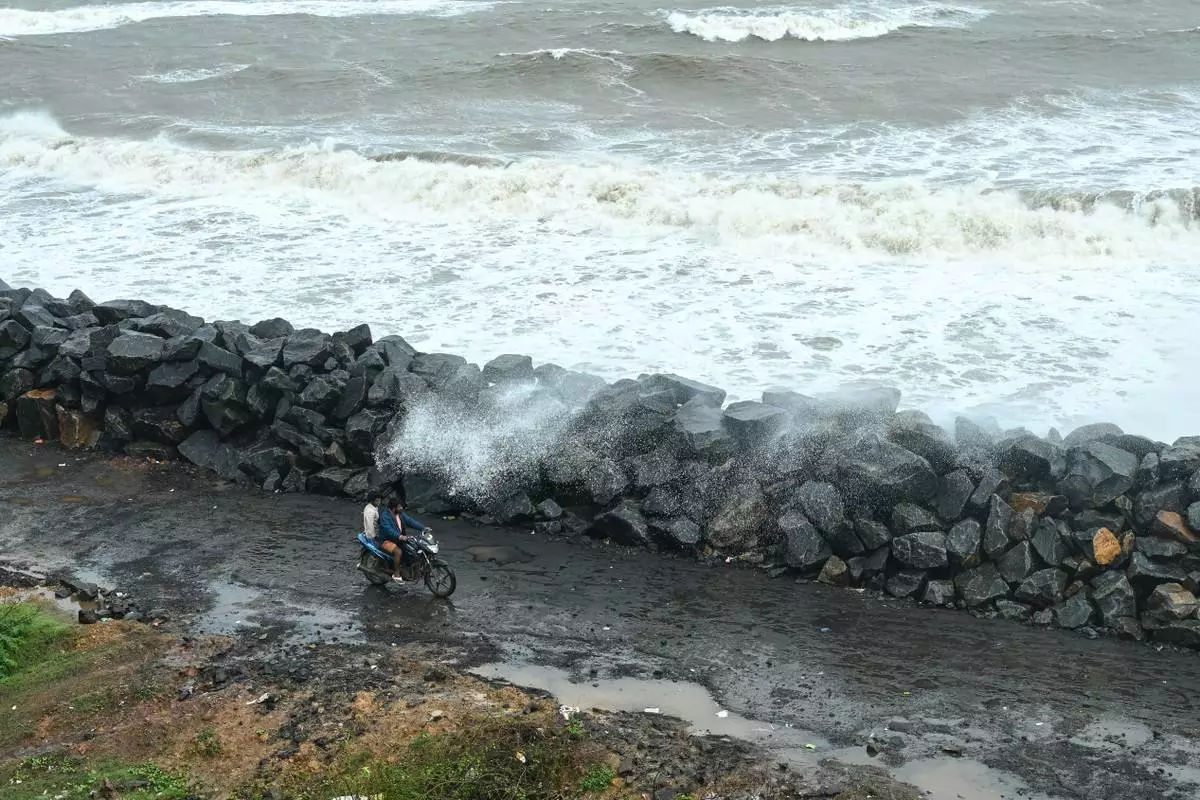
A motorist drives past boulders recently installed along the coastline to protect against high tides during Cyclone Montha, in Kakinada district of Andhra Pradesh, India, Tuesday, Oct. 28, 2025. (AP Photo)

Evacuated Indian villagers of Uppada eat food in a temporary relief centre as Cyclone Montha, in Kakinada district of Andhra Pradesh, India, Tuesday, Oct. 28, 2025. (AP Photo)

Evacuated Indian villagers of Uppada collect food to eat in a temporary relief centre as Cyclone Montha, in Kakinada district of Andhra Pradesh, India, Tuesday, Oct. 28, 2025. (AP Photo)

In this handout photo released by the National Disaster Response Force (NDRF), NDRF personnel warn residents of Cyclone Montha, in Yanam, in the Indian state of Andhra Pradesh, Monday, Oct. 27, 2025. (NDRF via AP)

DUBAI, United Arab Emirates (AP) — Israel said it launched airstrikes against Iranian missile launchers and a nuclear research site Tuesday, and Iran struck back against Israel and across the Gulf region, targeting U.S. embassies and disrupting energy supplies and travel.
Four days into a war that President Donald Trump suggested would last several weeks but perhaps longer, nearly 800 people have been killed in Iran, including some Trump said he had considered as possible future leaders of the country.
Explosions rang out Tuesday in Tehran and in Lebanon — where Israel said it retaliated against Hezbollah militants — and the American embassy in Saudi Arabia came under drone attack. Iran has fired dozens of ballistic missiles at Israel, though most of the incoming fire has been intercepted. Eleven people in Israel have been killed since the conflict began.
The spiraling nature of the war raised questions about when and how it would end. Trump seemed to leave open the possibility for more extensive U.S. military involvement, telling the New York Post on Monday that he was not ruling out the possibility of boots on the ground.
The administration has given various objectives. While the initial U.S.-Israeli strikes killed Iranian Supreme Leader Ayatollah Ali Khamenei and Trump urged Iranians to overthrow their government, senior administration officials have since said regime change was not the goal.
Trump said Monday the military campaign’s four objectives were to destroy Iran’s missile capabilities, wipe out its navy, prevent it from obtaining a nuclear weapon and ensure that it cannot continue to support allied armed groups.
Trump said Tuesday that “someone from within” the Iranian regime might be the best choice to take power once the U.S.-Israel campaign is finished.
Speaking from the Oval Office Tuesday, Trump said Reza Pahlavi, the exiled son of Iran’s toppled Shah, is not someone that his administration has considered in depth to take over.
As far as possible leaders inside Iran, “the people we had in mind are dead,” Trump said.
“I guess the worst case would be do this, and then somebody takes over who’s as bad as the previous person, right? That could happen," Trump said. "We don’t want that to happen.”
Iran’s leaders are scrambling to replace Khamenei, who ruled the country for 37 years. It’s only the second time since the 1979 Islamic Revolution that a new supreme leader is being chosen. Potential candidates range from hard-liners committed to confrontation with the West to reformists who seek diplomatic engagement.
Information coming out of Iran has been limited because of poor communications, round-the-clock airstrikes and tight restrictions on journalists. But across Iran’s capital, aircraft were heard overhead and explosions rang out.
The Israeli military said it conducted a wave of airstrikes on sites that produce and store ballistic missiles, in Tehran and Isfahan. It also said it destroyed what it called Iran’s secret, underground nuclear headquarters. Without providing evidence, it said the site was used for scientific research “to develop a key component for nuclear weapons.”
“The regime attempted to rebuild its efforts and conceal them, thinking we wouldn’t notice. They were mistaken,” said Israeli military spokesman Brig. Gen. Effie Defrin.
Iran has said it has not enriched uranium since June, though it has maintained its right to and says its nuclear program is peaceful.
The United Nations’ nuclear watchdog said Iran’s Natanz nuclear enrichment site had sustained “some recent damage,” though there was “no radiological consequence expected.” The U.S. hit Natanz during the 12-day war in June, when Israeli and American strikes greatly weakened Iran's nuclear program.
New rounds of U.S. and Israeli airstrikes rattled Tehran and several other Iranian cities.
“Since midnight, I and my wife are hearing sound of explosions,” said Ali Amoli, an engineer living in north Tehran. “Sometimes from the west side of the city and sometimes from other directions.” Streets and gas stations appeared quieter than in recent days.
Local media published images of a damaged commercial plane at Bushehr airport that broke apart following an airstrike on Tuesday.
A north Tehran resident who spoke on condition of anonymity for fear of retaliation described growing fears in the capital as it comes under heavy bombardment. The resident said most stores in the normally bustling area of Tajrish were closed, though bakeries and supermarkets remained open.
An attack from two drones on the U.S. Embassy in Riyadh caused a “limited fire,” according to Saudi Arabia’s Defense Ministry, and the embassy urged Americans to avoid the compound. It followed an attack on the U.S. Embassy in Kuwait. U.S. Embassies in Saudi Arabia, Kuwait and Lebanon said they were closed to the public.
The U.S. State Department ordered the evacuation of non-emergency personnel and family in Kuwait, Bahrain, Iraq, Qatar, Jordan and the United Arab Emirates. The U.S. also urged citizens to leave more than a dozen Middle Eastern countries, though with much of the airspace closed many were stranded.
The State Department said Tuesday it’s preparing military and charter flights for Americans who want to leave the Middle East. Several other countries also arranged evacuation flights for their citizens.
The U.S.-Israeli strikes have killed at least 787 people in Iran, according to the Red Crescent Society. In Lebanon, where Israel launched retaliatory strikes on the Iranian-supported militant group Hezbollah, 40 people were killed, including seven children, in Lebanon, the health ministry said. The ministry had previously said 52 people were killed.
The U.S. military has confirmed six deaths of American service members. In addition, three people were killed in the United Arab Emirates, and one each in Kuwait and Bahrain.
Turkish Foreign Minister Hakan Fidan on Tuesday criticized Iran's attacks against Gulf neighbors that had worked to prevent war as an “incredibly flawed strategy” that threatened to widen the war if these states decide to retaliate.
This story has been updated to correct that communications in Iran are poor, but that the internet isn't shut down. It also clarifies that more than one drone hit the U.S. Embassy in Saudi Arabia. Some instances referred to just one drone.
Becatoros reported from Athens, Greece, and Magdy from Cairo. Seung Min Kim, Michelle Price and Konstantin Toropin in Washington, David Rising in Bangkok, Melanie Lidman in Tel Aviv, Israel, Hallie Golden in Seattle, Giovanna Dell'Orto in Miami, and Suzan Fraser in Ankara, Turkey, contributed to this report.
A firefighter extinguishes fire at a building that was hit by an Israeli airstrike in Dahiyeh, a southern suburb of Beirut, Lebanon, Tuesday, March 3, 2026. (AP Photo/Hussein Malla)
A woman crosses almost deserted square with a billboard at rear showing a portrait of the late Iranian Supreme Leader Ayatollah Ali Khamenei, who was killed in the U.S.–Israeli military campaign, in Tehran, Iran, Tuesday, March 3, 2026. (AP Photo/Vahid Salemi)
Smoke rises from a destroyed building that was hit by an Israeli airstrike in Dahiyeh, a southern suburb of Beirut, Lebanon, Tuesday, March 3, 2026. (AP Photo/Hussein Malla)
An Iranian flag is placed among the ruins of a police station struck Monday during the U.S.–Israeli military campaign in Tehran, Iran, Tuesday, March 3, 2026. (AP Photo/Vahid Salemi)
Smoke rises from Israeli airstrikes in Dahiyeh, a southern suburb of Beirut, Lebanon, Tuesday, March 3, 2026. (AP Photo/Hussein Malla)
Jewish men covered in prayer shawls pray in an underground parking garage as a precaution against possible Iranian missile attacks, in Tel Aviv, Israel, Tuesday, March 3, 2026. (AP Photo/Oded Balilty)
A group of men inspects the ruins of a police station struck Monday amid the U.S.–Israeli military campaign in Tehran, Iran, Tuesday, March 3, 2026. (AP Photo/Vahid Salemi)
Smoke rises from Israeli airstrikes in Dahiyeh, a southern suburb of Beirut, Lebanon, Tuesday, March 3, 2026. (AP Photo/Hussein Malla)
Smoke rises from Israeli airstrikes in Dahiyeh, a southern suburb of Beirut, Lebanon, early Tuesday, March 3, 2026. (AP Photo/Bilal Hussein)
This image provided by U.S. Central Command shows a F-35C Lightning II preparing for launch on the flight deck of the USS Abraham Lincoln (CVN 72) in support of Operation Epic Fury on Monday, March 2, 2026. (U.S. Navy via AP)
Mourners take cover while air-raid sirens warn of incoming missiles launched by Iran toward Israel during the funeral of Sarah Elimelech and her daughter Ronit who were killed in an Iranian missile attack, in Beit Shemesh, Israel, Monday, March 2, 2026. (AP Photo/Ohad Zwigenberg)
A worker instals a billboard on an overpass containing a portrait of the late Iranian Supreme Leader Ayatollah Ali Khamenei, who was killed during the ongoing joint U.S.-Israeli military campaign, in Tehran, Iran, Monday, March 2, 2026. (AP Photo/Vahid Salemi)
Smoke engulfs a street after a strike in Tehran, Iran, Monday, March 2, 2026. (AP Photo/Mohsen Ganji)