CHICAGO--(BUSINESS WIRE)--Oct 30, 2025--
According to the newly released, updated report from higher education marketing and research firm Validated Insights, the marketplace for online program managers (OPM) continues to significantly contract with declining initiations, dropping revenue, and limited interest in new OPM arrangements by schools.
This press release features multimedia. View the full release here: https://www.businesswire.com/news/home/20251030532249/en/
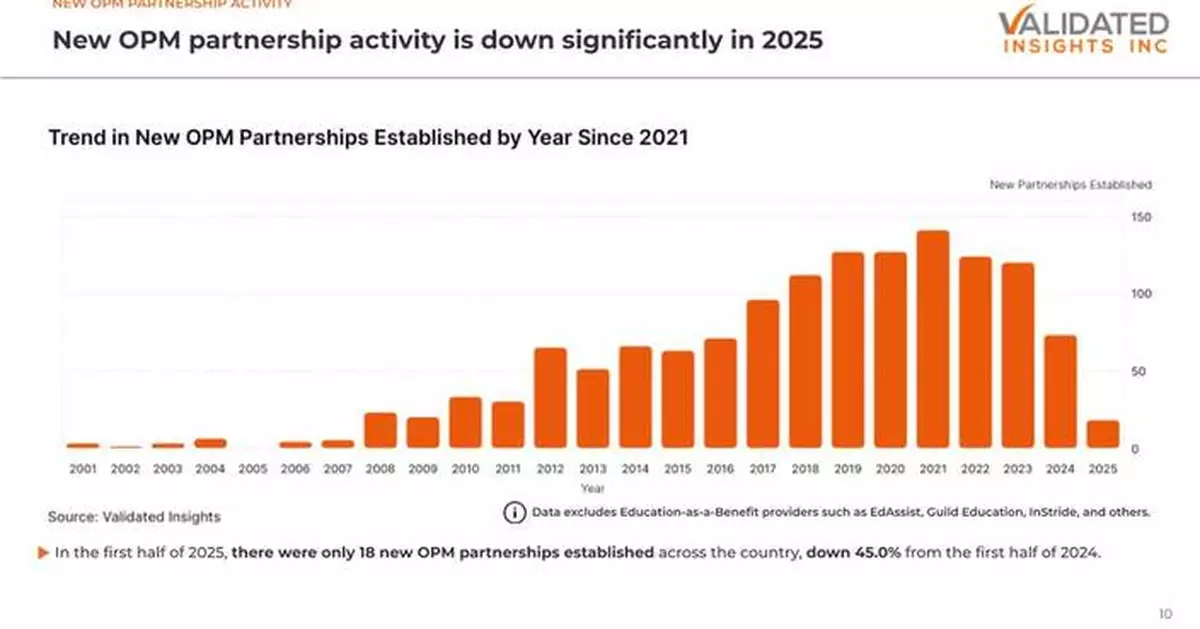
In both their October 2024 report and February 2025 reports on the OPM market, Validated Insights found that new partnership activity was declining. In this report, that decline continues. For all of 2024, just 81 new OPM partnerships were launched. In the first half of 2025, there were just 18 new OPM partnerships established across the country. That’s a drop of 45.0% from the first half of 2024.
The downward trend is also reflected in industry-wide revenue projections. According to the new report, “Pre-COVID, the U.S. OPM industry was projected to see revenue of $8.25B. Now, it is estimated that 2025 revenues will actually be just 40.9% of that projected revenue, or $3.37B.”
Solidifying the retracting outlook for OPM providers is that there appear to be few schools seeking, or with interest in, new OPM partnerships, the report found.
Among American private colleges and universities, for example, the report shared data showing the plurality, 41%, had not worked with an OPM and were not considering doing so. A further 18% of these schools had worked with an OPM in the past, but were also not considering doing so currently. Together, these two categories represent 59% of private schools.
A further 31% of private schools reported already working with an OPM, meaning that, as initiations and revenues fall, 90% of these schools either already have an OPM partner, or are not considering one, the report found.
“Clearly, these are not the best of times for online program managers,” said Brady Colby, Head of Market Research at Validated Insights. “The market is not growing, at least not compared to how it was just four years ago. Growth is very limited and revenue estimates for the sector have been well short,” he said.
The new report also echoes earlier releases regarding changes in the OPM business model, with less revenue sharing – even at smaller sharing percentages – and more a la carte, and fee-for-service arrangements.
Not every OPM provider is suffering, however. According to the report, OPM Risepoint “remains the leading OPM in the United States as of Q1 2025 with 12.9% of active partnerships across the country. The company has been solidifying its position as the top provider in recent months predominantly via the expansion of a number of existing partnerships,” the report says.
Also, Zschool is an industry bright spot, according to the new report. “Zschool, a newer provider in the space, has quickly risen to be the second largest provider in terms of the number of active partnerships,” it found.
“This is still a big, several billion-dollar market, impacting millions of students and thousands of schools,” Colby said. “And while the trajectory of the market as it is today is fundamentally down, it may be more accurate to say the OPM space is evolving more than dying, as new providers emerge, new models become common, and the needs of students and schools continue to rapidly change,” he said.
Validated Insights releases regular reports on education and training markets, including reports on MBA programs, nursing education, computer science programs, AI programs, trade schools. and overall enrollment trends. To receive future reports from Validated Insights, follow Higher Ed News by VI on LinkedIn.
About Validated Insights
Validated Insights is an agile marketing agency specializing in helping higher education institutions achieve and exceed their goals. With a comprehensive suite of services, including digital marketing, paid search, paid social, and web strategy, Validated Insights delivers data-driven strategies and measurable results. The agency's agile testing approach enables short- and long-term growth through better creative, strategy, media execution and continuous brand building. Validated Insights is the only agency in the higher education space to offer a performance guarantee in KPIs in the first 60 days - and continuous growth beyond that.
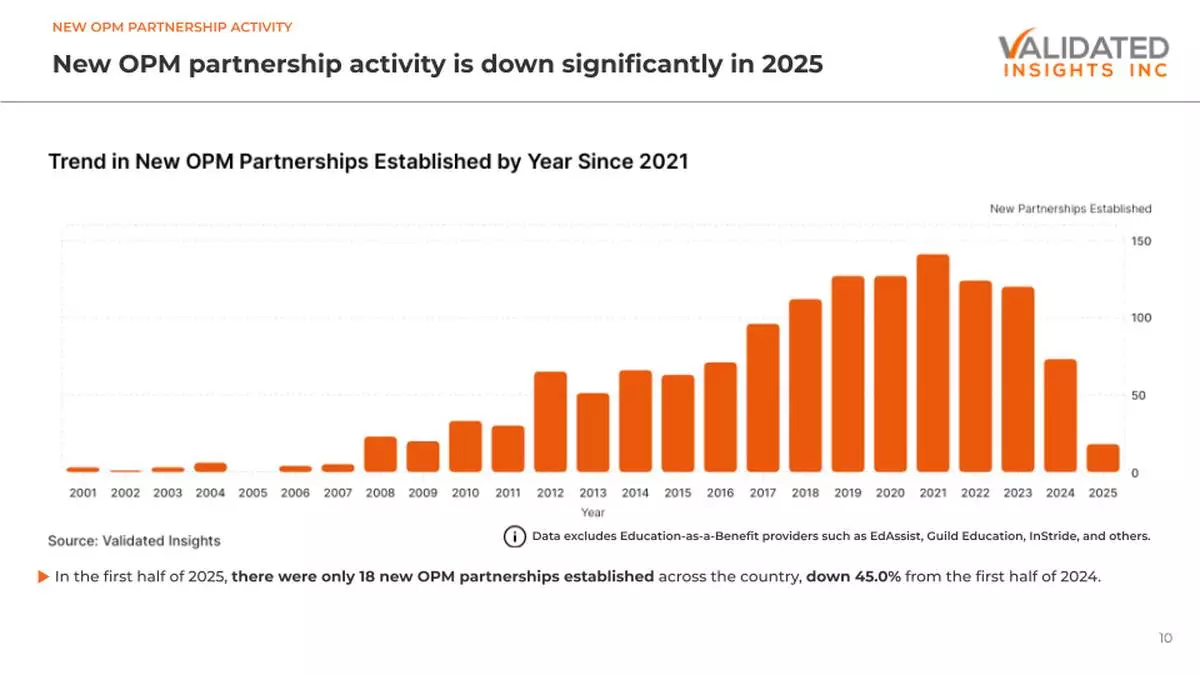
The newest report from Validated Insights shows that the U.S. OPM (Online Program Management) industry, which had recently been projected to see revenue of $8.25B, will see only 41% of that total revenue. This reflects the significant reduction in new OPM partnership activity in 2025. In the first half of 2025, there were only 18 new OPM partnerships established across the country, down 45.0% from the first half of 2024. The full report includes updates on the OPM market size, analysis of the leading OPM providers and new entrants to the market, as well as analysis of online enrollments by international students and at HBCUs.
Health and wellness advice is available in abundance on social media — from trendy to informative to straight-up disinformation — and you're far from alone in seeing it.
A new survey by the Pew Research Center finds that about 4 in 10 U.S. adults — and around half of those under 50 — get health information from social media or podcasts.
Researchers also looked at the social media profiles of 6,828 health and wellness influencers with at least 100,000 followers. Only about 4 in 10 list a background as a health professional. About one-third called themselves coaches, about 3 in 10 described themselves as entrepreneurs and about 1 in 10 cited their own life experience, like being a parent.
Despite the wide range of expertise, about half of people who get health and wellness information from influencers said the influencers help them better understand their own health, while about one-third said it hasn't made much difference. About 1 in 10 said it made them more confused.
Experts say a bit of skepticism is key to interacting with posts about fitness, mental health and personal health. Here are their tips on how to be a smarter consumer.
Experts said the biggest green flag is when an influencer's credentials are easy to find on their profile. Beware the fill-in-the-blank “coach” who can't prove their training.
Courtney Babilya, a certified medical exercise specialist and personal trainer who has more than 430,000 followers on Instagram, has seen this with maternity content: "Someone has a baby and suddenly they’re a pregnancy coach.”
“We have to be careful with people who have an experience in one thing and suddenly become a ‘coach’ on that,” she said.
Coach is a business model, not a sign of training. Babilya shares her own experience dealing with chronic illness online, but keeps it separate from her professional advice.
"You do have an obligation to make sure that you are not giving someone a false idea or spreading a message that isn’t going to be applicable to everyone," she said.
If it brings up big emotions, pause. For people who can't access care or feel unheard by their doctors, an offbeat opinion could feel like a long-sought answer. The Pew survey found 53% of uninsured people got health information from social media, compared to 38% of those who were insured.
But people who are trying to share good medical information online are not trying to incite fear or surprise, said Dr. Fatima Daoud Yilmaz, an OB-GYN at Stony Brook Medicine in New York, whose popular “Feminine Aisle” video series rates drug store products.
Even if the person has expertise, ask yourself: Are they speaking outside the scope of their knowledge? Is what they're saying in line with scientific consensus?
“All opinions are not created equal when it comes to something such as health or medicine or science,” said Daoud.
Look out for exaggerated or definitive claims, especially in the first few seconds of the video when influencers are trying hard to grab your attention, added Babilya.
Ambivalent wording is a good sign, said Nedra Glover Tawwab, a practicing therapist and author. In her videos on boundaries and mental health, she couches with “maybe,” “sometimes,” “perhaps," rather than diagnosing her 1.8 million followers on Instagram.
If you feel like you've found a diagnosis online, that is your sign to seek out a professional, Tawwab said.
People on social media are making money — for some, it is their livelihood.
“It doesn’t mean that all of the information that they put out is biased, but it should tell consumers of that information to take it with a grain of salt because they do have financial incentive to be pushing information like this,” Daoud said.
Babilya's platform is now a full-time job, and the way she helps support her family. Taking partnerships and brand deals was not an easy decision, but one that makes her work sustainable.
Babilya said she prioritizes being upfront with her audience and making sure her ads are transparently labeled.
Experts also recommend pausing to check the video’s sources. Look for gold standard science. Some posts are not well fact-checked, Babilya warned, citing studies that have nothing to do with what the influencer says it does.
Use the same standard as when you’re vetting a purchase online. Look at the larger conversation around the advice as you would reading product reviews, Tawwab said.
Two-thirds of users said they just happen to come across the content rather than seeking it out, according to the Pew survey.
If you want to control your feed, it will take time and ongoing effort, said Ash Milton of the University of Minnesota, who studies how users navigate online mental health information.
“You have to work for it because the algorithm is designed to be passive consumption,” Milton said.
You can use “Hidden Words” on Instagram or “Not Interested” on TikTok to filter out certain content, though Milton notes TikTok might not know exactly what in the video you're not interested in. Use your own reaction as a barometer to limit content by asking yourself: Is the health information actually applicable and helpful to your life, or just relatable?
Confirm with a trusted health professional before acting on anything you see online.
Influencers can say anything while medical professionals are ethically and legally liable for your care, and “may face professional and personal consequences for the advice that they give you," Daoud said.
“Ultimately, talk to the medical provider who knows you,” she said.
The Associated Press Health and Science Department receives support from the Howard Hughes Medical Institute’s Department of Science Education and the Robert Wood Johnson Foundation. The AP is solely responsible for all content.
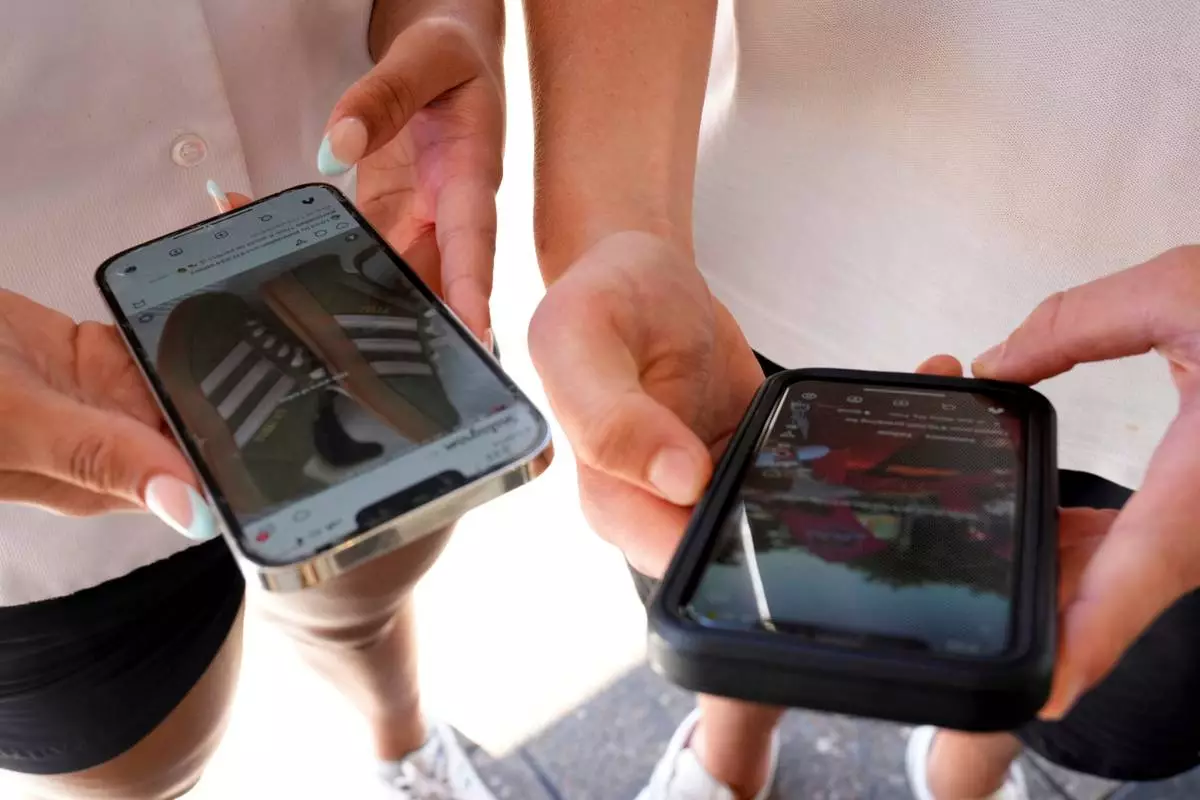
FILE - Young people use their phones to view social media in Sydney, Nov. 8, 2024. (AP Photo/Rick Rycroft, File)