Skip to Content Facebook Feature Image

China takes over as host of 2026 APEC CEO Summit

China

China

China

China takes over as host of 2026 APEC CEO Summit

2025-11-01 20:26 Last Updated At:20:37

The China Council for the Promotion of International Trade (CCPIT) officially took over as the host of next year's APEC CEO Summit on Friday.

Ren Hongbin, chairman of the CCPIT, led a delegation of more than 100 Chinese business leaders to attend the 2025 APEC CEO Summit held in Gyeongju, the Republic of Korea (ROK), from Wednesday to Friday.

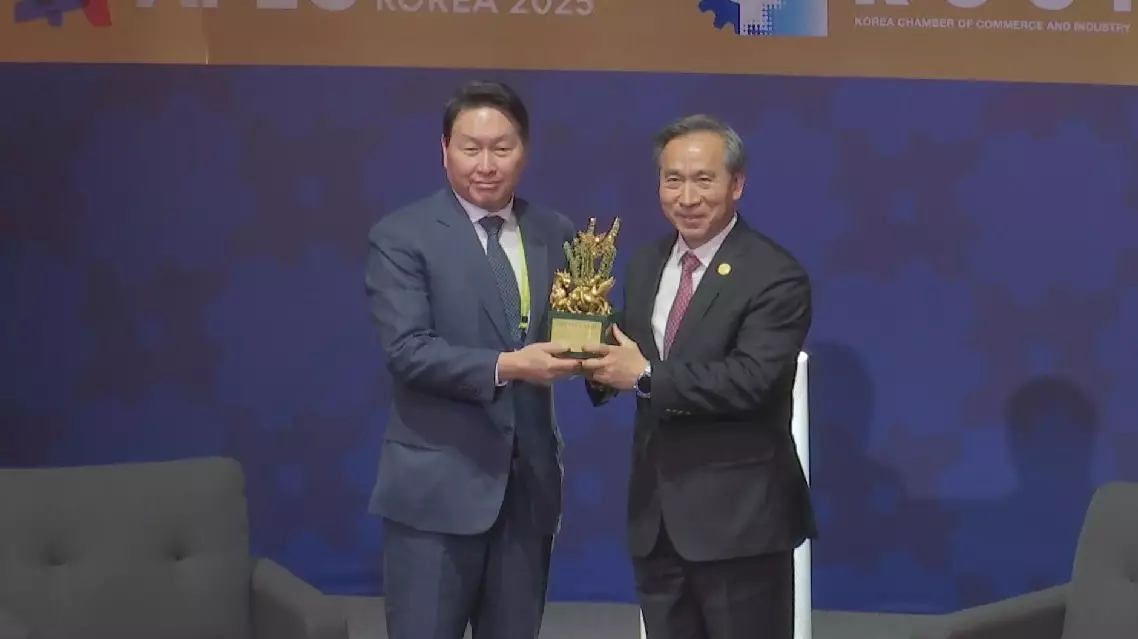
At the closing ceremony of the 2025 APEC CEO Summit, Ren received the summit's chairmanship from Chey Tae-won, chairman of the Korea Chamber of Commerce and Industry (KCCI), officially taking over as the host of the APEC CEO Summit 2026 on behalf of the CCPIT.

The CEO summit is a key part of the annual gathering of leaders and senior officials from the APEC member economies.

Themed "Bridge, Business, Beyond", this year's CEO summit brought together more than 1,000 representatives from various APEC economies to discuss regional economic integration, sustainability, artificial intelligence, digital innovation, global finance, biomedicine and other topics.

South China's tech hub of Shenzhen City will host the 33rd APEC Economic Leaders' Meeting in November 2026, Chinese President Xi Jinping announced Saturday at the APEC chairmanship handover session of the 32nd APEC Economic Leaders' Meeting.

It will be the third time for China to host an APEC Economic Leaders' Meeting.
China takes over as host of 2026 APEC CEO Summit


China takes over as host of 2026 APEC CEO Summit

The International Monetary Fund (IMF) has lowered its global economic growth forecasts for 2026 to 3.1 percent in the World Economic Outlook (WEO) report published on Tuesday, while keeping its projection for 2027 at 3.2 percent.

This marks a deceleration from the estimated 3.4 percent growth achieved in 2025. Before the outbreak of the Middle East conflict, the bottom-up forecasts for global growth would have been 3.4 percent in 2026 and 3.2 percent in 2027.

The forecast incorporates the impact of the war and assumes that it will be limited in duration, intensity and scope, with disruptions fading by mid-2026.

Under the reference forecast, global headline inflation is expected to increase to 4.4 percent in 2026 and decline to 3.7 percent in 2027.

If the conflict and the ensuing spike in oil prices last longer, global economic growth in 2026 will fall to 2.5 percent, while global inflation will climb to 5.4 percent, according to the report.

In extreme cases, global economic growth in 2026 could drop to two percent, the report warned.

To be specific, the U.S. economy is projected to grow by 2.3 percent in 2026 and 2.1 percent in 2027, although higher trade barriers introduced since April 2025 are expected to continue to weigh on activity.

In the euro area, growth is projected to decline from 1.4 percent in 2025 to 1.1 percent in 2026 before edging up to 1.2 percent in 2027. The forecasts for 2026 and 2027 are each 0.2 percentage point lower than those compared in the January 2026 WEO Update.

The 2026 growth forecast for emerging market and developing economies is revised down by 0.3 percentage point, to 3.9 percent, while the outlook for advanced economies remains broadly unchanged. With risks still tilted to the downside since the January 2026 WEO Update, the IMF suggested a comprehensive policy package combining domestic measures with coordinated international actions to strengthen resilience and foster adaptability.

It also stated in the report that "trade restrictions play a limited role in correcting imbalances but can worsen output," and urged countries to cooperate and take coordinated actions to restore stability to international economic relations.

IMF lowers global growth forecast for 2026 to 3.1 pct

IMF lowers global growth forecast for 2026 to 3.1 pct

Recommended Articles