Skip to Content Facebook Feature Image

China to embrace innovation, regional unity as 2026 APEC chair

China

China

China

China to embrace innovation, regional unity as 2026 APEC chair

2025-11-02 13:46 Last Updated At:14:07

Taking over as host country for APEC 2026, China is striving forward to enhance the strengths of the Asia-Pacific region with innovation, sustainability and unity.

It will be the third time the country has taken on the role, with previous summits held in Shanghai in 2001 and Beijing in 2014. Next year, Shenzhen, the tech hub of south China, will host APEC's flagship meetings.

On the final day of the 2025 APEC Economic Leaders' Meeting, which ran from Friday to Saturday in Gyeongju, the Republic of Korea, Chinese President Xi Jinping's put forth three key proposals as regional priorities: digital and smart development, low-carbon transformation, and an inclusive future.

Xi emphasized that as the world confronts slow growth and widening development gaps, countries in the Asia-Pacific must join hands, not build barriers.

His proposals have received a warm welcome from regional attendees at the event, including business leaders in emerging sectors that will play a key role in bringing the Chinese president's vision to fruition.

"I think it's important that countries learn to harmonize, work together and consolidate their capabilities, in particular, with energy and create more resilient supply chains for things that help power countries for the future," said Salvador Ahumada, chairman and CEO of ACEIS Electric and Power.

With China as host, topics including open trade, frontier technology and climate change are expected to dominate discussions in 2026.

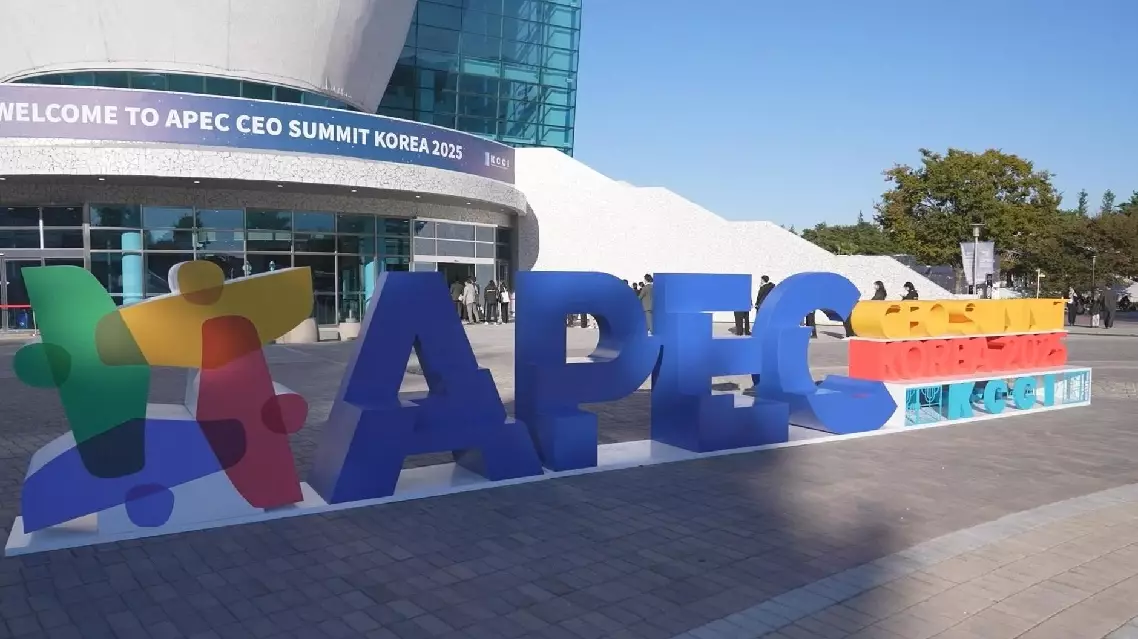
At the closing ceremony of the 2025 APEC CEO Summit on Friday, Ren Hongbin, chairman of the China Council for the Promotion of International Trade (CCPIT), received the summit's chairmanship from Chey Tae-won, chairman of the Korea Chamber of Commerce and Industry (KCCI), officially taking over as the host of the APEC CEO Summit 2026 on behalf of the CCPIT.

"The Asia Pacific is always a driving force, or we can say the engine of the global growth. Especially from the point of view of CCPIT. I think it's a task and a responsibility to help companies to overcome the current, very complex landscape," said Ren.

With the gavel passed to China, the spotlight shifts to Shenzhen -- the birthplace of China's free-trade policies and today a powerhouse of tech innovation.

From the historic city of Gyeongju to the futuristic tech hub Shenzhen, observers have expressed confidence that APEC will turn vision into action, creating a more connected and prosperous Asia Pacific.
China to embrace innovation, regional unity as 2026 APEC chair
China to embrace innovation, regional unity as 2026 APEC chair
A Chinese mainland spokesperson on Wednesday slammed Taiwan leader Lai Ching-te over his latest remarks on cross-Strait relations, accusing him of promoting secessionism and escalating tensions across the Taiwan Strait.

Chen Binhua, spokesperson for the Taiwan Affairs Office of the State Council, said in a press release that Lai's speech marking his second anniversary in office was "filled with lies and deception, hostility and confrontation."

Chen accused Lai of stubbornly adhering to a secessionist stance in pursuit of "Taiwan independence," while exaggerating the so-called threats from the mainland and intensifying confrontation across the Strait.

Lai played an old trick of advocating the secessionist agenda on one hand and, on the other, calling insincerely for dialogue and exchanges with the mainland, attempting to mislead people in Taiwan and deceive the international community, he said.

Chen said that these common tricks have been seen through by more and more Taiwanese people. Their deceptive and provocative actions will be met with firm opposition from compatriots on both sides and the international community, and are doomed to fail.

Reaffirming the mainland's position on the Taiwan question, Chen said Taiwan has never been a country, is not one now, and will never become one in the future.

He described the Taiwan question as a historical issue left over from a Chinese civil war in the 1940s.

No election result in Taiwan could alter the fact that Taiwan is part of China or sever the historical and legal bonds linking the two sides of the Strait, according to Chen.

The mainland would never allow any person or force to pursue secessionist activities under any pretext, he added.

Calling secessionists "the chief culprit" who undermines cross-Strait peace, Chen said the mainland would continue to uphold the one-China principle and the 1992 Consensus, unite broadly with Taiwan compatriots, combat secessionist activities, and safeguard peace and stability across the Strait.

Central government spokesperson refutes Lai Ching-te's latest remarks, warns against secessionist moves

Central government spokesperson refutes Lai Ching-te's latest remarks, warns against secessionist moves

Recommended Articles