From hammering nails to unpacking boxes, the ongoing Second World Humanoid Robot Games in Beijing are putting machines' practical skills to the test, accelerating their deployment in real-world industrial scenarios.
This year's event introduced a dedicated dexterous-hand competition featuring eight high-precision tasks.
Multiple teams relied on the same dexterous hand developed by the Shanghai-based AGILINK.
"In yesterday's competition, our robot completed bean-picking, powder weighing and block-building events fully autonomously, securing gold medals in all three. The challenges serve as an excellent starting point, proving that the dexterous hand's capabilities can indeed meet the demands of real-world applications," said Qiao Tianjie, CEO of AGILINK.
The robotic hand also demonstrated remarkable capability in more advanced challenges, including hammering nails, unpacking boxes, connecting flexible cables and prying open bottle caps.
The nail-driving event requires robots to hammer nails fully into a corkboard with no protruding heads or obvious bending, with the final score determined by the number of valid nails hammered within a five-minute window.
The challenge closely mirrors real-world complexities: a slight misalignment causes a crooked nail; too little force fails to drive it in, while too much sends it flying. The robot's vision must be precise, its hand steady, and the force feedback of the hammer strike accurate to the millisecond.
Similarly, in the box-unpacking challenge, robots have five minutes to slice open a cardboard box's sealing tape and extract its contents. Points are awarded only if the items remain undamaged and the box shows no significant tears, with the final score based on the total number of successful unpacks.
Beyond the spectacle of the arena, however, a more pragmatic hurdle remains: while competitions test robots' peak performance over a few minutes, industrial environments demand stable, reliable operation over hundreds or even thousands of hours.
"Currently, through advanced learning algorithms, robots can achieve a perception accuracy of up to 0.1 millimeters in a spatial perception event. However, in real-world scenarios, they must execute tasks consistently over long periods with high efficiency and high precision. Only then can they truly create value," said Jiang Zhihong, a professor specializing in intelligent robotic systems at the Beijing Institute of Technology.
Running from Saturday to Wednesday, the games have attracted 666 teams and 2,056 robots from 16 countries and regions across six continents, with team participation quadrupling from the inaugural edition last year.
The event features 51 competition items divided into two main categories: competitive matches and scenario-based challenges.
The competitive category includes athletics, football, gymnastics, weightlifting, martial arts, street dance, and tug of war, while the scenario-based category is set in real-world environments, namely factories, hotels, homes, emergency response sites, hospitals, and retail spaces.
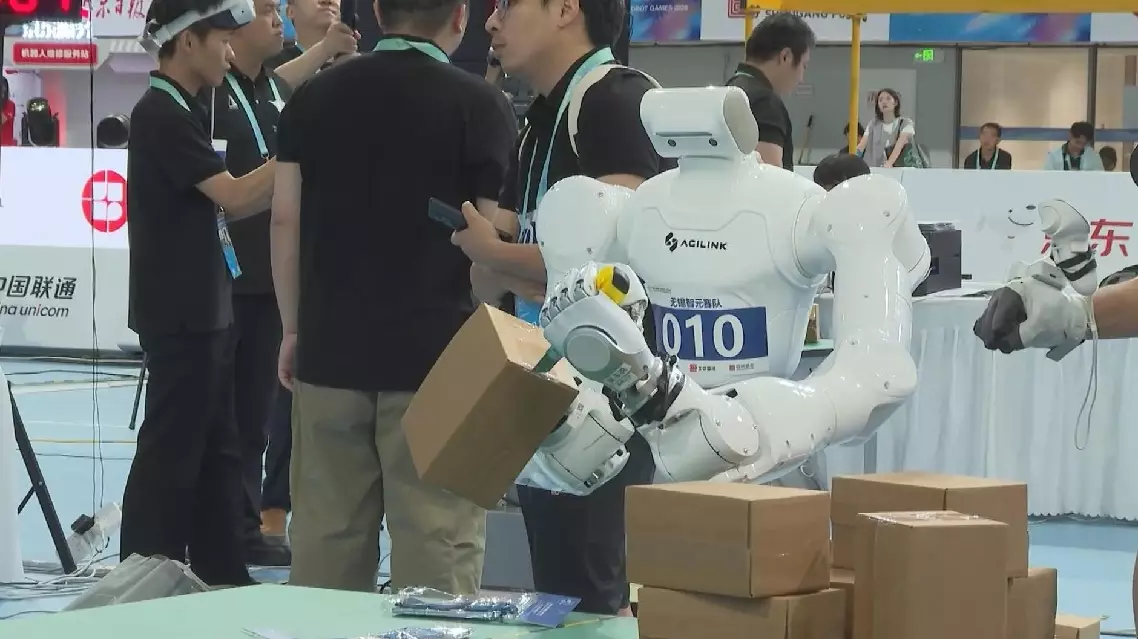
Humanoid Robot Games in Beijing test machines' real-world industrial skills
Backed by its massive consumer market, China is transforming into the world's "super buyer," bringing the globe's finest products to domestic consumers through optimized customs hubs and rapid logistics networks.
At the center of this push is Huahu International Airport in Ezhou City, central China's Hubei Province, China's first dedicated air cargo hub. At this place, chilled salmon from Norway and Chile are flown in and distributed nationwide, with some Atlantic catches even able to reach Chinese dining tables within 24 hours of leaving the water.
The speed is made possible by Ezhou's supply chain based on its aviation cold-chain system. In May, a salmon processing plant opened just a wall away from the airport, allowing long-haul shipments to move directly from aircraft to factory. Automated production lines and temperature-controlled intelligent operations preserve the fish's freshness at every step.
From the airport, processed salmon products are rapidly dispatched across Huahu's dense domestic route network. A 1.5-hour flight covers 80 percent of China's population, ensuring both peak freshness and fast delivery.
"We can feel the growth in domestic salmon consumption. The biggest change is that salmon has moved from high-end dining to everyday consumption. Small-packaged, high-freshness products are very competitive and popular. Backed by Huahu Airport's hub advantages, we have established a system featuring cross-border cold chain logistics, direct sourcing, transoceanic express shipping, port processing, and nationwide distribution, which allow us to source quality fresh products globally for the national market," said Cheng Hu, on-site manager of China Eastern Airlines Cold Chain's Central China Fresh Port.
The salmon boom is just the beginning. In June, Ezhou launched a seafood holding and processing base where live lobsters and other deep ocean catch are held, sorted, and processed before reaching dinner plates across China within 48 hours from source.
Customs data show that in the first seven months of this year, Ezhou handled 13,000 tonnes of imported fresh produce, including Boston lobster and salmon from North America and Europe, worth 1.28 billion yuan (about 1.90 billion U.S. dollars), up 3.5 percent year on year.
To keep the flow moving, Ezhou Customs has rolled out dedicated fast tracks for fresh products, round-the-clock clearance, and advance declaration services.
"Salmon imports have performed impressively this year. In the first half alone, imports surpassed 7,000 tonnes, up 260 percent, and we expect to top 10,000 tonnes by end of August. The variety of fresh products is also expanding. Niche high-end products like bluefin tuna and spiny lobster are now being imported through our port," said Liu Shi, a section chief from Ezhou customs.
The logistics revolution extends beyond air freight. On Sunday, the first return China-Laos freight train using a new "bonded logistics plus rail express" model arrived at Guiyang International Land Port in southwest China's Guizhou Province.
Carrying 40 standard containers with 1,100 tonnes of imported potash fertilizer, the train completed the journey from Vientiane South Station to Guiyang in just five days, further opening the corridor between the two countries.
"After the train arrives, we strengthen coordination and guide it onto the designated line immediately, then organize shunting to move the cars quickly to the unloading point. The goal is fast receiving and fast delivery," said Chen Shuanglin, deputy station master of Dulaying Station, a land port station in Guiyang.
Under the new model, trains no longer need to stop at border ports, but travel directly to Guiyang for customs clearance. For Guizhou, the system leverages the bonded zone's cargo and port functions, boosting clearance efficiency and cutting logistics costs.
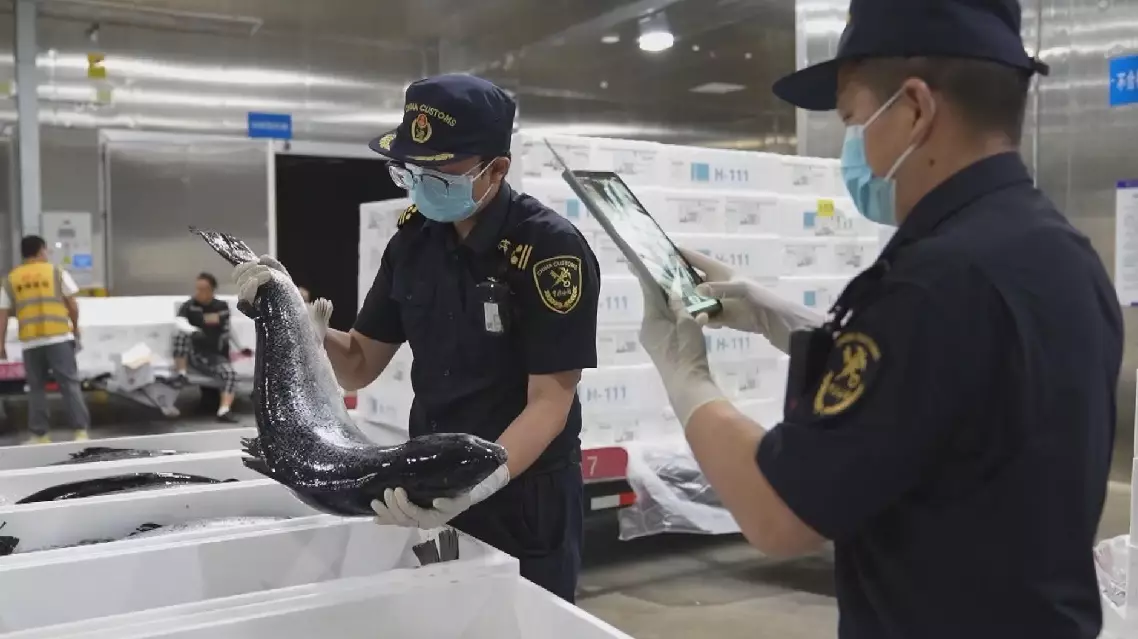
China expands global express corridors, serving domestic consumers with global freshness