A voice from Chilean youth is calling on Asia-Pacific Economic Cooperation (APEC) leaders to promote the responsible use of artificial intelligence (AI) as a tool for inclusive and sustainable development.
The 32nd Asia-Pacific Economic Cooperation (APEC) Economic Leaders' Meeting was held from Friday to Saturday in Gyeongju, the Republic of Korea, under the theme "Building a Sustainable Tomorrow: Connect, Innovate, Prosper."
Raquel Herrera, a young resident from southern Chile, said in a CGTN social campaign that her country's focus on sustainability, renewable energy, and ocean protection aligns well with APEC's goals.
"As a Chilean, I know that my country is deeply focused on sustainability, renewable energy, and protecting our oceans, which is really important to me as someone who lives in the southern area of Chile near the sea. So from my point of view, this topic really suits Chile's own priorities, including making connections through trade, innovation, and the use of clean economies," said Herrera.
"In my hometown, in southern Chile, I think the industry that needs to be developed the most is technology and digital innovation, focusing on helping local businesses to become more efficient, sustainable, and connected with the global markets," Herrera continued.
Herrera said APEC economies could collaborate on renewable energy, digital transformation, and smart management systems to help countries like Chile grow in a more inclusive and environmentally responsible way.
"Through APEC's cooperation, member economies could share their experience in areas like renewable energy, technologies, digital transformation, and smart management systems. Mutual investments in digital infrastructure and green innovation could also help my hometown grow in a more inclusive and environmentally responsible way," said Herrera.
Herrera also expressed her hope for shared standards and investment in green and inclusive technologies to ensure that AI is used fairly and transparently.
"AI is transforming the way we work, we communicate, we study, and also how we make decisions. But it also brings ethical, environmental, and social challenges. We must have international cooperation to ensure AI is used fairly, transparently, and sustainably without deepening inequality or harming our planet. And it comes to my mind, things like setting some shared standards and investing in green and inclusive technologies, so APEC members can make AI a tool for progress," said Herrera.

Chilean youth expect APEC to make AI tool for progress
Cuba has strongly condemned the United States' seizure of a Venezuelan oil tanker, with a former Cuban diplomat calling the action illegal and warning it threatens regional energy security as the U.S. escalates pressure on Venezuela.
Carlos Alzugaray, the former Cuban diplomat, said the seizure of the tanker and its cargo violates international law.
"They have seized the ship, the tanker, but they have also seized the oil, they have taken the oil. All the sanctions that the United States has imposed on Venezuela are illegal because they are not based on any decision of an international institution like the Security Council of the United Nations," he said.
U.S. forces last week seized a Venezuelan oil tanker, the Skipper, in the Caribbean, alleging it was part of an "illicit oil shipping network supporting foreign terrorist organizations." The U.S. has since intensified its campaign against Venezuela's oil trade.
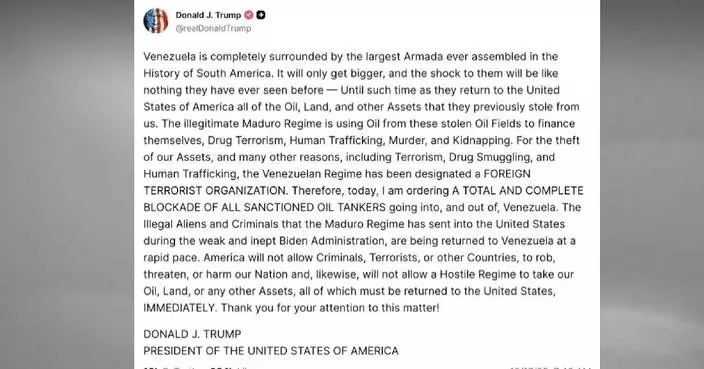
U.S. President Donald Trump said Tuesday that he has ordered a total blockade of all sanctioned oil tankers traveling to and from Venezuela, escalating a months-long pressure campaign against Venezuelan President Nicolas Maduro.
Trump also said that the Venezuelan government has been designated "a foreign terrorist organization," accusing it of involvement in crimes including terrorism, drug smuggling and human trafficking.
Trump also claimed that Venezuela is "completely surrounded by the largest armada ever assembled in the history of South America," warning that the pressure would continue until the assets he said had been taken are returned to the United States.
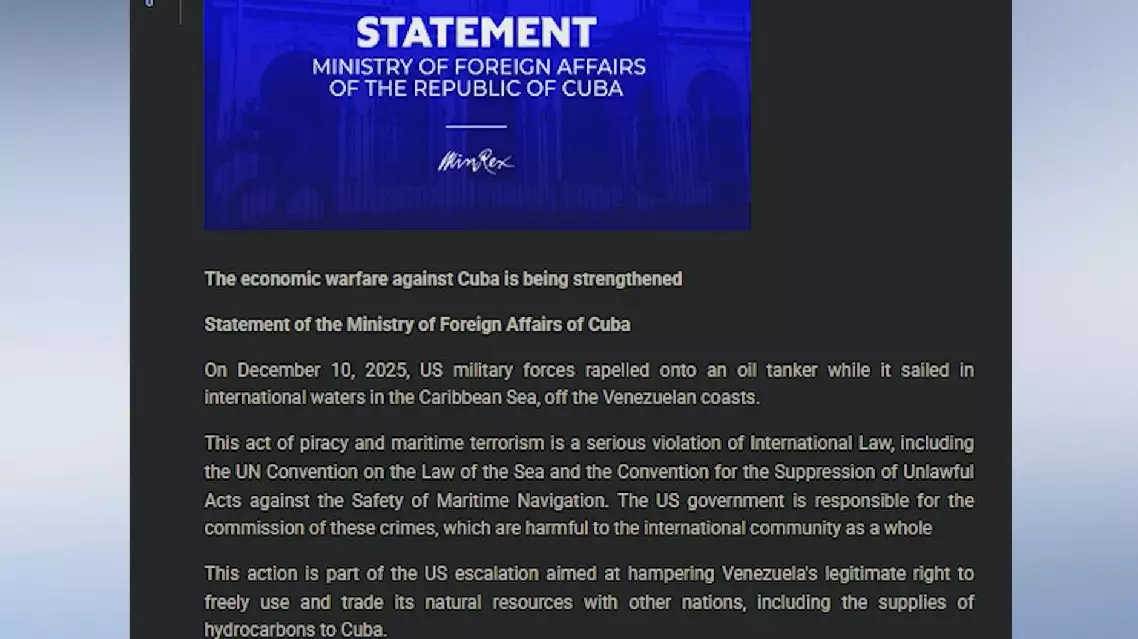
Cuban President Miguel Diaz-Canel has also denounced the U.S. seizure of Venezuelan oil tanker last week, calling it an act of piracy and maritime terrorism as the U.S. blockade may also impact Cuba, which is experiencing an energy crisis and is heavily dependent on oil imports from Venezuela.
For Cuba, the seizure raises particular concerns. The island is facing a deep energy crisis marked by rolling blackouts and relies heavily on oil imports from Venezuela. Cuban officials fear that expanded U.S. enforcement actions could further disrupt supplies.
The tanker seizure coincides with an expanded U.S. military presence in the Caribbean under "Operation Southern Spear," officially described as a counter-narcotics mission. Cuban authorities argue that the deployment violates a regional declaration designating Latin America and the Caribbean as a "Zone of Peace," and have called for international condemnation of the U.S. actions.
Cuba condemns US seizure of Venezuelan oil tanker amid energy crisis