Skip to Content Facebook Feature Image

Chinese firm breaks through technical barrier in smart-glass display with nanoscale light control

China

China

China

Chinese firm breaks through technical barrier in smart-glass display with nanoscale light control

2025-11-03 16:52 Last Updated At:19:07

A major breakthrough in augmented reality (AR) smart glasses has emerged from a company in Guangzhou City, south China's Guangdong Province, which overcomes a longstanding industry dilemma: how to deliver bright, clear displays without compromising lens transparency.

For years, the smart glasses industry was trapped in a fundamental trade-off: brighter displays meant darker, less transparent lenses, essentially turning them into sunglasses, while highly transparent lenses suffered from ghosting, poor contrast, or blurry overlays.

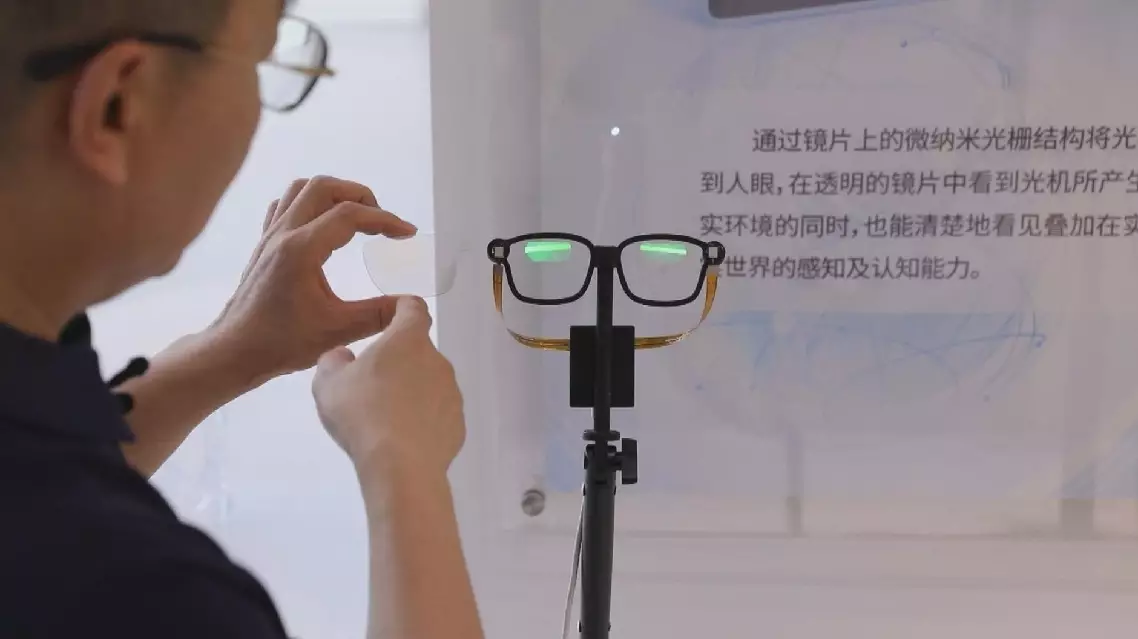
The SeeV Optoelectronics Technology Company from Guangzhou has now shattered this barrier using precisely engineered nanoscale diffraction gratings.

"The core display component in the glasses is our proprietary diffractive waveguide chip," said Li Xiaojun, chairman of SeeV Optoelectronics, adding that the technology allows them to precisely control how light travels through the lens.

Nanoscale diffraction gratings are microscopic structures etched into the lens that act like a "light tunnel".

These nanostructures guide light emitted from a miniature projector embedded in the frame through an engineered optical pathway and into a small, high-fidelity viewing window within the user's field of vision. The rest of the lens remains fully transparent, preserving an unobstructed view of the real world, according to Shi Rui, director of research and development at SeeV Optoelectronics.

"These gratings are only a few hundred nanometers in size. By fine-tuning their depth, width, and duty cycle, we can achieve an optimal display effect," said Shi.

Although it sounds simple, manufacturing such precision at scale is extraordinarily challenging, as it's like drawing a detailed map on a single strand of hair. A few nanometers off, you may get stray light or double images on the glasses, Shi noted.

To ensure quality, the team uses an electron microscope to meticulously inspect the fabricated gratings, checking for any deviations from the original design.

"All the gratings will be tested. We will test them at multiple points across different locations. If any deviations from our design are detected, we will continuously iterate and refine the fabrication process," said Shi.

So far, SeeV Optoelectronics has filed over 100 patents in China and abroad. They're tackling a bottleneck of the industry: eliminating the visible boundary between the display zone and the transparent lens, creating a truly "seamless" AR experience that can be mass-produced.

"We are very confident. By concentrating our resources and working together, we will break through the bottlenecks, whether in critical components, mass production, research and development, or performance," said Li.

Guangdong is rapidly emerging as a powerhouse for wearable devices. Roughly one in every two smart glasses sold nationwide is made in Guangdong's Shenzhen City, which now holds over 70 percent of China's research and development capability for AI-powered glasses.
Chinese firm breaks through technical barrier in smart-glass display with nanoscale light control
Chinese firm breaks through technical barrier in smart-glass display with nanoscale light control
Chinese firm breaks through technical barrier in smart-glass display with nanoscale light control
Chinese firm breaks through technical barrier in smart-glass display with nanoscale light control
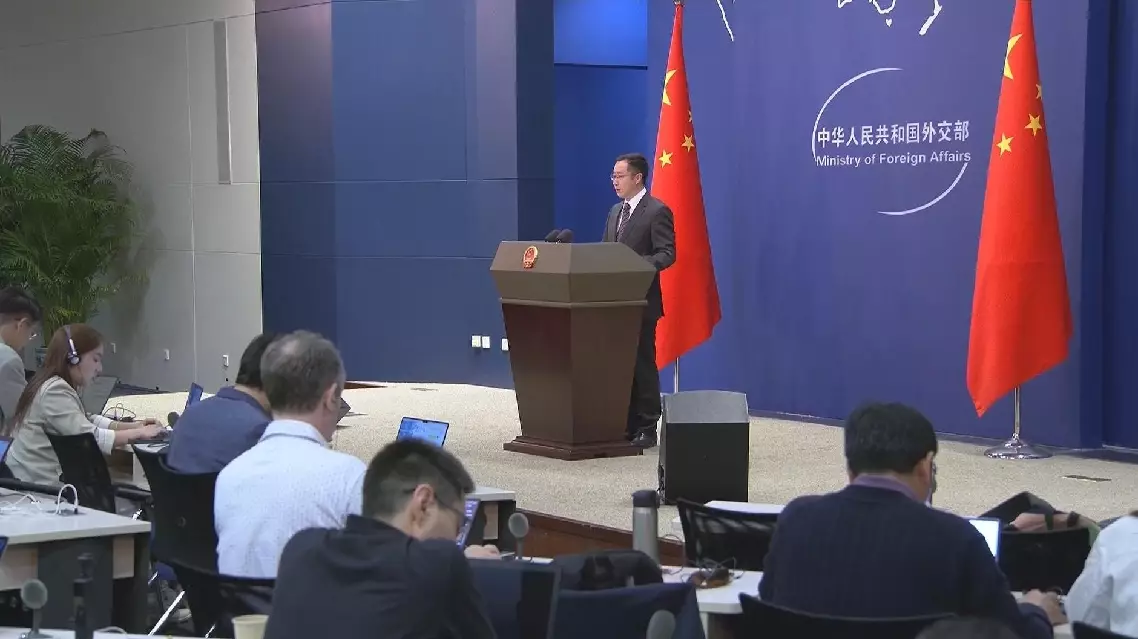
China's development has never been a "threat" to anyone but the source of growth advancing common development of all countries, Foreign Ministry spokesman Lin Jian said at a regular press conference in Beijing on Friday.

Some Western media and think tanks are peddling so-called "China Shock 2.0," saying that "China is achieving fast development in high-tech sectors such as renewable energy and AI and relies on foreign markets to absorb its overcapacity, thus reducing the market share of developed countries and sending more serious shock waves to the global economy compared with the era of traditional manufacture industry," while there are foreign commentators saying that the "China Shock 2.0" argument ignores the genuine innovation occurring within the Chinese industrial ecosystem and that Chinese export is the exact booster of the global economy that is needed in the turbulent period and more indispensable than ever.

Commenting on that, Lin said: "From the world's factory to the world's market and innovation powerhouse, China's development is achieved through strong performance driven by innovation and brings tangible cooperation opportunities and space to the world. High-quality Chinese products represented by the 'old three' of textiles, furniture and home appliances have stabilized the global industrial and supply chain, lowered the living cost of global consumers and eased the inflationary pressure worldwide. China's green production capacity represented by the 'new three' of electric vehicles, batteries and solar panels has bridged the gap between supply and demand in global green development and bolstered the global energy transition and low-carbon development. Moreover, China's high-tech products represented by the 'new new three' of robots, AI and innovative drugs have broken high-tech barriers and monopoly and enabled people in more countries to access affordable new technologies," said the spokesman.

"Openness and cooperation bring about progress and win-win result. China's development has never been a 'threat' to anyone but the source of growth advancing common development of all countries. What really creates 'shocks' to the world has never been the innovation of Chinese companies and efficiency of Chinese industrial capacity, but protectionist moves of setting up barriers, decoupling and severing industrial and supply chains. China will stay committed to high-standard opening up, defend the multilateral trading system and provide more certainty and new impetus to the world economy with its own steady development," said Lin.

China's development never a threat: FM spokesman

China's development never a threat: FM spokesman

Recommended Articles