MEXICO CITY (AP) — What should have been a five-minute time-saving walk from Mexico’s National Palace to the Education Ministry for President Claudia Sheinbaum has become a symbol of what Mexican women face every day after a video captured a drunk man groping the country's first woman president.
On Wednesday, gender violence catapulted to the highest-profile platform, and Sheinbaum used her daily press briefing to say that she had pressed charges against the man.
She also called on states to scrutinize their laws and procedures to make it easier for women to report such assaults and said Mexicans needed to hear a “loud and clear, no, women’s personal space must not be violated.”
Sheinbaum said she felt a responsibility to press charges for all Mexican women. “If this is done to the president, what is going to happen to all of the young women in our country?”
Indeed, if Mexico’s president is not exempt from street harassment, then it’s not difficult to imagine what women with hourslong commutes on public transportation are experiencing daily.
Andrea González Martínez, 27, who works for Mexican lender Nacional Monte de Piedad, said she has been harassed on public transportation, in one case the man followed her home.
“It happens regularly, it happens on public transportation,” she said. “It’s something you experience every day in Mexico.”
Her coworker, Carmen Maldonado Castillo, 43, said she has witnessed it.
“You can’t walk around free in the street,” she said.
Sheinbaum said Wednesday that she had similar experiences of harassment when she was 12 years old and using public transportation to get to school, and understands the problem is widespread.
“I decided to press charges because this is something that I experienced as a woman, but that we as women experience in our country,” she said.
The incident immediately raised questions about the president’s security, but Sheinbaum dismissed any suggestion that she would increase her security or change how she interacts with people.
She explained that she and her team had decided to walk from the National Palace to the Education Ministry to avoid a 20-minute car ride in city traffic.
Mexico City Mayor Clara Brugada had announced overnight that the man had been arrested.
Brugada used some of Sheinbaum’s own language about being elected Mexico’s first woman president to emphasize that harassment of any woman – in this case Mexico’s most powerful – is an assault on all women.
When Sheinbaum was elected, she said that it wasn’t just her coming to power, it was all women.
Brugada said that was “not a slogan, it’s a commitment to not look the other way, to not allow misogyny to continue to be veiled in habits, to not accept a single additional humiliation, not another abuse, not a single femicide more.”
Lilian Valvuena, 31, said she didn’t think Sheinbaum had really taken violence against women seriously until her firsthand experience yesterday. She hopes that work to better train police to respond will follow.
“They have to prepare them,” she said. “They don’t know what protocols to follow.”
Marina Reyna, executive director of the Guerrero Association against Violence toward Women, said that watching the video she initially worried that Sheinbaum had minimized the assault, continuing to smile and talk calmly to the man. But she hoped the president's willingness to talk about it Wednesday would change how such cases are handled, after years of activists highlighting the issue.
“You lose confidence in the institutions,” Reyna said. “The people stop going to report it, because when you report it nothing happens.”
A World Health Organization report this year revealed that one in three women in the Americas has experienced physical or sexual violence from a partner or by a third party at some point in their lives.
In the first seven months of this year cases of femicide in Mexico dropped almost 40%, compared to the same period in 2024, and intentional injuries against women decreased by 11%, according to figures from the Federal Security Secretariat.
Reyna indicated that the violence suffered by Mexican women is related to impunity, which she estimated at over 70%, and added that this situation leads women not to report crimes.
From 2019 to 2024, only 20% to 30% of women experiencing violence in Mexico, Argentina, Brazil, Chile, Ecuador, Honduras, Peru and Uruguay used state services specifically designed for them, according to a report by the Economic Commission for Latin America and the Caribbean (ECLAC) on femicide in the region.
Political scientist Manuel Pérez Aguirre, a researcher at the Seminar on Violence and Peace at the College of Mexico academic center, argued that in the case of the president, there must be a “truly exemplary punishment” that serves as a clear message to sexual aggressors in Mexico.
Follow AP’s coverage of Latin America and the Caribbean at https://apnews.com/hub/latin-america
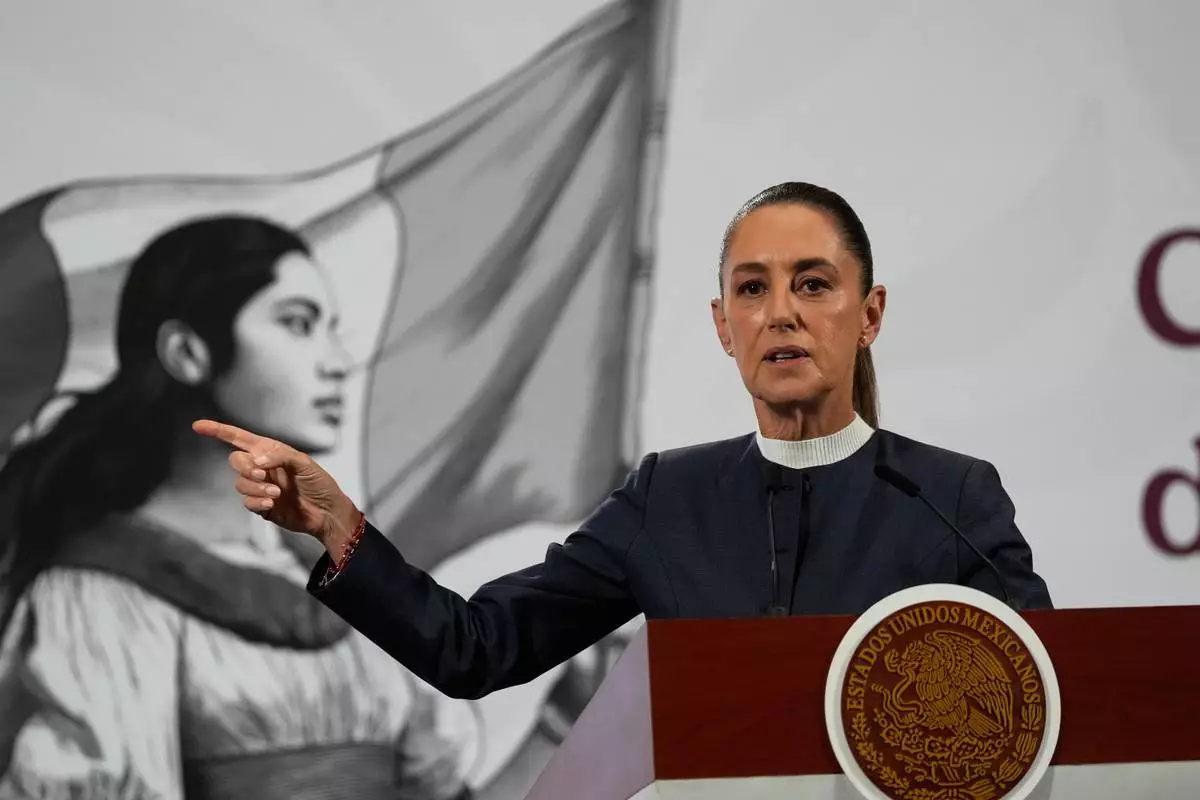
Mexican President Claudia Sheinbaum gives a morning press conference at the National Palace in Mexico City, Monday, Nov. 3, 2025. (AP Photo/Marco Ugarte)
LAS VEGAS (AP) — A Nevada judge sentenced “Dances With Wolves” actor Nathan Chasing Horse on Monday to life in prison for sexually assaulting Indigenous women and girls.
A jury had previously convicted him of 13 charges, mostly related to sexual assault of three women.
Accusers and their families told Judge Jessica Peterson they continue to suffer from the trauma caused by Chasing Horse, 49, and struggle with their faith after he exploited his position as a spiritual leader.
“There is no way to get back the youth, the childhood loss, my first time, my first kiss, the graduation I never got to have,” said Corena Leone-LaCroix, who was 14 when Chasing Horse assaulted her. “The life that little girl could have lived has been taken from me forever.”
The Associated Press typically does not use the name of alleged sexual assault victims unless they come forward publicly, as Leone-LaCroix has.
Chasing Horse, wearing his navy blue Clark County Detention Center uniform, stared straight ahead as victims read their statements and remained quiet as he was escorted out of the courtroom. He’ll be eligible for parole after serving for 37 years, and has continued to deny the charges against him.
“This is a miscarriage of justice,” he told the judge on Monday.
Peterson said she was struck by his continued denial of the charges despite the evidence shown in trial.
“You preyed on these women’s trusts and their spirituality, and you manipulated them for your own personal gratification," she said before she announced his sentence. When the hearing adjourned, more than a dozen people in the courtroom clapped.
The sentencing wraps a yearslong effort to prosecute the former actor after he was first arrested and indicted in 2023. That initial arrest reverberated around Indian Country, with law enforcement in other states and Canada following up with more criminal charges. Those charges are still pending.
The British Columbia Prosecution Service said Chasing Horse was charged with sexual assault in February 2023, though the date of the alleged offense took place in September 2018 near Keremeos, a village about four hours east of Vancouver. In November 2023, the case paused due to Chasing Horse’s charges in the United States, but resumed the following year.
After all of Chasing Horse’s appeals have been exhausted, British Columbia prosecutors will assess next steps, Damienne Darby, communications counsel for the British Columbia Prosecution Service, said in an email.
A warrant against Chasing Horse remains outstanding in Alberta, the Tsuut’ina Nation Police Service in Alberta said in a statement following Chasing Horse’s conviction in January. The Tsuut’ina Nation Police Service said that it is in contact with the Alberta Crown Prosecutors Office regarding the warrant.
Chasing Horse was born on the Rosebud Reservation in South Dakota, which is home to the Sicangu Sioux, one of the seven tribes of the Lakota nation. Following his appearance as the young Sioux tribe member Smiles a Lot in Kevin Costner’s Oscar-winning film “Dances With Wolves,” Chasing Horse traveled across Indian Country to attend powwows and perform healing ceremonies.
During his trial, Nevada prosecutors said Chasing Horse used his reputation as a Lakota medicine man to prey on Indigenous women and girls.
Deputy District Attorney Bianca Pucci told the jury that for almost 20 years, Chasing Horse “spun a web of abuse” that ensnared many women.
Jurors heard from three women who said Chasing Horse sexually assaulted them. The jury returned guilty verdicts on some charges. He was acquitted on others.
Multiple victims described how they participated in his ceremonies or went to Chasing Horse for medical help.
Chasing Horse allegedly told Leone-LaCroix when she was 14 that the spirits wanted her to give up her virginity to save her mother, who was diagnosed with cancer. He then sexually assaulted her and told her that if she told anyone, her mother would die, according to Pucci. The sexual assaults continued for years, Pucci said.
Chasing Horse denied the allegations and his attorney questioned the main accuser’s credibility, calling her a “scorned woman.” His attorney had filed a motion for a new trial, arguing that a witness was not qualified to talk about grooming and that the statute of limitations had expired. That motion was denied.
Victims and their family members testified that they struggle with their faith as a result of Chasing Horse’s actions. The mothers of the victims said Chasing Horse betrayed their trust and abused sacred traditions.
“Even to this day I struggle to regain my faith and spirituality,” said Lynnette Adams, the mother of Siera Begaye, one of the other victims.
The AP typically does not use the name of alleged sexual assault victims unless they come forward publicly or approved the use of their names, as Begaye has.
Begaye said she still faces complications after suffering an ectopic pregnancy as a result of the assault and being forced to undergo surgery.
“I am choosing to see this moment as a fresh start," Begaye said. "I will rebuild my life, reclaim my voice and continue fighting for the future I deserve."
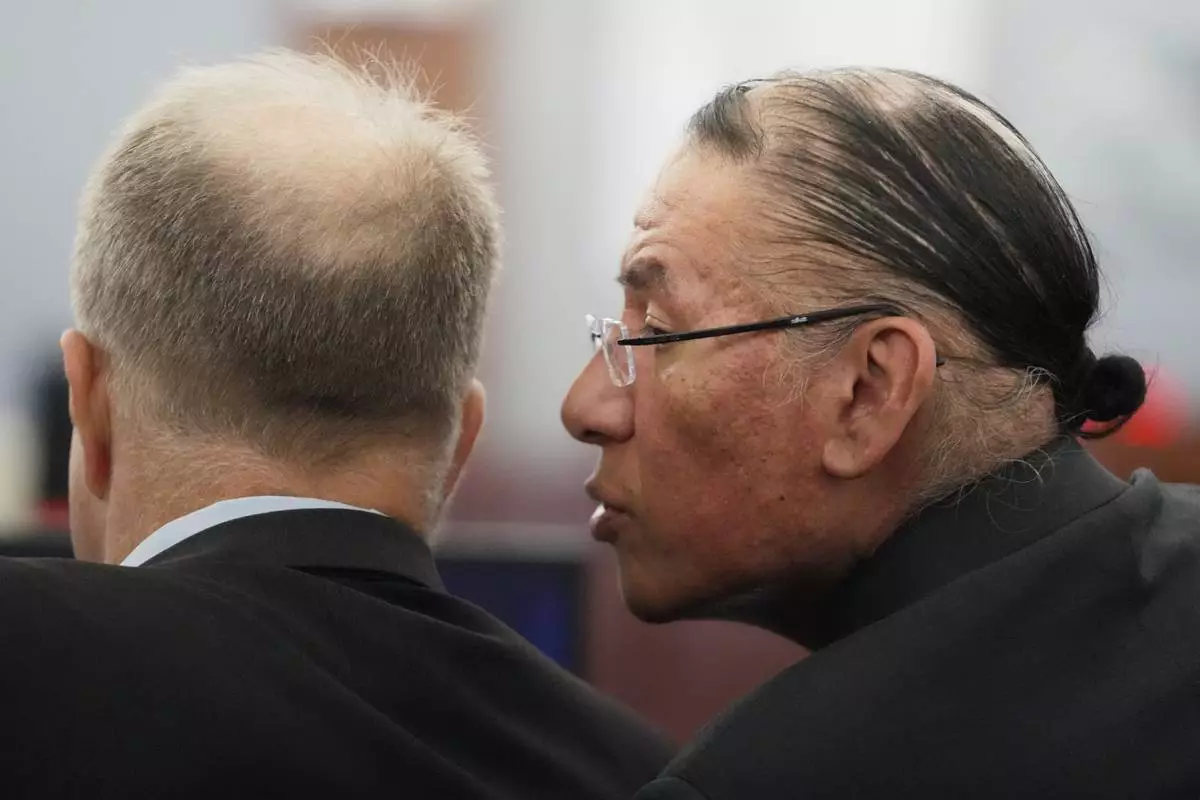
FILE - Nathan Chasing Horse, right, talks to his attorney Craig Mueller during his trial on charges of sexually abusing Indigenous women and girls, Jan. 13, 2026, in Las Vegas. (AP Photo/Ty ONeil, file)