Japan should stay prudent on the Taiwan question and stop sending erroneous signals to secessionists, Foreign Ministry spokeswoman Mao Ning said at a press briefing in Beijing on Thursday.
She made the comments in response to a media query about the recent interactions between the Japanese government and Taiwan secessionists.
"Awarding a medal to someone who advocates Taiwan secession raises questions about Japan's intentions. Does Japan mean to encourage and embolden separatists, and what kind of signal does it intend to send to the Taiwan separatist forces? The Taiwan question is at the very core of China's core interests and concerns the political foundation of China-Japan relations as well as Japan's basic credibility," she said.
"This year marks the 80th anniversary of the victory of the Chinese People's War of Resistance Against Japanese Aggression and the World Anti-Fascist War, as well as the 80th anniversary of Taiwan's restoration. China urges Japan to deeply reflect on its responsibility for the war crimes in history, abide by the one-China principle and the spirit of four China-Japan political documents, exercise prudence in its words and actions on the Taiwan question, and stop sending any wrong signals to the Taiwan secessionist forces," said Mao.

Japan must stay prudent on Taiwan question: spokeswoman
Japan must stay prudent on Taiwan question: spokeswoman
The operational efficiency of Guangzhou Baiyun International Airport in south China's Guangdong Province has greatly improved following the launch of a new terminal and a new runway one month ago.
The airport officially put into operation its Terminal 3 and fifth runway on October 30, making it China's first civil airport to operate five commercial runways.
Terminal 3 features a range of self-service facilities, including check-in kiosks, automated baggage drop systems, and smart security screening equipment, which have greatly streamlined passenger processing.
Since its opening, five airlines have shifted their domestic operations to Terminal 3, which now handles an average of 158 flights and about 26,000 passengers daily.
"Compared with Terminal 1, both the number of staffed counters and self-service kiosks of Terminal 3 have increased significantly, greatly reducing the average check-in time for passengers. For domestic direct flights, the entire check-in process can be completed in a minimum of one minute," said Shi Mengyao, a staffer with the ground service department of the Guangdong branch of China Eastern Airlines.
Beyond efficiency improvements, the terminal also includes an observation deck that offers travelers panoramic views of the airfield.
"Since its opening, the observation deck attracts over 3,000 visitors per day on average, with total visits exceeding 100,000 to date," said Luo Li, deputy general manager of a terminal management company at Baiyun International Airport.
The airport's expansion also marks another step toward building a world-class airport cluster in the Guangdong-Hong Kong-Macao Greater Bay Area.
"The airport's expansion not only consolidates the Greater Bay Area as an aviation hub connecting China with the world, but also helps lower logistics costs within the area, promote the free flow and efficient allocation of economic resources, and enhances the area's capacity for global resource allocation," said Li Jing, chief planner with the Guangdong Provincial Department of Transport.
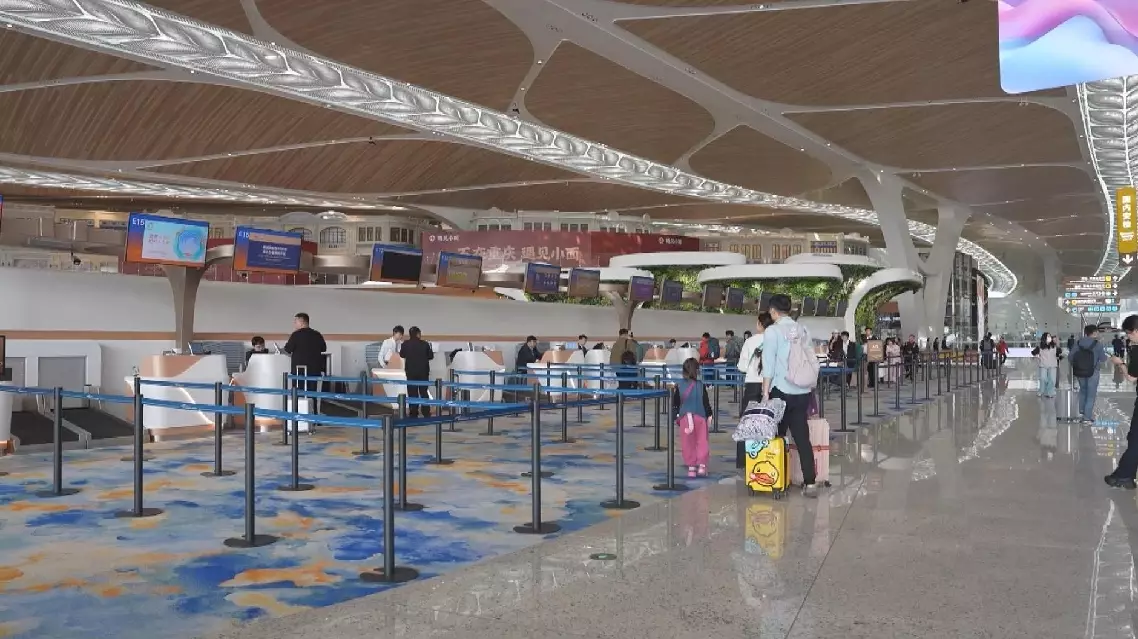
New terminal, runway boost operational efficiency of airport in Guangzhou