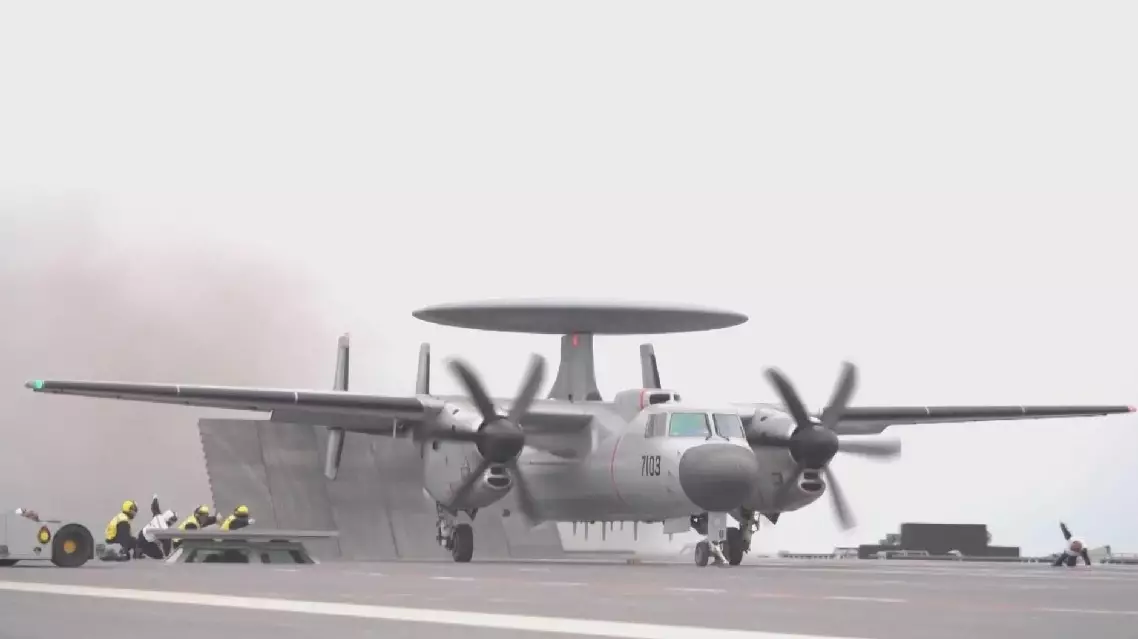
China's KJ-600 early warning aircraft features special designs enabling it to take off and land on the country's newly commissioned third and most advanced aircraft carrier the Fujian, said experts.
As an airborne command post, the KJ-600 is primarily responsible for detecting, perceiving, synthesizing and disseminating situational information for the aircraft carrier group. Meanwhile, it also can perform non-combat missions such as maritime search and airspace command and control.
"To meet the requirement of combat operation, the aircraft features a distinctive design. First, it must be capable of taking off and landing on an aircraft carrier. Compared to conventional land-based transport aircraft, it has a much stronger structural built to withstand catapult launches, arrested landings, and significant overload forces on the deck. Another notable aspect of its appearance is the vertical stabilizers. While traditional aircraft typically have one or two vertical fins, the KJ-600 is equipped with four, providing enhanced tail control capability. As a result, the tail surfaces are designed to be larger," said Geng Yansheng, director of Xi'an Aircraft Research and Design Institute with Aviation Industry Corporation of China (AVIC).
Another distinctive feature of the KJ-600's appearance is its foldable wings.
At the AVIC Xi'an Aircraft Research and Design Institute, there is a test bench especially for the foldable wings. Engineers have done thousands of experiments to develop such a type of reliable wings.
"During the simulated unlocking process, when a gust of wind passes through, the wings should be capable of stretching. Meanwhile, we've added another wind load here. So when under significant wind loads, the wings can still be locked," said Guo Xiang, deputy chief engineer of AVIC Xi'an Aircraft Research and Design Institute.
Traditional propeller aircraft typically rely on mechanical control systems. Although the engines are symmetrically positioned, their identical rotational direction during flight causes asymmetric airflow across the left and right wings. To address this issue, the KJ-600 employs fly-by-wire technology, enabling its flight control laws to adapt precisely to varying flight conditions.
"The flight control laws of the KJ-600 have undergone 11 rounds of assessment by pilots with optimizations in each cycle. Unlike traditional mechanically operated aircraft that require manual compensation during flight, the adoption of fly-by-wire technology allows the control system to automatically correct these deviations within the flight control laws. Therefore, the pilots can feel that the aircraft is easier to fly and the flight quality is very good," Geng said.
China's KJ-600 early warning aircraft specially designed for aircraft carriers: designer