Chinese smartphone brands have captured a dominant position in the Latin American market by delivering cutting-edge technologies, deeply localized experiences, and exceptional value to customers across the region.
According to the Singapore-based market research firm Canalys, Chinese brands now command over 60 percent of the Latin American smartphone market. In Peru, that figure climbs to a staggering 70 percent.
From bustling malls to street-side stores, devices from Xiaomi, OPPO, and Huawei are everywhere, and consumers are responding with loyalty.
Peruvian tech influencer Leonel Delgado, with over 2.5 million followers across internet platforms, has become a vocal advocate for Chinese phones.
"I think Chinese manufacturers are very daring. They take a lot of risks, and they want to offer a lot of functionalities, and that kind of thing adds value to their products. What we are seeing is that Chinese manufacturers are introducing artificial intelligence (AI) across various product categories, not only in the most expensive devices, but also in mid-range equipment. That brings value for users," said Delgado.
Users applaud features tailored to their daily life, including ultra-fast charging, massive batteries that last up to two full days, a smooth and responsive interface, and cameras finely tuned for vibrant social media sharing.
Chinese smartphone brands have also forged deeper connections with Peruvian consumers through localized innovations, diverse product lines, and unique fan community engagement.
"I choose Chinese brands like Xiaomi because they offer a wide range of products with strong interconnectivity between devices, and their products have a high cost-performance ratio," said a local customer.
Peruvian industry experts say that Chinese brands, with continuous technological upgrades, are reshaping the competitive landscape of the regional market.
"I would say that now the first to bring the new features are Chinese cell phones. If Chinese manufacturers always manage to maintain that leadership in innovation and in introducing new features, based on their tremendous efforts in research and development, I believe they will remain at the forefront of the industry, even if they are not always in the first place," said David Chavez, a professor with the Department of Engineering of the Pontifical Catholic University of Peru.
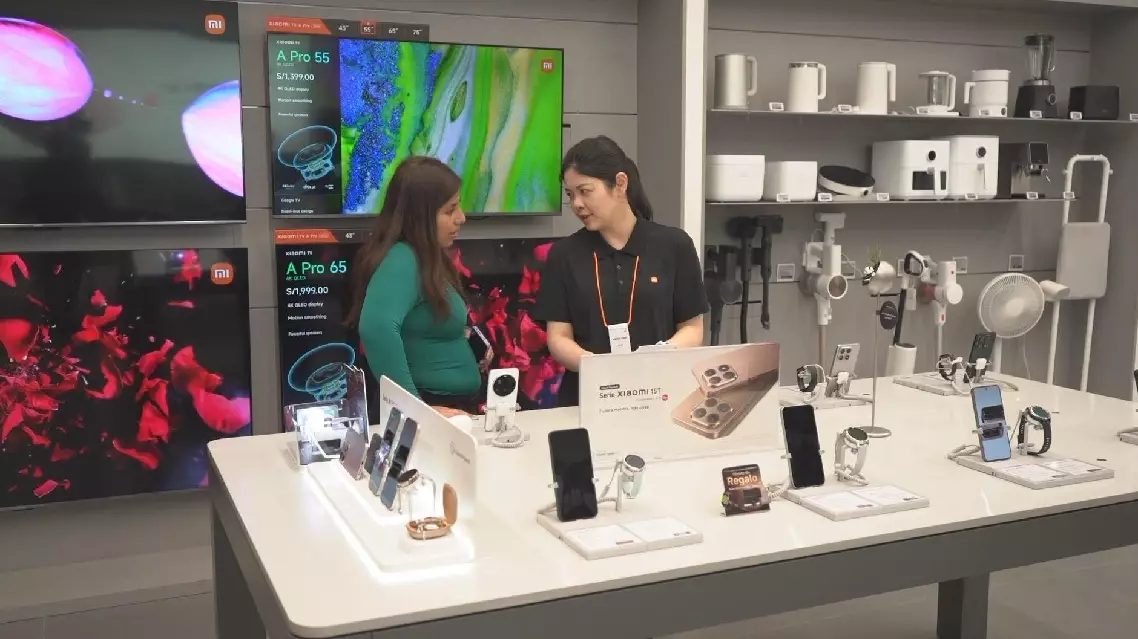
In Colombia, where consumers demand hands-on experience before purchasing, Chinese brands have invested heavily in physical retail.
Xiaomi, OPPO, and Huawei now dominate high-end shopping centers, not just through product displays, but through immersive brand experience zones showcasing smart home integrations.
"Xiaomi is a brand that offers a very good experience for customers in terms of innovation, quality and price. We also have brands such as OPPO and Huawei [in our mall]," said Mariluz Herrera, manager of a local shopping mall.
"I really like the technologies offered by Chinese smartphones. They are very convenient to use. I can turn on the lights in my home with just a tap on the screen," said a local customer.
Chinese smartphone brands have also rapidly expanded their retail networks through franchise partnerships, gaining access to broader regional markets, while tailoring product specifications to local consumer habits.
"Since 2021, Xiaomi has held the top position in the Colombian smartphone market for four consecutive years. Particularly, our market share reached 30 percent in the second quarter of this year," said Wu Jie, Xiaomi's brand manager in Colombia.
In Brazil, Latin America's largest smartphone market with over 40 million units sold in 2024, competition is fierce. Yet, Chinese brands are gradually expanding their market share through deep localization strategies and differentiated competition.
"Both JOVI (a sub-brand of Chinese phonemaker Vivo) and OPPO have focused on after-sales services, ultimately becoming more competitive than traditional manufacturers we're familiar with. For example, they offer a two-year warranty, while in Brazil, the average warranty period in the market is only 12 months," said Tassio Veloso, senior editor at a Brazilian tech website.
To gain recognition in the Brazilian market, Chinese brands have established local partnerships and invested in domestic production. This has not only reduced manufacturing costs and unlocked favorable tax incentives, but also strengthened consumer trust and brand affinity among locals.
JOVI has built a state-of-the-art manufacturing plant in the Manaus Free Trade Zone in northern Brazil. With two production lines already in operation, the factory is capable of churning out 100,000 units per month -- one phone every 22.5 seconds.
A joint venture between JOVI and Brazilian electronic manufacturing services company GBR was launched early this year. This collaboration project has not only generated employment opportunities, but also cultivated a cohort of skilled local technicians.
"There were many things I didn't understand at all before, but today I've discovered that I can do them and have developed the necessary skills. This has been an excellent opportunity for both my personal and professional growth," said Keila Lima Alves, a worker at the JOVI plant.
"We anticipate that by next year, JOVI alone will employ more than 300 workers," said Salvador Brandao, industrial director at GBR.
Chinese smartphones dominate Latin American market with cutting-edge tech, localized innovation