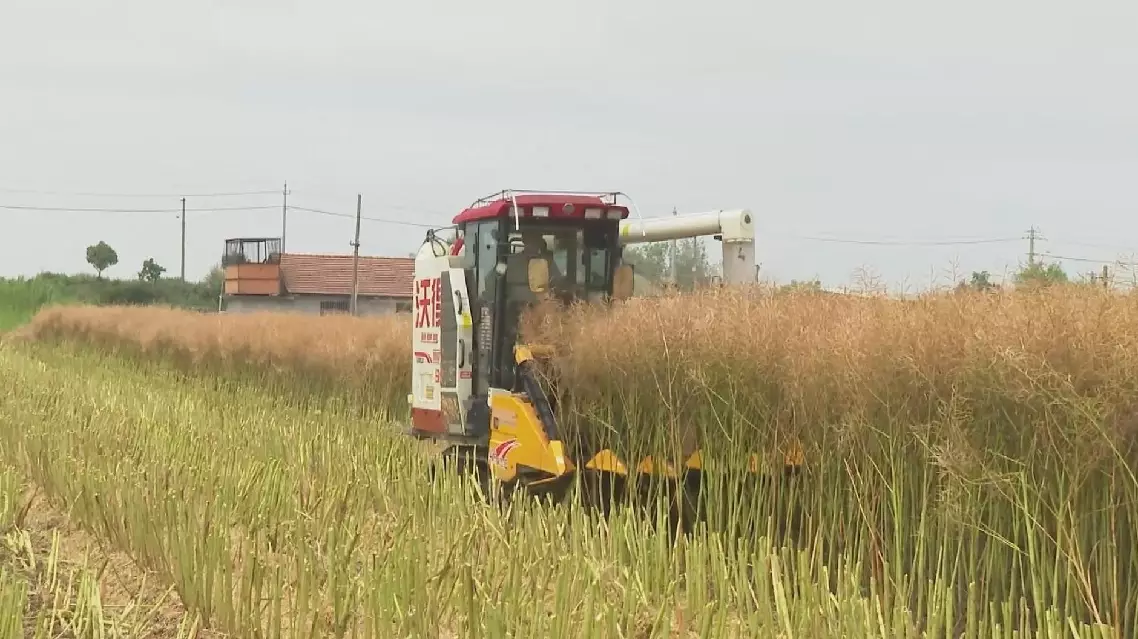
The latest agricultural situation report from the Ministry of Agriculture and Rural Affairs shows that China's winter rapeseed harvest has entered its peak period, with progress exceeding 40 percent, slightly faster than the same period of last year.
The country's summer oilseed crop is primarily winter rapeseed, which accounts for over 40 percent of domestically produced edible vegetable oil.
In Xishui County, Huanggang City, central China's Hubei Province, a major rapeseed planting demonstration base showcases the progress of the harvest.
Hubei ranks among China's leading rapeseed-producing provinces, with 19 million mu (approximately 1.27 million hectares) under cultivation.
As a renowned grain and oil-producing county in eastern Hubei, Laishui maintains stable rapeseed cultivation of over 400,000 mu (about 26,667 hectares) annually. The oilseed industry serves as a crucial pillar for local farmers' income growth.
The rapeseed grown in Xishui meets national standards for "double-low" rapeseed, meaning low erucic acid and low glucosinolate content.
The low erucic acid improves taste, ensuring the pressed rapeseed oil is free from bitter or astringent flavors, making it more aromatic and healthier. The low glucosinolate content enhances added value, as the rapeseed meal remaining after oil extraction is non-toxic and harmless, suitable for direct use as high-quality animal feed.
Thanks to its superior quality, the crop fully meets the procurement standards of major grain and oil enterprises, enjoying high market recognition and broad sales channels. This has fostered a large-scale rapeseed industry cluster locally, stabilizing purchase prices and consistently boosting income for local farmers.
Premium varieties must be paired with scientific planting and harvesting techniques to translate into real economic returns. One of the biggest challenges in rapeseed cultivation has been severe harvest losses. Under traditional one-pass mechanical harvesting, nearly one-seventh of the seeds per mu were left in the field uncollected.
This year, Hubei Province has comprehensively advanced large-scale yield improvement initiatives for rapeseed. Building on superior seeds, fertile fields, and effective methods, Xishui has focused on tackling the challenge of harvest losses. Specialized training on mechanical harvesting loss reduction has been conducted at the demonstration field.
Professor Zhou Guangsheng from Huazhong Agricultural University, who is also a member of the Ministry of Agriculture and Rural Affairs' Rapeseed Expert Advisory Group, led the training session.
"Mechanical harvesting loss rates are difficult to control. So, to address this critical issue in production, we organized this training session on mechanical harvesting loss reduction. We employ suitable and correct harvesting techniques. When harvesting, we only harvest the silique layer of the rapeseed, reducing the loss rate during mechanical cleaning and selection, thereby lowering the overall loss rate. Second, when operating the machinery, the operators should minimize their driving speed as much as possible, which can also improve the efficiency of mechanical selection," said Zhou.
With the widespread adoption of mechanical harvesting loss-reduction technology, the average loss rate for summer-harvested rapeseed across Hubei Province is expected to decrease by another one percentage point this year. This means that Hubei Province alone can recover 60 million jin (30,000 metric tons) of rapeseed seeds, equivalent to reclaiming the production capacity of nearly 190,000 mu (about 12.67 hectares) of rapeseed fields, directly generating over 168 million yuan in additional income for farmers.
China's summer oilseed harvest enters peak season