Trade in agricultural and food products between China and the Association of Southeast Asian Nations (ASEAN) reached 51.3 billion U.S. dollars in the first 10 months of this year, up 8.9 percent year on year, according to China's General Administration of Customs (GAC) on Thursday.
The figures were announced during the Ninth China-ASEAN Ministerial Meeting on Sanitary and Phytosanitary (SPS) Cooperation held in Chongqing Municipality, southwest China.
Nearly 100 foreign guests from 10 ASEAN member states and the ASEAN Secretariat attended the conference.
Economic and trade relations between China and ASEAN have remained robust. Since 2022, the annual bilateral trade in goods has consistently exceeded 900 billion U.S. dollars and hit a record 982.1 billion U.S. dollars in 2024.
ASEAN has been China's largest trading partner for agri-food products for eight consecutive years, and has remained for many years China's top export market and second-largest import source for agri-food products, said Sun Meijun, head of the GAC at the conference.
"Trade in agricultural and food products between China and ASEAN reached 51.3 billion U.S. dollars in the first 10 months of this year, up 8.9 percent year on year. China has imported 33.1 billion U.S. dollars' worth of products from ASEAN during the period, up 15.4 percent. In particular, imports of dried and fresh fruits and vegetables exceeded 10 billion U.S. dollars, accounting for more than two-thirds of global imports," she said.
Sun noted that since China set a goal in late 2021 to import 150 billion U.S. dollars worth of high-quality agricultural products from ASEAN over the next five years, substantial progress has been made. From 2022 through October 2025, China has imported 141.2 billion U.S. dollars worth of products, achieving 94 percent of the target.
In the face of a challenging global trade environment, trade relations between China and ASEAN have shown strong resilience. The recent signing of the China-ASEAN Free Trade Area 3.0 Upgrade Protocol, which includes enhancements to SPS measures and trade facilitation, is expected to further boost agri-food trade between the two sides.
"Our country produces three main durian varieties: Black Thorn, Musang King, and Golden Pillow. These durians will reach Chinese consumers quickly via the China-Laos Railway," said Kikeo Singnavong, deputy minister of Agriculture and Environment of Laos.
"We now are finalizing the protocol of poultry and poultry product to export to China," said a Malaysian official.
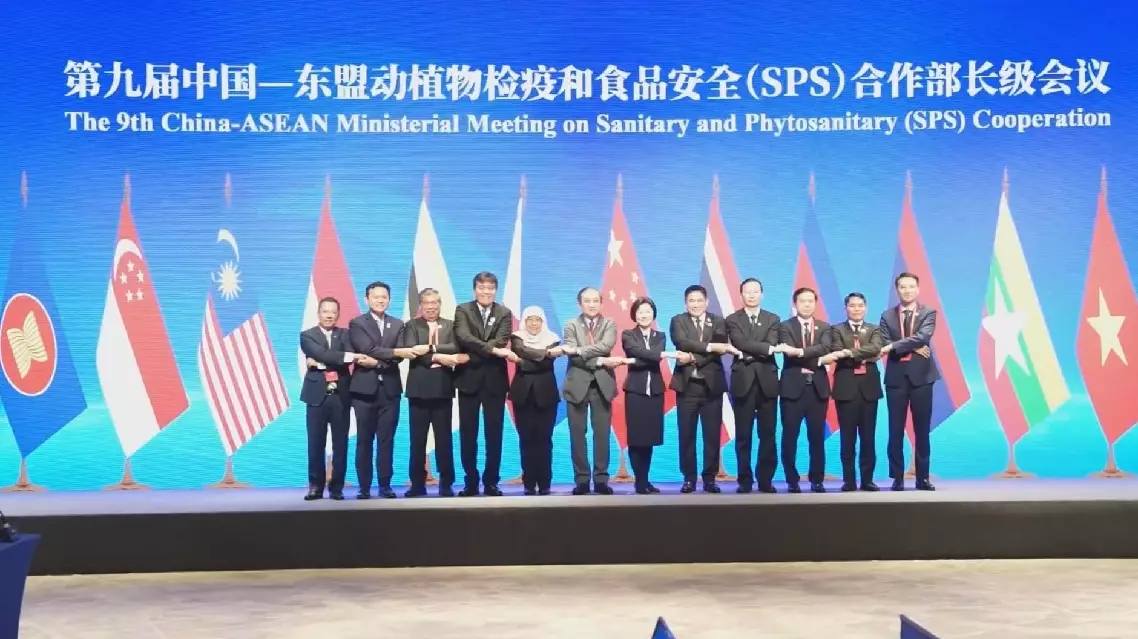
China-ASEAN agri-food trade grows 8.9 pct in first 10 months of 2025