Skip to Content Facebook Feature Image

Equestrian dressage wows spectators with grace, precision

China

China

China

Equestrian dressage wows spectators with grace, precision

2025-11-14 17:22 Last Updated At:11-15 02:27

The equestrian events at China's 15th National Games has proven to be a crowd favorite, captivating spectators with their high entertainment value based on elegant postures and precise coordination of the riders and horses.

In the dressage competition, riders and their horses must complete a series of movements within a 60-meter-long by 20-meter-wide arena within a set time. The event demands perfect coordination between the pair while showcasing a harmony of strength and beauty, earning it the name "equestrian ballet."

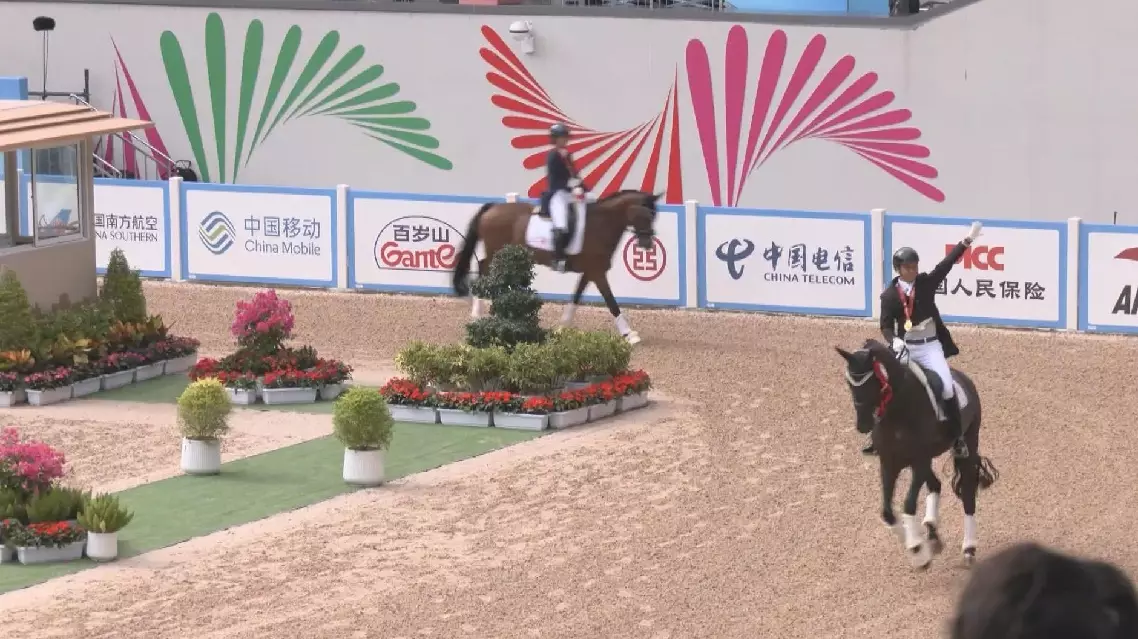
During the equestrian dressage individual final held on Wednesday in Shenzhen, south China's Guangdong Province, the horse performs intricate gait transitions, including walk, trot, canter, and piaffe under the guidance of the rider. The impressive movements repeatedly elicit enthusiastic cheers and applause from the audience.

Liu Tao from the team of northwest China's Xinjiang Uygur Autonomous Region clinched the gold medal with an impressive score of 72.425 in the competition.

For the gold medalist, his horse is like a close comrade-in-arms.

"'Harmony between rider and horse' refers to showcasing both the horse and rider in their most natural and relaxed state during a competition. It's about performing movements without coercion. We treat the horse as an equal partner instead of a tool," said Liu.

Many spectators were amazed by the exquisite coordination between the riders and their horses.

A young spectator said, "How can the horse and rider coordinate so well? I think it's like what my mom always says: 'It takes 10 years of hard practice offstage to make a perfect minute on stage.'"

"Under the guidance of equestrian athletes, the horses can follow musical rhythms and beats, creating a highly captivating and visually appealing performance," said a spectator surnamed Zhang.

Against the backdrop of social and economic development, as well as rising living standards, equestrian sports have been enjoying growing popularity across China in recent years.

"I've noticed that the level of equestrian sports in our country is gradually improving," said a spectator from Hong Kong.

"The quality of the sport, the quality of horses, the quality of riders, and the qualities of operation -- it is a major step within from the last National Games to now and I can see the drive for excellence, equine excellence and the importance of equine. The industry will grow," said Winfried Engelbrecht-Bresges, chief executive officer of the Hong Kong Jockey Club.

The National Games is taking place across Guangdong Province, the Hong Kong Special Administrative Region, and the Macao Special Administrative Region from Nov 9 to 21, marking the first time that three Chinese regions are co-hosting the country's highest-level and largest national multi-sport event.
Equestrian dressage wows spectators with grace, precision

Equestrian dressage wows spectators with grace, precision
Iran will never negotiate its missile program with the United States and will vigorously fight and prevail in any conflict initiated by the U.S., said Seyed Mohammad Marandi, a professor of English literature and orientalism at the University of Tehran.

The U.S. has been calling on Iran to curb its missile program over the past months, a demand Tehran has firmly rejected.

On Saturday, Iran's Foreign Minister Seyed Abbas Araghchi said that the country's missile program is "never negotiable."

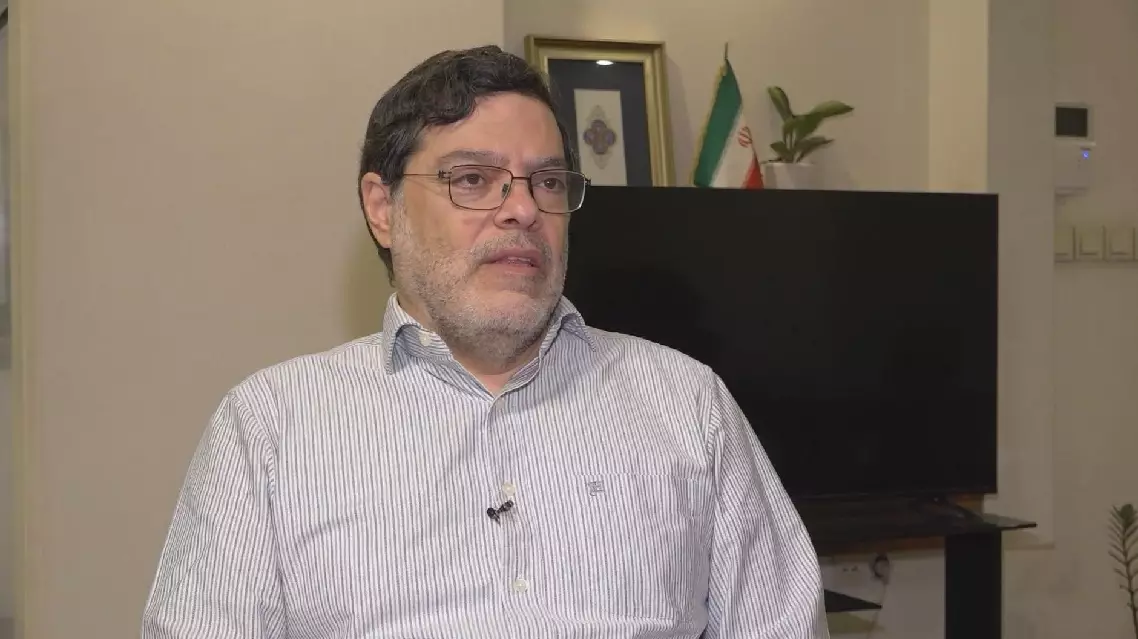
In an interview with China Global Television Network (CGTN), Prof. Marandi reiterated that negotiating the missile program is "out of the question" as Iran's military capability is a crucial defense against potential U.S. aggression.

"Negotiating the missile program is a red line. It will not happen today; it will not happen next month, and it will not happen next year. That is out of the question. The Americans would like to see such a thing happen, but it is impossible. What has protected Iran from U.S. aggression is its military capability. We have no illusions about what the United States would do if it could do it. And what prevents it from attacking us is our missile and drone capabilities, which we are going to strengthen rather than pull back on," said Marandi.

Marandi emphasized that while Iran does not seek war and has never initiated conflict with the U.S. or Israel, an attack from the U.S. would lead to a fierce fight for survival, given Iran's strong defenses in the Persian Gulf.

"What Iran has that can be used against the United States is much greater than what it has that can be used against the Israeli regime, because its defenses alongside the Persian Gulf are very enormous and diverse: short-range missiles, medium-range missiles, countless drones, submarines. Everything in the Persian Gulf and on the other side of the Persian Gulf, where the U.S. bases exist, can be easily destroyed. This is not a war that the United States can win. We don't want war, and we have never initiated a conflict, neither with the United States nor with the Israeli regime. But if the United States attacks Iran, it will be a fight for our survival, and we will pull no punches," he said.

The U.S. and Iranian delegations held indirect negotiations on Friday, marking a renewed diplomatic effort amid heightened tensions between Tehran and Washington in view of the latter's military buildup in the region.

On Saturday, commenting on the negotiations between the two countries that focused solely on Iran's nuclear issue, Araghchi said they were a good "start," but there is a long way ahead to build trust.

Iran never to negotiate missile program with US: professor

Iran never to negotiate missile program with US: professor

Recommended Articles