The southern Chinese tech hub of Shenzhen has established a seamless customs clearance system for the ongoing 15th National Games, enabling athletes to pass through border control straight to Hong Kong without a stop for the cross-border marathon on Saturday.
A total of 69 athletes from 22 provinces and regions participated in the first cross-border marathon in the history of China's National Games, with six representing Hong Kong and Macao.
Starting from the Shenzhen Bay Sports Center, runners headed to the Shenzhen Bay Port before crossing the Shenzhen Bay Bridge into Hong Kong. They experienced what's called a "zero-delay, zero-contact, zero-wait" clearance through special lanes set up for the marathon event. Non-Hong Kong runners enter with ID cards while Hong Kong-bound runners use facial recognition.
"For this marathon, we adopted a new cross-border event support model at the Shenzhen Bay Port in an innovative way, which includes pre-check, biometric identification, wristband positioning, and closed-loop management. In this pre-check area, you can see that we have established ten express lanes," said Wang Wenbin, leader of the technical support team with the Shenzhen Bay Immigration Inspection Station.
To enable real-time tracking of phone-free marathon runners, each runner is equipped with a wristband.
"This wristband uses China's BeiDou navigation chip. It sends location updates every few seconds to a back-end and database, letting us monitor each runner's path," said Wang.
While people move through quickly, the customs inspection area, equipped with security gates and baggage X-ray machines, can streamline the flow of bags and gear.
Vehicles get smart treatment too.
"When it comes to vehicles, we use 5G smart glasses linking field checks with command centers to ensure their fast and efficient customs clearance supervision," said Huang Weiqin, a customs officer with the General Office of Shenzhen Bay Customs House.
Indeed, Shenzhen and Hong Kong land ports already use extensive contactless clearance systems, handling over 600,000 crossings daily between the two cities.
"We had no prior experience hosting a cross-border event of this scale. The Shenzhen Bay Port is very busy, serving both passenger and freight transport, with a daily throughput of nearly 100,000 people," said Chen Yan, a fourth-class researcher of the Shenzhen Port Office.
The National Games, taking place across Guangdong Province, Hong Kong, and Macao from Nov 9 to 21, mark the first time that the three Chinese regions are co-hosting the country's highest-level and largest national multi-sport event.
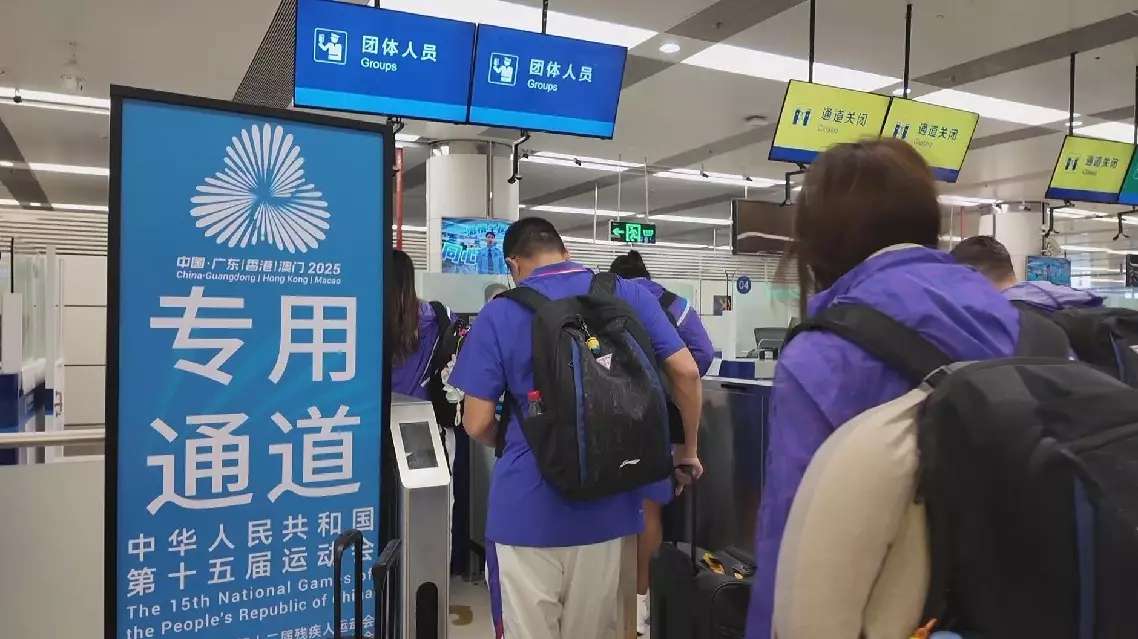
Shenzhen's smart tech enables athletes in first National Games' cross-border marathon to cross borders without stopping