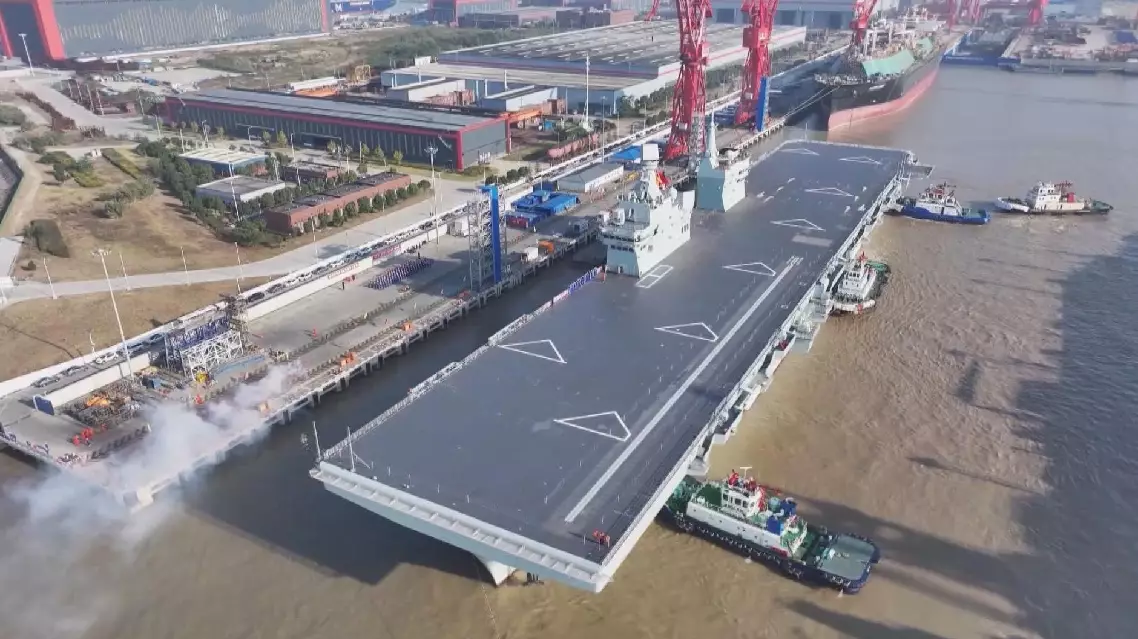
China's first Type 076 amphibious assault ship, PLANS Sichuan, is equipped with electromagnetic catapult and arrestor systems, making it a quasi-aircraft carrier, according to a military expert.
The Sichuan set sail from a military port in Shanghai on Friday morning to conduct its maiden sea trial, with a focus on testing and verifying the reliability and stability of the ship's power, electrical and other systems.
This new-generation amphibious assault ship of the Chinese People's Liberation Army (PLA) Navy has a full-load displacement of over 40,000 tons, capable of carrying fixed-wing aircraft, helicopters, amphibious equipment and other assets.
"There are many amphibious assault ships worldwide, and they carry a variety of aircraft. However, due to the limited deck length and area of amphibious assault ships, the aircraft they carry typically need to have vertical or short takeoff and landing (V/STOL) capabilities. With electromagnetic catapult and arrestor systems, however, conventional carrier-based aircraft can take off from an amphibious assault ship without any modifications. For example, China's Fujian aircraft carrier uses electromagnetic catapults to launch the J-35 stealth fighter. On the Type 076 vessel, the exact same launch and recovery capabilities can be replicated without any modifications to the J-35. This makes it a true 'quasi-aircraft carrier'," said Du Wenlong, a military commentator, in a TV program by China Central Television.
He noted that this innovation bypasses the complexity and limitations of V/STOL technology, offering a simpler, more versatile, and cost-effective solution for power projection.
"The entire technological approach is straightforward: It simply replicates the electromagnetic catapult and arrestor systems of an aircraft carrier, perfectly bypassing the highly complex V/STOL technology used by other countries. From the perspective of critical amphibious warfare equipment, this is an innovation. There are currently no such amphibious ships in the world," said Du.
When asked about whether the Sichuan will operate alongside an aircraft carrier, Du said, "In the future, different missions will call for different configurations. For large-scale operations, the new-generation amphibious ship can operate within an aircraft carrier strike group, enabling large-scale, high-intensity, long-range amphibious assaults under the protection of the carrier and with support from other escort vessels."
For low-intensity or short-range missions, Du noted, the Sichuan can form an independent task force, with itself playing the core role and supported by Type 055 and Type 052D destroyers, frigates, submarines, and replenishment ships.
Electromagnetic catapult makes China's Type 076 amphibious assault ship a quasi-aircraft carrier: expert