FREMONT, Calif.--(BUSINESS WIRE)--Nov 17, 2025--
Penguin Solutions, Inc. ("Penguin Solutions") (Nasdaq: PENG ), a leading provider of high-performance computing and AI infrastructure solutions, today announced the release of ICE ClusterWare ™ software 13.0. This latest version introduces powerful new capabilities that solve two critical challenges in production-scale AI and HPC: sustaining peak cluster performance and secure provisioning of a single cluster to diverse user groups. These new features enable organizations to maximize return on their AI infrastructure investments by safely sharing resources across more users while ensuring consistent, reliable performance.
This press release features multimedia. View the full release here: https://www.businesswire.com/news/home/20251117135297/en/
When an organization’s AI deployments progress from isolated pilot projects to enterprise-wide production environments, operational demands on infrastructure intensify immediately. Penguin’s ICE ClusterWare 13.0 addresses this with built-in anomaly detection and auto-remediation, along with network-isolated multi-tenancy—delivering the operational excellence required to support AI as a core business function.
“With the launch of our ICE ClusterWare software 13.0, we’re delivering pivotal advancements to help organizations manage the growing complexity of modern AI and HPC environments,” said Sharri Parsell, vice president software engineering for Penguin Solutions. “As AI continues to evolve from experimental pilots to enterprise-scale deployments, organizations need robust, intelligent infrastructure that drives operational excellence and enables AI success across the enterprise.”
The patent-pending anomaly detection and auto-remediation technology ensures peak cluster performance and resource availability, continuously monitoring for hidden performance degradation that traditional diagnostic tools miss. Upon detection, the system automatically isolates underperforming nodes and initiates remediation in real time, ensuring that workloads are scheduled on validated, high performing nodes. This proactive approach reduces administrative burdens, prevents unplanned downtime, and maximizes the cluster’s usable capacity. As a result, this new capability significantly shortens model training by reducing restarts and loss of work.
The new optional network-isolated multi-tenancy feature enables organizations to securely and efficiently share high-value GPU clusters, creating dedicated subclusters to support different departments, projects, or GPU-as-a-Service (GPUaaS) customers. This capability provides isolated environments, giving tenants the autonomy to select their own workload manager, govern users, and run workloads with confidence that data and operations remain segregated and secure.
"The pace and quality of biomedical research are directly tied to the technology that supports it," said Assistant Dean for Information Technology Shailesh Shenoy, Albert Einstein College of Medicine. "AI and HPC are crucial to providing the computational power that biometrics, life science, and medical research require, but we also had to ensure that it is optimized for our specific use cases. Having a trusted partner in Penguin Solutions has enabled us to not only build out this infrastructure, but also helped ensure we can manage and optimize it to keep it running smoothly and at capacity, freeing our faculty and student researchers to continue their groundbreaking work without interruption."
Reducing the security and resource utilization conflicts that previously forced organizations to build separate clusters drastically improves time to value. This capability is essential for cloud service providers and hyperscalers providing GPUaaS, enterprises and research institutes delivering AI computing to internal business groups, and federal or government agencies that require the highest level of security and resource isolation.
General availability for ICE ClusterWare software 13.0 is scheduled for December 2, 2025. To learn more about ICE ClusterWare 13.0, visit https://www.penguinsolutions.com/en-us/contact-us and register for our upcoming webinar: Navigating the AI Journey from Pilot to Production, on December 17, 2025 at 10:00 a.m. PST.
ICE ClusterWare is a trademark or registered trademark of Penguin Solutions, Inc. or its affiliates. All other trademarks are the property of their respective owners.
About Penguin Solutions
The most exciting technological advancements are also the most challenging for companies to adopt. At Penguin Solutions, we support our customers in achieving their ambitions across our computing, memory, and LED lines of business. With our expert skills, experience, and partnerships, we turn our customers’ most complex challenges into compelling opportunities.
For more information, visit https://www.penguinsolutions.com.

Penguin Solutions releases ICE ClusterWare management software 13.0 with powerful new capabilities that solve two critical challenges in production-scale AI and HPC: sustaining peak cluster performance and secure provisioning of a single cluster to diverse user groups.
LONDON (AP) — Labour’s Andy Burnham, the current mayor of Greater Manchester, has won a special election for a seat in Parliament that puts him in a position to challenge embattled Prime Minister Keir Starmer for leadership of the country.
Burnham decisively won the seat of Makerfield in northwest England over Rob Kenyon of the anti-immigration party Reform UK.
The victory announced early Friday cements the status of Burnham, a 56-year-old politician nicknamed the King of the North, as the top contender to replace Starmer as leader of the Labour Party and the country. Burnham won almost 55% of the 45,510 votes cast for a field of more than a dozen candidates, over 9,000 more than runner-up Kenyon.
Burnham’s victory speech left no doubt that he wants to lead the country, and not just be one of the more than 400 Labour lawmakers in the 650-seat House of Commons.
“Everyone knows that politics isn’t working," he said. "Everyone can feel that the country isn’t where it should be. Tonight could, just could, be the turning point.”
Starmer congratulated Burnham, writing on X that voters “chose Labour’s campaign of hope and optimism over division and hate.”
But he insisted he would fight attempts to oust him.
“Yes, I will run, I will stand,” if there is a Labour leadership contest, Starmer said. "I’ve said repeatedly I’m not going to walk away from that.”
Burnham has led Manchester since 2017, overseeing rapid regeneration for the city where the Industrial Revolution was forged. He is pledging to repeat his signature brand of “Manchesterism” on a national scale.
Burnham said he would work to ensure that “the name Makerfield is forever synonymous with bringing about the change this country needs.”
He said Labour had “a final chance to change" and win back voters' trust.
“But it is a chance now, from this result tonight, to build a new politics based on unity and hope, turning away from the path that takes us to a divided, dark politics of the kind we see in the United States,” he said.
Starmer’s popularity has cratered since he led the center-left Labour Party to a landslide election victory in July 2024.
He has struggled to deliver promised economic growth, repair tattered public services and ease the cost of living, and been hamstrung by repeated missteps, including his decision to appoint Peter Mandelson, a scandal-tarnished friend of Jeffrey Epstein, as the U.K. ambassador to the United States.
Labour is losing liberal voters to the growing Green Party, and facing a rising Reform UK, which consistently leads in nationwide opinion polls. The Nigel Farage -led party has rapidly gained ground in post-industrial northern England areas like Makerfield, some 200 miles (320 kilometers) northwest of London.
Burnham’s resounding victory gives Labour new hope of stopping the Reform tide. Farage acknowledged he was “disappointed, no question about it,” with the result of Thursday’s vote.
A dismal performance by Labour in May’s local elections spurred scores of lawmakers to demand Starmer’s resignation. He has refused to budge, but senior colleagues are trying to force a change.
Wes Streeting resigned as health secretary in May, saying that “where we need vision, we have a vacuum.” Streeting has said he will run in a leadership contest if there is one.
Then Josh Simons, the Labour lawmaker for Makerfield, stepped down to trigger a special election and give Burnham the chance to return to Parliament.
Britain’s parliamentary system allows governing parties to change leaders midterm, with the winner becoming prime minister without the need for a national election. Under Labour rules, a lawmaker can challenge the leader if they have backing from a fifth of the party’s House of Commons lawmakers — a number that stands at 81.
The victorious Burnham will head to London to be sworn in as a lawmaker as soon as Monday. He’s likely to seek a meeting with Starmer to argue that the prime minister should exit gracefully and set a timetable for his departure.
Culture Secretary Lisa Nandy said Burnham and Starmer would in the next few days have to “have a conversation about what comes next.”
Labour lawmaker Louise Haigh, a Burnham ally, said Starmer should “do what’s best for both the country and the Labour Party” and “consider an orderly and managed transition.”
“Andy won’t be doing anything rash or hasty,” she told Sky News. “I’m really hopeful the prime minister and Andy can come to an agreement.”
Starmer has so far insisted he has no intention of leaving his post, saying he was elected on a “mandate for change” and would carry on with it.
Starmer suggested that he could offer Burnham a Cabinet post, telling Sky News on Wednesday that “I want him to have a big role in government.” Allies of Burnham indicated that he wasn’t interested.
Despite his stubborn determination, Starmer could be forced out if several members of the Cabinet tell him the game is up and quit, or threaten to quit, in protest.
There could then be a leadership contest, or a coronation, depending on whether other potential candidates think Burnham has an unassailable lead.
Rob Ford, professor of political science at the University of Manchester, said “the pressure on Starmer will be very hard to resist” now that Burnham is back in Parliament.
Ford said defeating Reform UK in Makerfield strengthens Burnham’s claim to be Labour’s biggest asset.
“The narrative he can bring is, ‘No one else could have won that seat. I won that. I bring something unique. I bring an ability to renew our appeal,’” Ford said.

Labour party's Andy Burnham stands beside candidate Count Binface, left, and a candidate for Protect British Wildlife after winning the Makerfield by-election, paving the way for a leadership challenge against Prime Minister Sir Keir Starmer. in Wigan, England, Friday, June 19, 2026.(AP Photo/Jon Super)
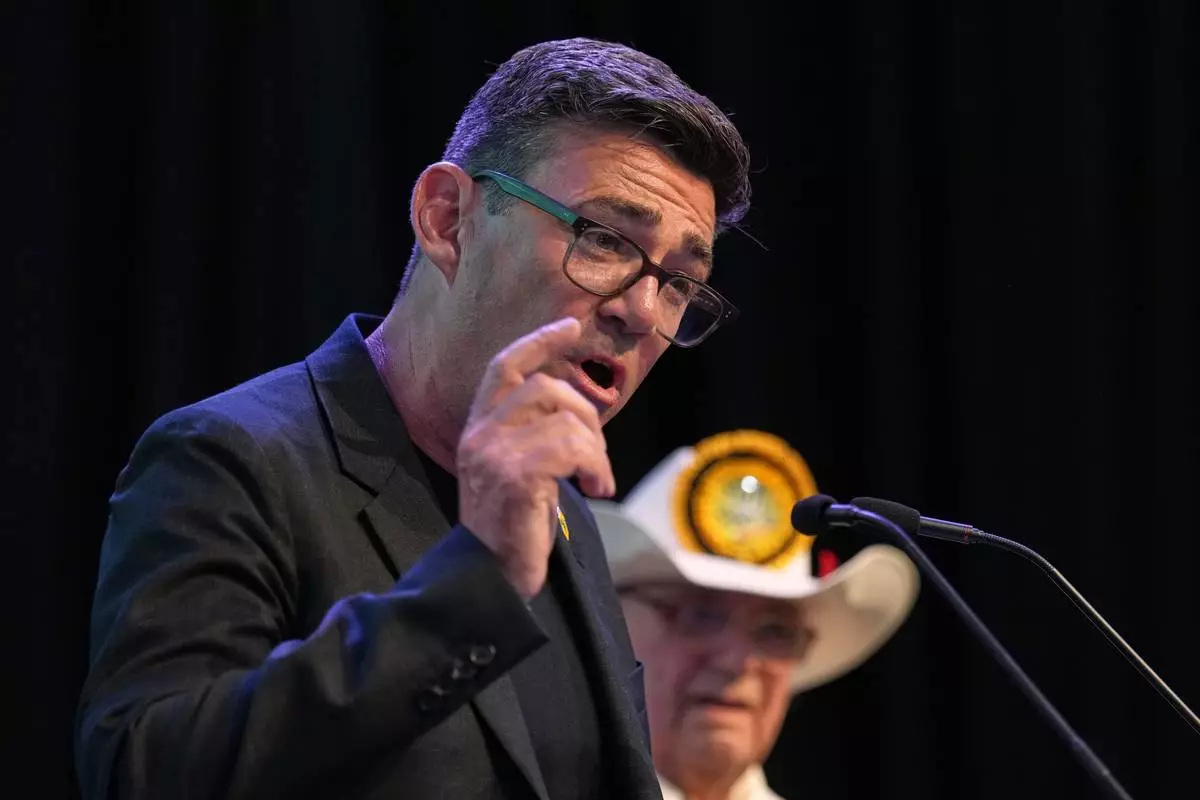
Labour party's Andy Burnham speaks after winning the Makerfield by-election, paving the way for a leadership challenge against Prime Minister Sir Keir Starmer. in Wigan, England, Friday, June 19, 2026.(AP Photo/Jon Super)

Britain's Labour party's Andy Burnham leaves with his wife Marie-France Van Heel and their daughter Rosie after winning the Makerfield by-election, paving the way for a leadership challenge against Prime Minister Sir Keir Starmer. in Wigan, England, Friday, June 19, 2026.(AP Photo/Jon Super)

Vote counts started after the Makerfield by-election in Wigan, England, Friday, June 19, 2026.(AP Photo/Jon Super)

Labour party's Andy Burnham speaks after winning the Makerfield by-election, paving the way for a leadership challenge against Prime Minister Sir Keir Starmer. in Wigan, England, Friday, June 19, 2026.(AP Photo/Jon Super)
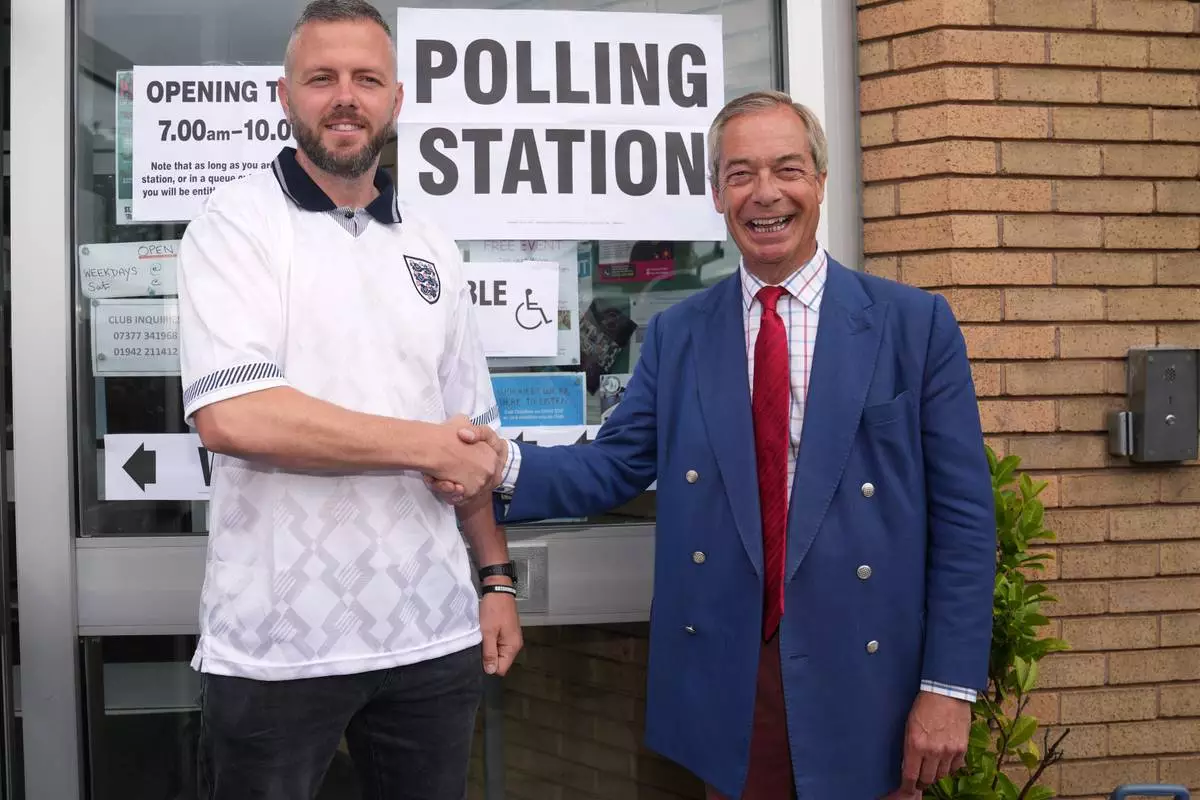
Britain's Reform Party leader Nigel Farage and local candidate Rob Kenyon ashake hands at a polling station during the by-election in Makerfield, England, Thursday, June 18, 2026.(AP Photo/Jon Super)

Andy Burnham, Britain's Labour candidate for Makerfield, gestures in front of supporters during the by-election in Makerfield, England, Thursday, June 18, 2026 where voters are choosing a new lawmaker with Andy Burnham of the Labour Party as the leading contender.(AP Photo/Jon Super)

Labour party candidate Andy Burnham arrives at the Edge Wigan for the Makerfield by-election result announcement in Wigan, England, Friday, June 19, 2026.(AP Photo/Jon Super)