IRVINGTON, N.Y.--(BUSINESS WIRE)--Nov 17, 2025--
X-Caliber Capital Holdings LLC, (X-Caliber), a national, direct commercial real estate lender focused on impact lending, today announced the closing of a $285MM Rural PACE-X financing for the ground-up construction and redevelopment of a national resort in Missouri.
This press release features multimedia. View the full release here: https://www.businesswire.com/news/home/20251115291200/en/
The Oasis at Lakeport, a national family resort and entertainment district in Osage Beach, Missouri, has a total project cost of $495 million. It features a Marriott hotel with 402 rooms, a conference center, indoor waterpark, amusement park, and various amenities, aiming to become a premier Midwest tourist destination.
The combined $285MM Rural PACE-X financing consists of $220MM of conventional senior-secured debt through an affiliate of X-Caliber Rural Capital, XRL-ALC, LLC, and $65MM of Commercial Property Assessed Clean Energy (C-PACE) financing through CastleGreen Finance. This is X-Caliber’s largest Rural PACE-X transaction closed to date since the product launched in late 2024. In addition, the C-PACE financing is the largest to date for the state of Missouri and for CastleGreen Finance.
Rural PACE-X is a propriety and innovative financing solution that provides high-leverage financing for ground-up construction projects in micro-rural areas.
“The Lakeport at Oasis project marks a transformational moment for Missouri and its communities,” said X-Caliber President and CEO, Chris Callahan. “Rural PACE-X proved to be the ideal product to help bring it to life. The innovative financing structure helped make it possible to deliver a premier family resort; one that will drive economic growth, create jobs, and attract new tourism to the region and state for decades to come.”
The loan was originated and structured by the X-Caliber Advisors team comprised of Gregg Delany, Ken Lorman, and Gabe Mashaal on behalf of Tegethoff Development Company.
“This transformational project brings so many benefits to the local economy including well-paying jobs, tax revenues, and vibrant cultural entertainment,” said Jeff Tegethoff, Founder and CEO of Tegethoff Development. “Regarding the financing, I want to thank X-Caliber Advisors who initiated the transaction, created an innovative structure quite superior to our initial plan, and worked with us every step of the way through complications associated with a development this large. CastleGreen Finance, in addition to the other lending verticals at X-Caliber, seamlessly executed an attractive, non-recourse, fixed-rate solution, which met all of our capital stack needs."
The buildings’ energy efficiency design is estimated to save around $11MM in costs over the lifetime of the improvements.
“This financing provides a highly effective solution that exemplifies the power of hybrid funding, seamlessly executing both efficient short- and long-term capital strategies,” said Sal Tarsia, Managing Partner, CastleGreen Finance. “By integrating state-of-the-art energy efficiency upgrades, it delivers sustainable, future-ready performance for this exciting hotel resort project. We are proud to have combined our multiple lending pillars to offer a full-service solution and be a part of bringing the Oasis at Lakeport to life.”
The Oasis at Lakeport is expected to create over 1500 construction jobs and over 500 full-time jobs. The resort is also expected to draw 600,000 visitors a year.
“Rural PACE-X leverages X-Caliber’s innovative offerings and strong partnerships to bring tailored solutions to the specific needs of rural areas,” said Jordan Blanchard, Co-Founder, X-Caliber Rural Capital. “We are focused on providing capital solutions that foster meaningful economic growth and lasting positive impact in rural communities.”
This collaborative effort underscores the potential for innovative developments to transform local economies and enhance community experiences.
The amusement park and attractions are slated to open in the spring of 2026 while the Marriott hotel and indoor waterpark are projected to open in late 2027.
For more details and full Rural PACE-X product parameters and information, click here.
About X-Caliber Capital Holdings LLC (“X-Caliber”)–www.x-caliber.com
X-Caliber Capital Holdings is a nationally recognized commercial real estate finance franchise whose affiliate companies provide direct mortgage lending, servicing, advisory, and investment opportunities. Our diverse and growing lending and investment entities support and leverage our expansive and innovative lending platforms that offer FHA, bridge, USDA, and C-PACE financing.
About CastleGreen Finance –www.CastleGreenfinance.com
CastleGreen Finance is an affiliate of X-Caliber Capital Holdings and embraces the collaboration of commercial real estate construction along with a green energy and carbon emission reduction strategy by providing property owners with the financing tools needed to create and redevelop clean, sustainable, energy-efficient real estate through a superior capital stack.
About X-Caliber Rural Capital –www.xrcusda.com
X-Caliber Rural Capital is an affiliate of X-Caliber Holdings, a national real estate lending and investment firm. X-Caliber Rural Capital is a national, licensed and approved U.S. Department of Agriculture lender that provides financing for rural business and economic development projects under four flagship programs that fall under the OneRD Guaranteed Loan Initiative. The Company is dedicated to creating attractive solutions for its borrowers that meet the needs of rural communities throughout the country.
About X-Caliber Advisors
X-Caliber Advisors sources financing and provides transaction advice to institutional owners and developers nationally. The group optimizes capital stacks for ground-ups, renovations, and permanent financing for all major property types.

Oasis at Lakeport resort rendering courtesy of Tegethoff Development and TRI Architects.
NASA's launch team has loaded more than 700,000 gallons of fuel into the 32-story Space Launch System rocket, setting the stage for the Artemis II mission crew members to board.
The mission is NASA’s planned lunar fly-around by four astronauts that will be the first moon trip in 53 years.
The Space Launch System rocket is poised to blast off Wednesday evening with a two-hour launch window beginning at 6:24 p.m. EDT at Kennedy Space Center in Florida.
Artemis astronauts Reid Wiseman, Victor Glover, Christina Koch and Jeremy Hansen will be on board. They’ll hurtle several thousand miles beyond the moon, hang a U-turn and then come straight back. No circling around the moon, no stopping for a moonwalk — just a quick out-and-back lasting less than 10 days. NASA promises more boot prints in the gray lunar dust, but not before a couple practice missions.
Unlike the Apollo missions that sent astronauts to the moonfrom 1968 through 1972, Artemis’ debut crew includes a woman, a person of color and a Canadian citizen.
Artemis II is the opening shot of NASA’s grand plans for a permanent moon base. The space program is aiming for a moon landing near the lunar south pole in 2028.
The Latest:
Wiseman, Glover, Koch and Hansen have left the Neil Armstrong Operations and Checkout Building and are on their way to launch pad 39B.
Waving to family, colleagues and news photographers, the crew boarded the so-called astrovan for the 9-mile ride to the launch pad and their awaiting SLS rocket.
Before their highly anticipated walkout, commander Reid Wiseman and his crew played a quick card game with NASA’s chief astronaut Scott Tingle. It’s a preflight tradition since the space shuttle era.
Losing is good: It means the astronaut has gotten rid of all bad luck before launching.
The four thanked the suit techs and posed for photos, keeping a safe distance from many of the bystanders to avoid germs. They then went down the elevator at the Neil Armstrong Operations & Checkout Building and walk out to a barrage of cameras and cheers.
They’ll take a custom-designed astrovan for the ride to the launch pad
House Speaker Mike Johnson posted on the social media site X ahead of the planned Artemis II launch.
“Praying for the safety and success of the Artemis II crew and @NASA as they undertake a mission that will carry humanity farther into space than we have gone in over half a century. I had the privilege of hosting these courageous pioneers at the State of the Union earlier this year. Americans are watching proudly as our Golden Age reaches new heights!” Johnson wrote.
Wiseman, 50, a retired Navy captain from Baltimore, was serving as NASA’s chief astronaut when asked three years ago to lead humanity’s first lunar trip since 1972.
His wife Carroll’s death from cancer in 2020 gave him pause.
His two teenage daughters, especially the older one, had “zero interest” in him launching again after a 2014 trip to the International Space Station.
“We talked about it and I said, ’Look, of all the people on planet Earth right now, there are four people that are in a position to go fly around the moon,” he said. “I cannot say no to that opportunity.”
The next day, homemade moon cupcakes awaited him, along with his daughters’ support.
Artemis is the twin sister of Apollo in Greek mythology. They are the children of Zeus and Leto. Artemis has long been associated with the moon.
While the Artemis name builds on the Apollo program and pays homage to it, “there is no way we could be that same mission or ever hope to even be,” said NASA astronaut Christina Koch, part of the Artemis II crew.
The Apollo program was all about beating the Russians to the moon and planting the U.S. flag. NASA sent 24 astronauts to the moon between 1968 and 1972, including 12 moonwalkers. Now China is the competition.
NASA is striving for a long-term lunar presence under Artemis, with Mars to follow.
The Artemis II astronauts are now in their orange Orion spacesuits that they will wear for launch and reentry. Testing these new suits is one of the main goals of the mission.
The four are expected to emerge for their trip to the pad sometime before 2pm.
NASA created bright orange custom spacesuits for launch and reentry. Astronauts will also use them in case of a depressurization or some other emergency.
They can survive up to six days in the suits, inserting a straw into the helmet to sip water or protein shakes and relying on undergarment bags and bladders as a built-in toilet.
Future Artemis crews to the lunar surface will wear white moonwalking suits designed by Axiom Space.
During the Apollo era, astronauts wore the same white bulky spacesuits for launch and return as well as for moonwalks because there wasn’t enough storage on board for different outfits.
“We should have done Artemis 50 years ago,” said John Tribe, a propulsion engineer during the Apollo era.
The launch team has loaded more than 700,000 gallons of fuel into the 32-story Space Launch System rocket, setting the stage for the Artemis II crew to board.
The wind is picking up at Cape Canaveral, more clouds are appearing and rain is expected in about two hours. But there is no lightning threat, NASA says, and there’s still an 80% chance the weather will be good enough to launch.
L-minus tracks the overall time to liftoff, counting down the days, hours and minutes away before the planned blastoff. It doesn’t include built-in holds, or pauses — that’s T-minus time.
The T-minus countdown in the final 10 minutes is where nerves tense up and hearts start pounding. Automated software kicks off a series of highly choreographed milestones. During this period, the clock can be stopped if a problem is spotted and restarted if it’s fixed in time.
T-0 is the moment of liftoff — zero — when the boosters ignite and the rocket begins its journey.
NASA has a narrow time frame each month to fly to the moon.
The Earth and moon must be aligned just so to achieve the proper trajectory for the mission. In any given month, there’s only about a week when Artemis II astronauts can lift off.
The Orion capsule needs to get a check of its life-support and other systems in near-Earth orbit. If that goes well, Orion will fire its main engine to hurtle toward the moon, taking advantage of the moon and Earth’s gravity to get there and back in a slingshot maneuver that requires little if any fuel.
Orion also needs sunlight for power and can’t be in darkness for more than 90 minutes at a time. Plus NASA wants to minimize heating during reentry at flight’s end.
The latest launch window runs through April 6. The next opportunity opens on April 30.
The hydrogen tank of the rocket’s core stage is 100% filled. NASA said no significant leaks have been observed so far in fueling. It was hydrogen leaks that prevented the rocket from flying in February.
The alarm clocks just went off in Kennedy Space Center’s crew quarters.
That means it’s rise and shine for the three Americans and one Canadian who are about to become the first lunar visitors in more than 53 years.
They have a long day ahead of them, whether they launch or not.
After breakfast, they’ll start suiting up. NASA’s launch window opens at 6:24 p.m. and lasts a full two hours.
Launch director Charlie Blackwell-Thompson is wearing green as are many of the controllers alongside her in the firing room.
Green represents “go” for NASA, a color symbolizing good luck.
The team is monitoring the fueling of the 322-foot moon rocket, set to blast off Wednesday evening.
A plush toy named Rise will ride with the Artemis II astronauts around the moon, carrying the names of more than 5.6 million people.
Rise is what’s known as a zero gravity indicator, which gives the astronauts a visual cue of when they reach space.
The design was inspired by the iconic “Earthrise” photo during Apollo 8, showing the planet as a shadowed blue marble from space in 1968.
Rise was selected from more than 2,600 contest submissions. It was designed by Lucas Ye of California.
Commander Reid Wiseman and his crew tucked a small memory card into Rise before the toy was loaded into the Orion capsule. The card bears the names of all those who signed up with NASA to vicariously tag along on the nearly 10-day journey.
“Zipping that little pocket on the bottom of Rise was kind of the moment that put it all together for me,” Wiseman said. “We are going for all and by all. It’s time to fly.”
NASA is fueling the new rocket that will send four astronauts to the moon.
Launch teams have begun pumping more than 700,000 gallons (2.6 million liters) of liquid hydrogen and liquid oxygen into the Space Launch System rocket at Kennedy Space Center in Florida.
It’s the latest milestone in the two-day countdown that kicked off on Monday when launch controllers reported to duty.
It will take at least four hours to fully load the rocket before astronauts climb aboard for humanity’s first flight to the moon since Apollo 17 in 1972.
The two-hour launch window opens at 6:24 p.m. EDT.
▶ Read more about Apollo vs. Artemis
The Americans who blazed the trail to the moon more than half a century ago were white men chosen for their military test pilot experience.
The Artemis II crew includes a woman, a person of color and a Canadian, products of a more diversified astronaut corps.
▶ Read more about Christina Koch, Victor Glover, Jeremy Hansen and Reid Wiseman
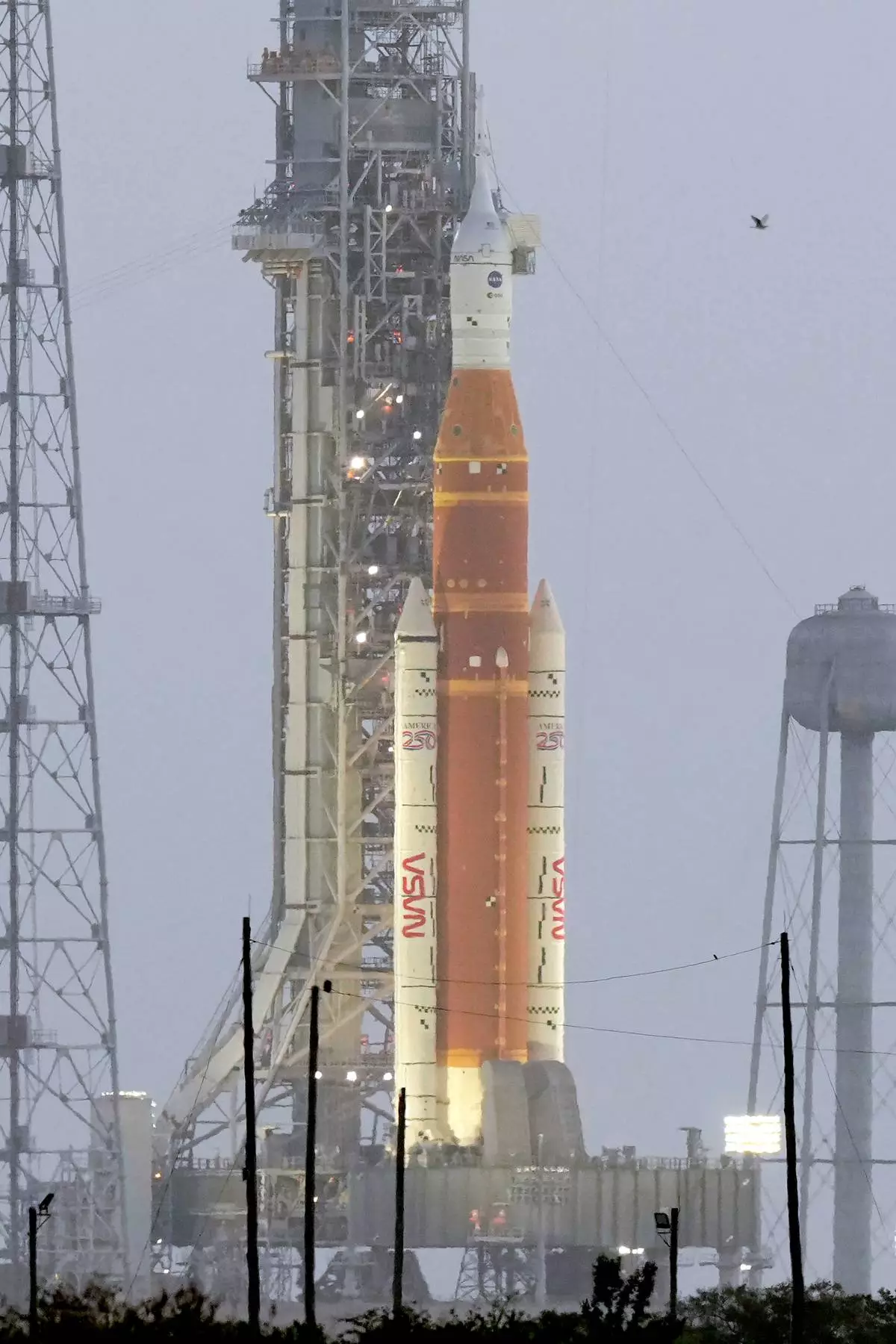
NASA's Artermis II moon rocket sits on Launch Pad 39-B at the Kennedy Space Center hours ahead of planned liftoff Wednesday, April 1, 2026, in Cape Canaveral, Fla. (AP Photo/Chris O'Meara)
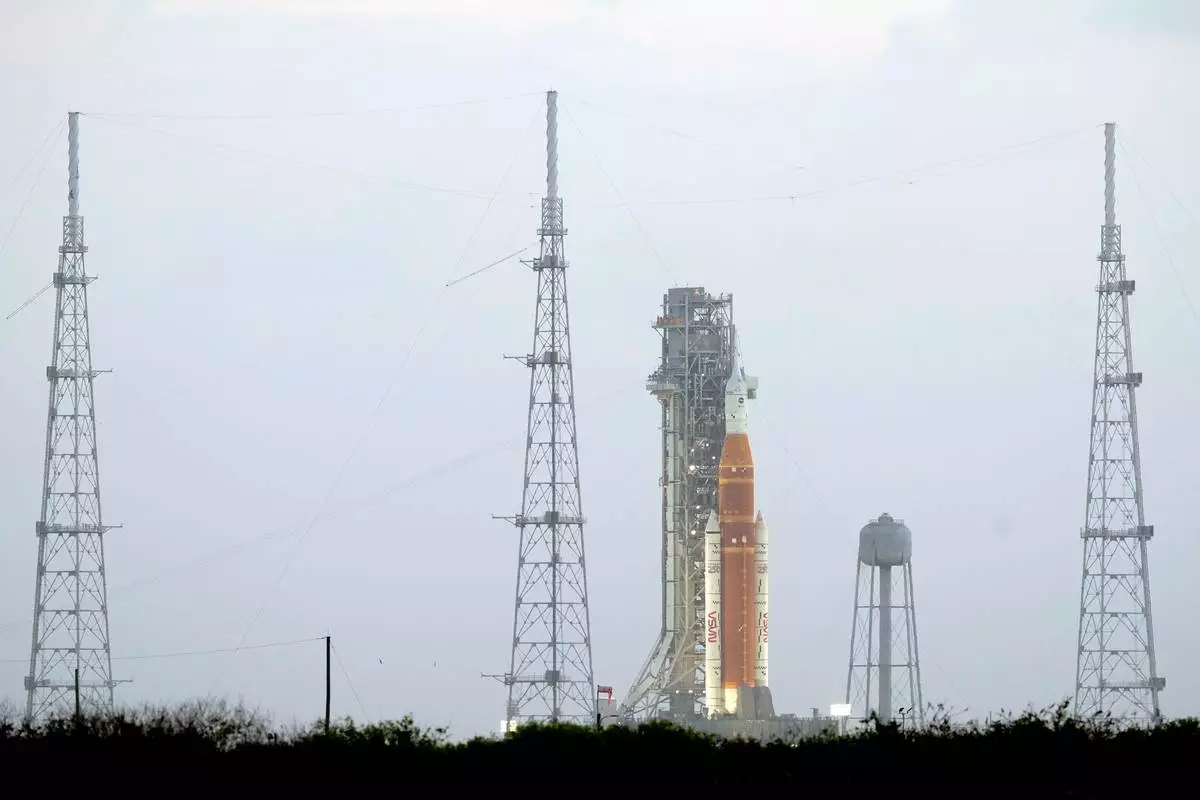
NASA's Artermis II moon rocket sits on Launch Pad 39-B at the Kennedy Space Center hours ahead of a planned launch attempt Wednesday, April 1, 2026, in Cape Canaveral, Fla. (AP Photo/Chris O'Meara)
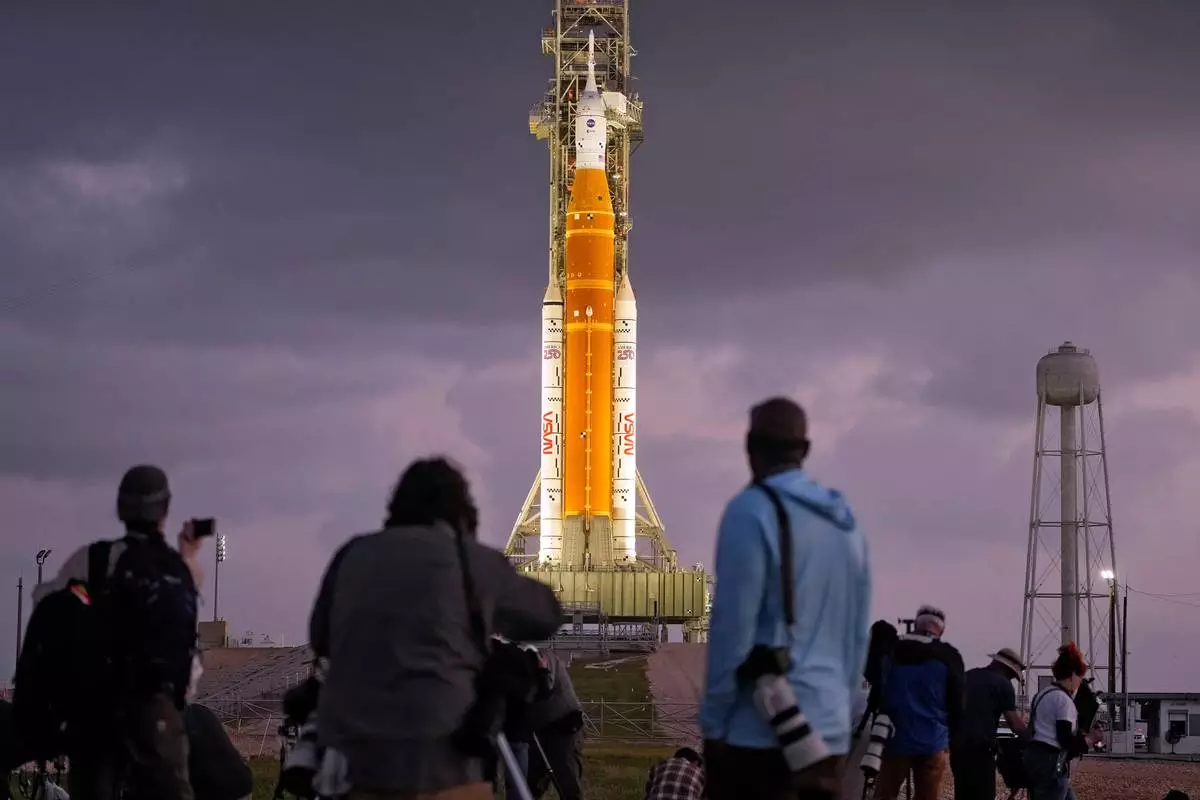
Photographers set up remote cameras near NASA's Artermis II moon rocket on Launch Pad 39-B just before sunrise at the Kennedy Space Center Tuesday, March 31, 2026, in Cape Canaveral, Fla. (AP Photo/Chris O'Meara)