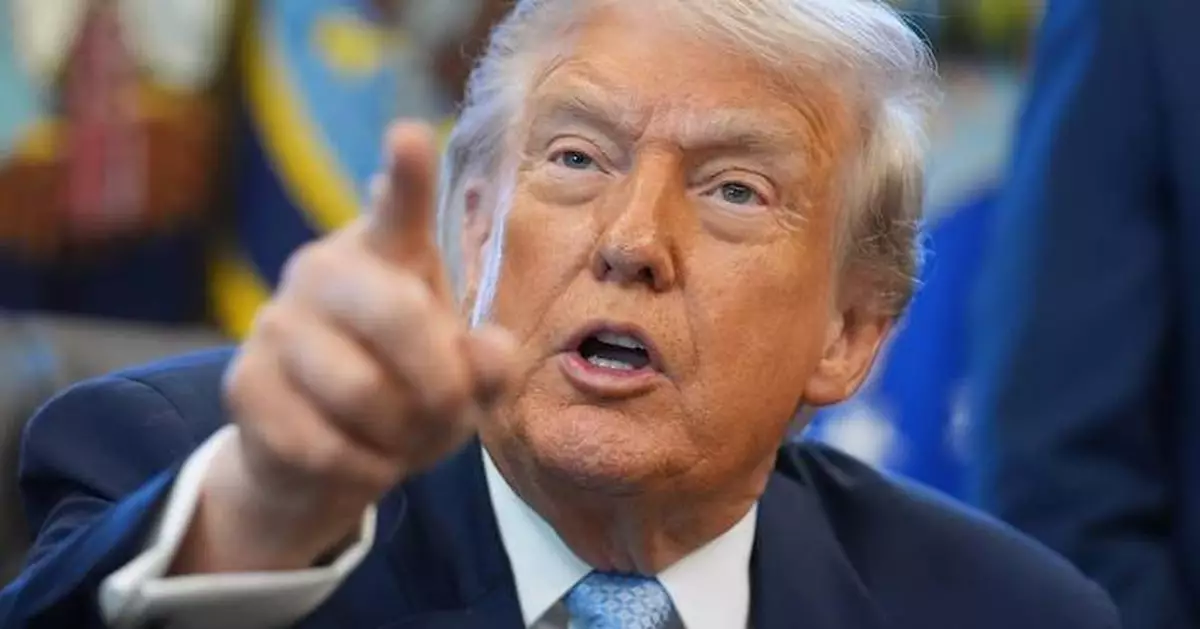
WASHINGTON (AP) — President Donald Trump said Monday he will sell F-35 fighter jets to Saudi Arabia despite some concern within the administration that such a sale could lead to China gaining access to the U.S. technology behind the advanced weapon system.
The announcement came on the eve of Saudi Crown Prince Mohammed bin Salman’s highly anticipated Washington visit, his first to the United States in more than seven years.
“I will say that that we will be doing that,” Trump said when asked if he would sell the jets to Saudi Arabia. “We’ll be selling F-35s.”
The sale of the fighter jets is one of several major deals between the two countries expected to be announced during the visit.
Saudi Arabia is expected to announce a multibillion-dollar investment in U.S. artificial intelligence infrastructure, and the two countries are will lay out details about new cooperation in the civil nuclear energy sector, according to a senior Trump administration official who was not authorized to comment publicly ahead of the formal announcement.
The crown prince had been expected to arrive with a wish list that includes receiving formal assurances from Trump defining the scope of the U.S. military protection for the kingdom and an agreement to buy U.S.-made F-35 fighter jets, one of the world’s most advanced aircraft.
The Republican administration, however, has been wary about upsetting Israel’s qualitative military edge over its neighbors, especially at a time when Trump is depending on Israeli support for the success of his Gaza peace plan.
Another long-standing concern, which also derailed a potential similar sale to the United Arab Emirates, is that the F-35 technology could be stolen by or somehow transferred to China, which has close ties to both the UAE and Saudi Arabia, according to three administration officials who spoke on the condition of anonymity to discuss internal deliberations on the matter.
The Saudis and China last month held joint naval exercises hosted by the kingdom. And Beijing in 2023 helped mediate an agreement between the Saudi Arabia and Iran to reopen their embassies and exchange ambassadors amid ongoing tensions.
China surpassed the U.S. last year as Saudi Arabia's top trade partner, but the United States has remained Riyadh's favored nation for arms sales.
Bradley Bowman, senior director of the Center on Military and Political Power at the Foundation for Defense of Democracies, said Congress could press the administration to detail what assurances Riyadh has given the White House about its relationship with China.
He added that the White House is likely to also face questions about plans to ensure Israel maintains its qualitative military edge.
The announcement by Trump comes at a moment in which he's trying to persuade Saudi Arabia and Israel to normalize relations.
He has talked up his push to extend his first-term Abraham Accords — the project that formalized commercial and diplomatic ties between Israel and a trio of Arab nations — as key to his plan for bringing long-term stability to the Middle East as the fragile ceasefire between Israel and Hamas in Gaza continues to hold.
“I hope that Saudi Arabia will be going into the Abraham Accords very shortly,” Trump told reporters aboard Air Force One on Friday as he made his way to Florida for the weekend.
Yet Trump’s optimism that a U.S.-brokered deal could come soon is tempered by more sober internal assessments.
The Saudis have made clear that a guaranteed path to a Palestinian state remains a condition for the kingdom signing onto the accords — something Israel vehemently opposes.
The U.N. Security Council on Monday approved a U.S. plan for Gaza that authorizes an international stabilization force to provide security in the devastated territory and envisions a possible future path to an independent Palestinian state.
Still, Saudi Arabia is unlikely to sign on to the accords anytime soon, but there is cautious optimism that an agreement can be sealed by the end of Trump’s second term, the officials said.
“Let’s hope that President Trump makes clear that the first F-35 will not be delivered until Saudi Arabia normalizes relations with Israel,” Bowman said. “Otherwise, the president will undercut his own leverage.”
The Trump administration formally notified Congress in November 2020 that it planned to sell 50 stealth F-35 fighter jets to the United Arab Emirates as part of a broader arms deal worth $23 billion aimed at deterring potential threats from Iran, despite concerns raised by Israel.
The UAE announcement came shortly after Trump lost the 2020 election to Democratic Joe Biden and followed the signing of the Abraham Accords between and the UAE.
But Biden, soon after taking office in January 2021, put a hold on that sale.
Trump's move is likely to receive scrutiny from human rights activists as Prince Mohammed’s trip marks his first visit to Washington since 2018.
On that visit, the crown prince went on a three-week U.S. tour aimed at improving the perception of his nation in the eyes of Americans concerned by the kingdom’s conservative social mores, its unequal treatment of women and the ignominious fact that 15 of 19 hijackers that took part in the Sept. 11, 2001, attacks on the United States were Saudi citizens.
The Saudis’ reputation was further eroded months after Prince Mohammed’s last Washington visit with the killing and dismemberment of Washington Post columnist Jamal Khashoggi in the Saudi consulate in Turkey, an operation targeting a critic of the kingdom that U.S. intelligence agencies later determined Prince Mohammed likely directed. The crown prince has denied he was involved.
But seven years later, the dark clouds in the U.S.-Saudi relationship have been cleared away by Trump, who has tightened his embrace of the 40-year-old crown prince he views as an indispensable player in shaping the Middle East in the decades to come.
“They have been a great ally,” Trump said.
—-
AP Diplomatic writer Matthew Lee contributed reporting.
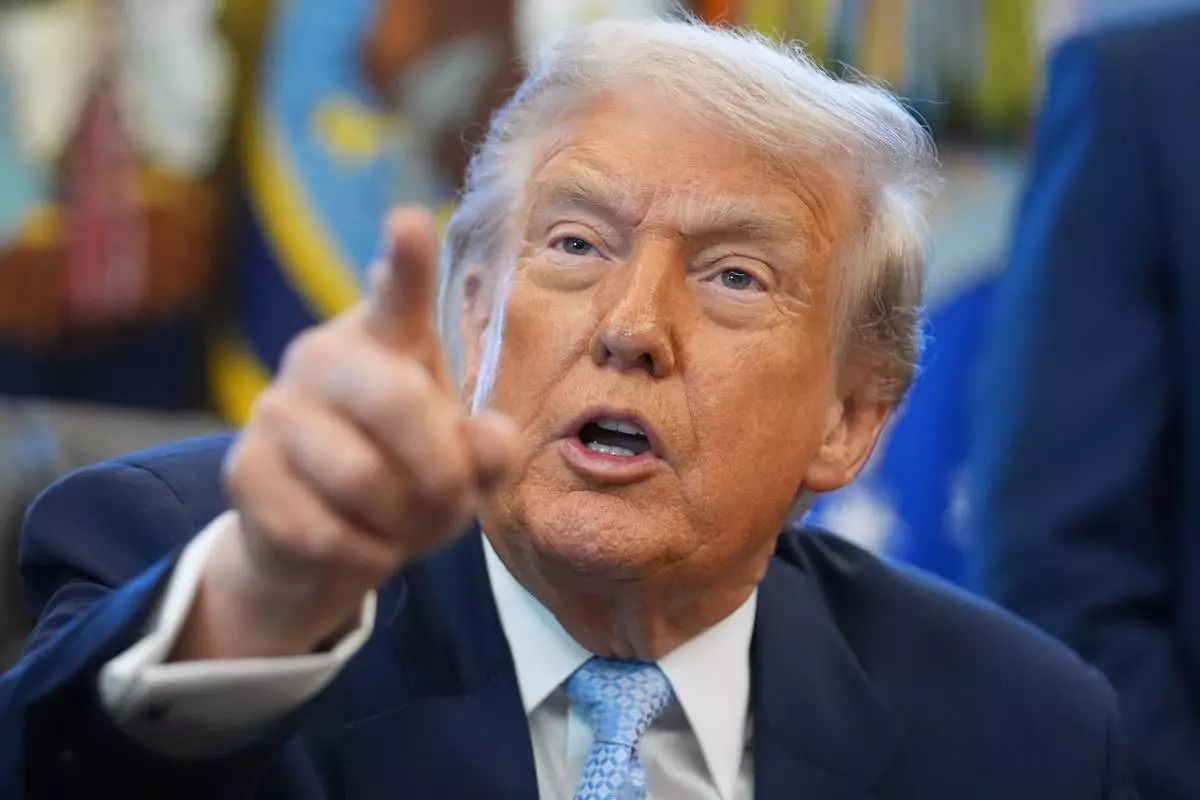
President Donald Trump answers questions from reporters during a meeting with the White House task force on the 2026 FIFA World Cup in the Oval Office of the White House, Monday, Nov. 17, 2025, in Washington. (AP Photo/Evan Vucci)

SURIN, Thailand (AP) — Cambodia’s powerful Senate President Hun Sen on Tuesday vowed that his country would carry out a fierce fight against Thailand as a second day of widespread renewed combat between the Southeast Asian neighbors drove tens of thousands of people to flee border areas.
Fighting broke out following a skirmish in which one Thai soldier was killed Sunday night, despite a ceasefire that ended fighting in July over competing territorial claims. The five days of fighting then left dozens dead on both sides, and forced the evacuation of over 100,000 civilians.
In a sign that neither side was willing to back down, Thai Prime Minister Anutin Charnvirakul said Tuesday that Cambodia had not yet contacted Thailand about possible negotiations and the fighting would continue.
“We’ve got to do what we’ve got to do,” he said. “The government will support all kinds of military operations as planned earlier.” He had said Monday that military action was necessary to safeguard the nation’s sovereignty and ensure public safety.
In a statement posted to Facebook and Telegram, Hun Sen claimed that his country had refrained from retaliating on Monday, but overnight began to fire back at Thai forces, saying Cambodia would "weaken and destroy enemy forces through counterattacks.”
Thailand’s military said Cambodia attacked Thai positions with artillery and rocket and drone attacks on Tuesday. Thailand says that Cambodian forces also fired at its troops Sunday and Monday, but each side blames the other for firing the first shots.
“Cambodia wants peace, but Cambodia is forced to fight back to defend its territory,” Hun Sen wrote. He was Cambodia’s long-serving prime minister until 2023, when he was succeeded by his son Hun Manet, but is still widely seen as the country’s de facto leader.
Cambodia’s military announced Tuesday that the new fighting had killed seven civilians and wounded 20. A Thai military spokesperson announced Tuesday that three soldiers have been killed in the new fighting.
Thailand on Monday carried out airstrikes along the frontier, which it said were a defensive action targeting military installations. Thai military spokesperson Rear Adm. Surasant Kongsiri said Tuesday that such operations would continue “until attacks stop.”
Ordinary citizens meanwhile had to deal with life after being relocated from the danger zones.
An evacuation shelter at a university in Thailand's northeastern city of Surin is hosting more than 3,600 people. Evacuees sit or lie on thin mats spread across the floor, and several have set up small tents in their allotted areas as sleeping spaces.
At lunchtime, some line up with their own plates to receive cooked rice, while others wait in place to be served ready-to-eat meals packed in small plastic bags. An army band plays for their entertainment.
Portable fans cool them during the day. Blankets, in piles beside them, keep them warm at night, when temperatures can fall to as low as 18 C (64 F).
“We were preparing to evacuate. We hadn’t left yet. But when we heard shots we hurried out immediately," cassava farmer Pan-ngam Kanchangthong told The Associated Press. "I was scared. Who wouldn’t be scared of shelling?”
The Thai army said almost 500 temporary shelters have been set up in four border provinces, accommodating 125,838 people. Additional refugees from the fighting are expected to stay with relatives in safe areas.
Evacuees on the Cambodian side had similar experiences.
“I felt terrified when I heard the sound of the explosion from the shelling. At that time, I was working at the garment factory," said 44-year-old Vach Neang, a father of seven.
“I called my wife and my kids but couldn't reach them, and by that time the sound of explosions was getting louder, so the factory owner let us go home," said Vach Neang, speaking at a former market in Cambodia’s northwestern province of Banteay Meanchey that has been repurposed as a shelter, He added that he packed just a few clothes before leaving his home.
Cambodian Information Minister Neth Pheaktra said almost 55,000 people have been evacuated and the numbers are mounting.
Thailand and Cambodia have a history of enmity over centuries and experience periodic tensions along their land border of more than 800 kilometers (500 miles). Centuries ago both were powerful empires, but Thailand's size and greater development over the past century give it the military advantage.
Some of the disputed territory hosts centuries-old temples that both nations covet as part of their legacy.
The ceasefire that ended July’s fighting was brokered by Malaysia and pushed through by pressure from U.S. President Donald Trump, who threatened to withhold trade privileges from the two nations unless they agreed to it.
A more detailed agreement signed in October called for removing heavy weapons from the border; desisting from disseminating false information and harmful rhetoric; implementing measures to restore mutual trust; and coordinating operations to remove land mines.
None of these actions appear to have been fully implemented by either side. After the ceasefire, both nations continued to fight a bitter propaganda war using disinformation, alongside minor outbreaks of cross-border violence.
A major Cambodian complaint has been that Thailand continues to hold 18 prisoners who were taken captive the same day the ceasefire went into effect. Thailand claims they approached its positions in a threatening manner, an allegation denied by Phnom Penh.
Meanwhile, Thailand accuses Cambodia of laying new land mines in the areas under dispute, in several cases maiming Thai soldiers. Cambodia says the mines are left over from decades of civil war that ended in 1999.
The mines issue caused Thailand to declare earlier this month that it was indefinitely pausing implementation of the details of the ceasefire until Cambodia apologized for the latest incident wounding Thai soldiers.
Sopheng Cheang reported from Mongkol Borey, Cambodia.
Thai people, who fled clashes between Thai and Cambodian soldiers, takes shelter in Buriram province, Thailand. Tuesday, Dec. 9, 2025. (AP Photo/Wason Wanichakorn)
A Thai Buddhist monk uses his computer while taking shelter in Buriram province, Thailand, Tuesday, Dec. 9, 2025, after he fled clashes between Thai and Cambodian soldiers. (AP Photo/Wason Wanichakorn)
Thai residents, who fled clashes between Thai and Cambodian soldiers, takes shelter in Buriram province, Thailand, Tuesday, Dec. 9, 2025. (AP Photo/Wason Wanichakorn)
In this photo released by Agence Kampuchea Press (AKP), Cambodian villagers sit on tractors as they flee from the home in Preah Vihear province, Cambodia, Monday, Dec. 8, 2025. (AKP via AP)
A Thai resident who fled clashes between Thai and Cambodian soldiers, uses mobile phone while taking shelter in Buriram province, Thailand, Tuesday, Dec. 9, 2025. (AP Photo/Wason Wanichakorn)