Skip to Content Facebook Feature Image

US has warned others to avoid loans from Chinese state banks. But it's the biggest recipient of all

News

US has warned others to avoid loans from Chinese state banks. But it's the biggest recipient of all
News

News

US has warned others to avoid loans from Chinese state banks. But it's the biggest recipient of all

2025-11-18 14:01 Last Updated At:14:53

WASHINGTON (AP) — For years, Washington has been warning others not to trust loans from Chinese state banks fueling its rise as a superpower. But a new report reveals an ironic twist: The United States is the biggest recipient of all — by far. And the security and technology implications have yet to be fully understood.

China’s state lenders have funneled $200 billion into U.S. businesses for a quarter of a century, but many of the loans have been kept secret because the money was first routed through shell companies in the Cayman Islands, Bermuda, Delaware and elsewhere that helped obscure their origins, according to AidData, a research lab at the College of William & Mary in Virginia.

More alarming, much of the lending was to help Chinese companies buy stakes in U.S. businesses, many tied to critical technology and national security, including a robotics maker, a semiconductor company and a biotech firm.

The report found a far more widespread and sophisticated lending network than previously thought — a web of financial obligations extending beyond developing countries to rich ones, including the U.K., Germany, Australia, the Netherlands and other U.S. allies.

“China was playing chess while the rest of us were playing checkers,” said former White House investment adviser William Henagan, who worries the hidden lending has given China a chokehold on technologies. “Wars will be won or lost based on whether you can control products critical to running an economy."

While the U.S. still welcomes most foreign investment — and President Donald Trump has courted it — money from China has drawn particular scrutiny as the world's two biggest economies with opposing ideologies battle for global supremacy.

Deals financed by China’s state-owned banks, the ones studied in the AidData report, are especially problematic. The lenders are controlled by China's central government and the Communist Party's Central Financial Commission, and they are directed to advance China’s strategic goals.

In total, the AidData report found China lent more than $2 trillion from 2000 through 2023 around the world, double the highest previous estimates and a surprise to even longtime analysts of China's rise. And much of the lending to wealthy countries was focused on critical minerals and high-tech assets — rare earths and semiconductors needed for fighter jets, submarines, radar systems, precision-guided missiles and telecom networks.

“The U.S., under both (former President Joe) Biden and Trump, have been beating this drum for more than a decade that Beijing is a predatory lender,” said Brad Parks, executive director of AidData. “The irony is very rich.”

Until now, a full accounting of China's state lending has never been published because much of the financing is buried beneath layers of secrecy, masked by Western-sounding shell companies and mislabeled by international databases as ordinary private financing.

“There is a complete lack of transparency that speaks to the lengths to which China goes, whether through shell companies or confidentiality agreements or redactions, to make it extremely difficult to come up with this full picture,” said Scott Nathan, the former head of the U.S. International Development Finance Corp., an agency set up in the first Trump term to invest in foreign projects deemed in the U.S. national interest.

Since the report’s last documented loan in 2023, U.S. scrutiny has gotten better. Screening mechanisms, such as the interagency Committee on Foreign Investment in the U.S., got beefed up in 2020 to protect sensitive sectors in the economy.

But China has gotten better, too, in part by setting up banks and branches overseas — more than 100 in recent years — that then lend to offshore entities, further clouding the origins of the money.

“In places where there are more cops on the beat," Parks said, “it has found ways to work around barriers to entry.”

Chinese state bank financing has touched projects across the U.S., particularly in the Northeast, the Great Lakes region, the West Coast and along the Gulf of Mexico, which Trump has renamed the Gulf of America. Many loans targeted critical high-tech industries, according to the report.

— In 2015, for instance, Chinese state-owned banks lent $1.2 billion to a private Chinese business to buy an 80% stake in Ironshore, a U.S. insurer whose clients included the Central Intelligence Agency and Federal Bureau of Investigation officials and undercover agents who might need help paying legal bills in case they got into trouble in their jobs.

U.S. regulators were unaware of the Chinese government involvement because the financing was funneled through a Cayman Island business with no obvious ties to China, according to the report. U.S. officials later realized the Chinese government could access information and ordered the Chinese buyer to divest.

— That same year, the Chinese government published “Made in China 2025," a list of 10 high-tech areas, such as semiconductors, biotechnology and robotics, where it wanted to reach 70% self-sufficiency within a decade. The next year, in 2016, the Export–Import Bank of China, a policy bank, provided $150 million in loans to help a Chinese company buy a robotics equipment company in Michigan.

After China’s adoption of the manufacturing master plan, the percentage of projects targeting sensitive sectors such as robotics, defense, quantum computing and biotechnology rose from 46% to 88% of China’s portfolio for cross-border acquisition lending, according to AidData.

— In 2017, a Delaware private equity firm using a Cayman Islands company tried to buy a U.S. chip maker; the deal was blocked when investigators discovered both companies were owned by a Chinese state-owned enterprise. That same Delaware company successfully bought a U.K. semiconductor maker that had to be divested when British authorities found out.

— And in 2022, the U.K. forced a Chinese company to divest another sensitive British firm in the industry, a designer of chips in Apple phones but potentially adaptable for military systems. The Chinese company had bought it through a company in the Netherlands that they owned. That Dutch firm is now accused of withholding semiconductors vital to automakers in the U.S.-China trade war.

To trace China's hidden lending, AidData dug through regulatory filings, private contracts and stock exchange disclosures in more than 200 countries written in multiple languages.

The effort to track China's state loans and investment started more than a decade ago when Beijing launched its Belt & Road Initiative to build infrastructure in developing countries. The project expanded sharply three years ago when the AidData team, which eventually grew to 140 researchers, realized many of the loans were landing in advanced economies such as the U.S., Australia, the Netherlands and Portugal, where acquisitions could allow it to access technology that Beijing considers essential to its global rise.

The report says the findings show a shift in the use of state credit from promoting economic development and social welfare to gaining geo-economic advantages.

“There’s global concern that this is part of a concerted effort to gain control over economic chokepoints and use this leverage,” said Brad Setser, an adviser to the U.S. Trade Representative in the Biden administration. “It’s important that we understand what they’re doing, and they don’t make it easy.”

Condon reported from New York.
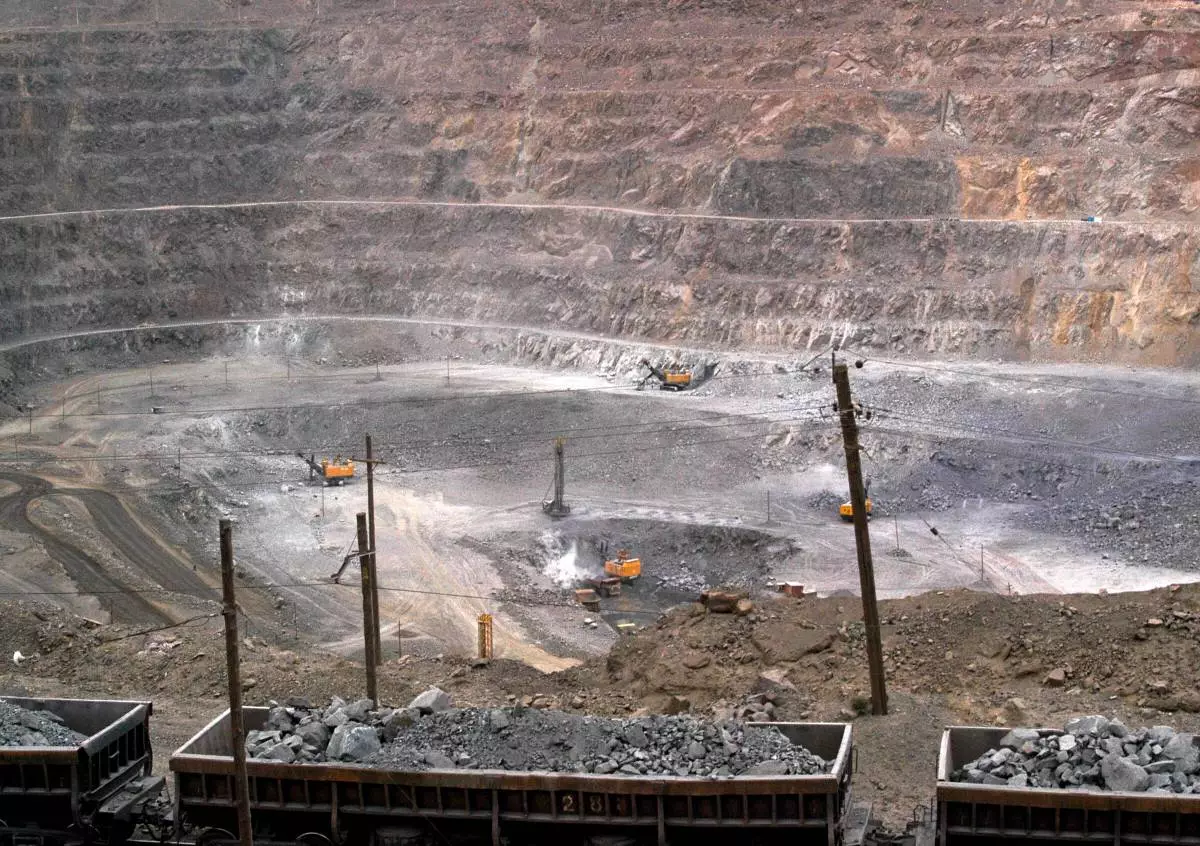
FILE - In this July 6, 2010 file photo, workers use machinery to dig at a rare earth mine in Baiyunebo mining district of Baotou in north China's Inner Mongolia Autonomous Region. (AP Photo, File)
FILE - In this July 6, 2010 file photo, workers use machinery to dig at a rare earth mine in Baiyunebo mining district of Baotou in north China's Inner Mongolia Autonomous Region. (AP Photo, File)
WASHINGTON (AP) — Chaotic weather, from surprising heat in California to damaging winds around Washington, D.C., put over half the U.S. population in the path of extreme conditions Monday.

Storms across the nation's eastern half forced airlines to cancel more than 3,000 flights nationwide Monday, and many schools closed early in the mid-Atlantic states, where high winds and tornadoes were in the forecast for the evening.

Blizzards buried parts of Michigan, Wisconsin and Minnesota while torrential rains flooded homes and washed out roads in Hawaii.

In Washington, the House of Representatives postponed votes because of difficulty traveling with inclement weather, and federal agencies told workers to go home early.

Airport delays and cancellations piled up Monday in some of the nation’s largest airports — including those in New York, Chicago and Atlanta.

The private weather service AccuWeather calculated that more than 200 million people were under threat Monday of some kind of dangerous weather.

Those range from extreme heat and wildfire advisories to flood and freeze watches from the National Weather Service.

The storm system that dropped snow by the foot in the Midwest is barreling toward the East Coast with dangerously high winds and potential for “producing strong and long track tornadoes,” the weather service warned Monday.

“Wind is the primary threat, but within any of these areas of strong wind there could be some embedded tornadoes and even the potential for a tornado to develop ahead of the line,” said Evan Bentley, a meteorologist with the weather service.

The biggest threat stretched from Maryland to the upper edge of South Carolina.

North Carolina Gov. Josh Stein urged residents to enable emergency alerts on their phones ahead of expected gusts topping 70 mph (112 kph).

Blizzard conditions continued in the Upper Midwest and Great Lakes on Monday after the storm walloped parts of Wisconsin and Michigan with several feet of snow.

Since Saturday, nearly 3 feet (61 centimeters) had fallen in the northern Wisconsin town of Mountain.

Another round of snow and gusts on Monday could bring another foot of snow across Michigan's Upper Peninsula.

A heat dome over the Southwest will push temperatures well into the triple digits in Arizona most of the week, much earlier than the region usually sees.

Much of California is starting to feel like summer too. The San Francisco Bay Area and Sacramento will see temperatures pushing toward 90 F (32 C) by midweek.

“This is a heat wave that we have not seen before in recorded history in the Southwest,” said AccuWeather meteorologist Dan DePodwin.

Phoenix is expected to have five straight days of triple digit temperatures this week — only once before, in 1988, has the city recorded a 100 F (37.8 C) day in March, DePodwin said.

Dry and windy conditions were charging the largest wildfire in Nebraska’s history. Fires in the state have consumed more than 937 square miles (2,428 square kilometers) of mostly grassland.

Unrelenting rains triggered landslides, washed away roads and flooded homes and farmland in Hawaii over the weekend.

All of Hawaii’s islands had spots with more than 15 inches (38 centimeters) of rain while parts of Maui were overwhelmed with double that amount, the weather service said.

While the worst of the storm has passed, more heavy rain is forecast for later this week. Maui Mayor Richard Bissen said there were no reports of injuries or deaths and crews were assessing damage.

Forecasters said the East Coast storms were expected leave sharply colder weather in its wake.

The storm will stick around parts of the Northeast until Tuesday morning. By then, wind chills below freezing were expected to reach the Gulf Coast and the Florida Panhandle with warnings in effect across the Southeast and in part of Arkansas, Oklahoma, Louisiana, and Texas, forecasters warned.

To the north, rain was expected to change over to snow behind the cold front with heavy snow possible in the central Appalachians of West Virginia.

__

Brumfield reported from Cockeysville, Maryland, and Seewer from Toledo, Ohio. Associated Press writers Jennifer Kelleher in Honolulu; Margery Beck in Omaha, Nebraska; Julie Walker in New York; Jeff Martin in Atlanta; and Gary Fields in Washington contributed.

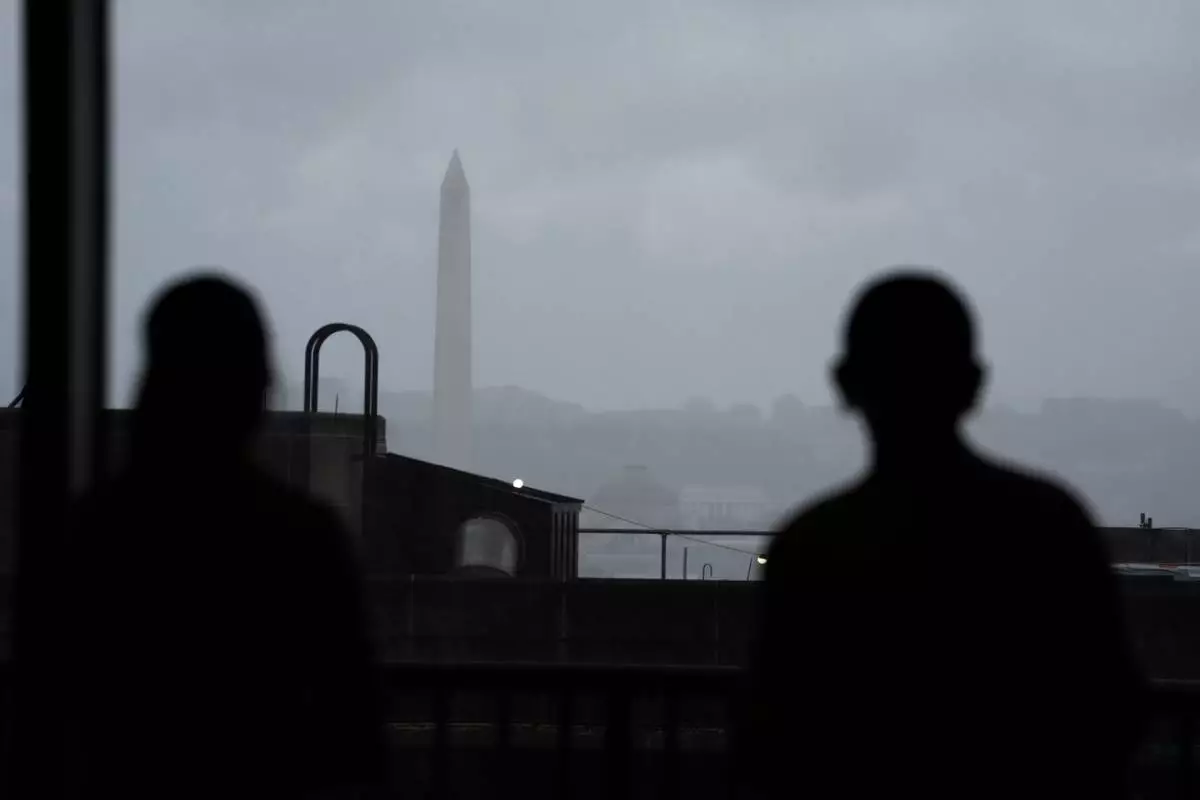
People watch as storms roll over the U.S. Capitol Monday, March 16, 2026, in Washington. (AP Photo/Allison Robbert)

People watch as storms roll over the U.S. Capitol Monday, March 16, 2026, in Washington. (AP Photo/Allison Robbert)

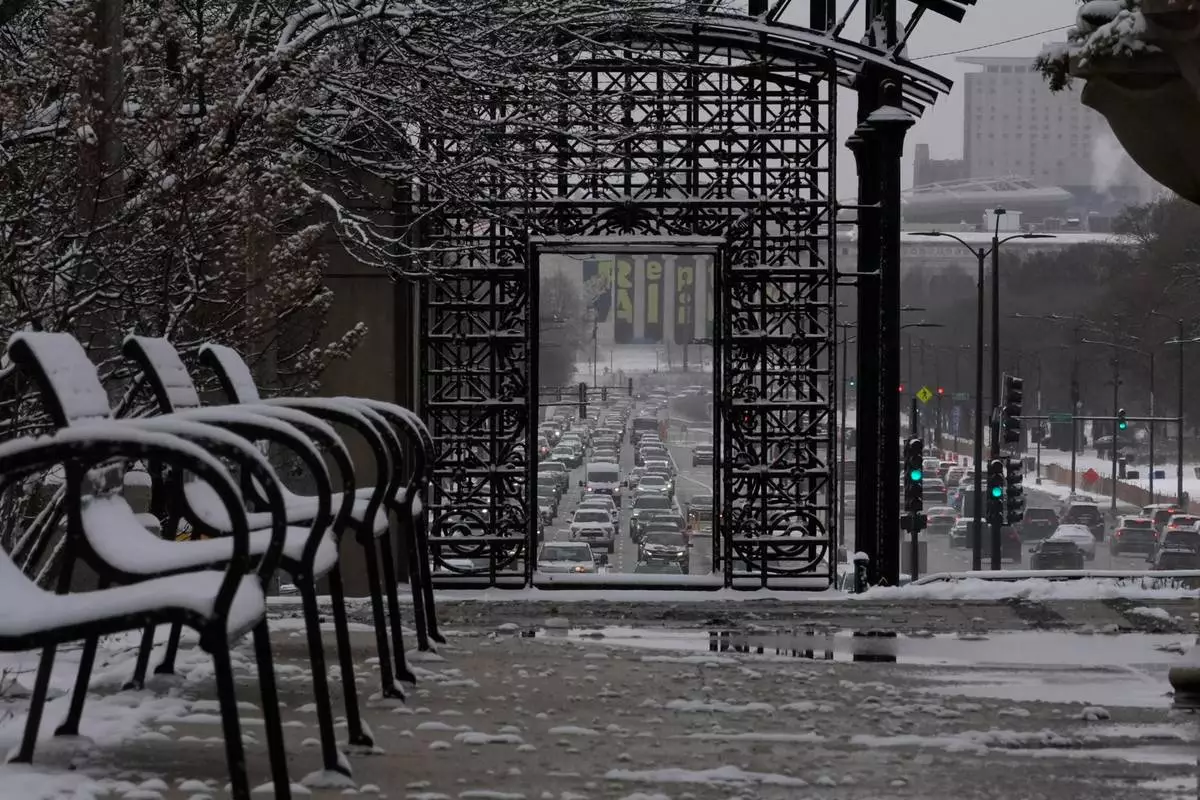
Morning traffic is seen on Lake Shore Drive, after the overnight snow, Monday, March 16, 2026, in downtown Chicago. (AP Photo/Kiichiro Sato)

Morning traffic is seen on Lake Shore Drive, after the overnight snow, Monday, March 16, 2026, in downtown Chicago. (AP Photo/Kiichiro Sato)

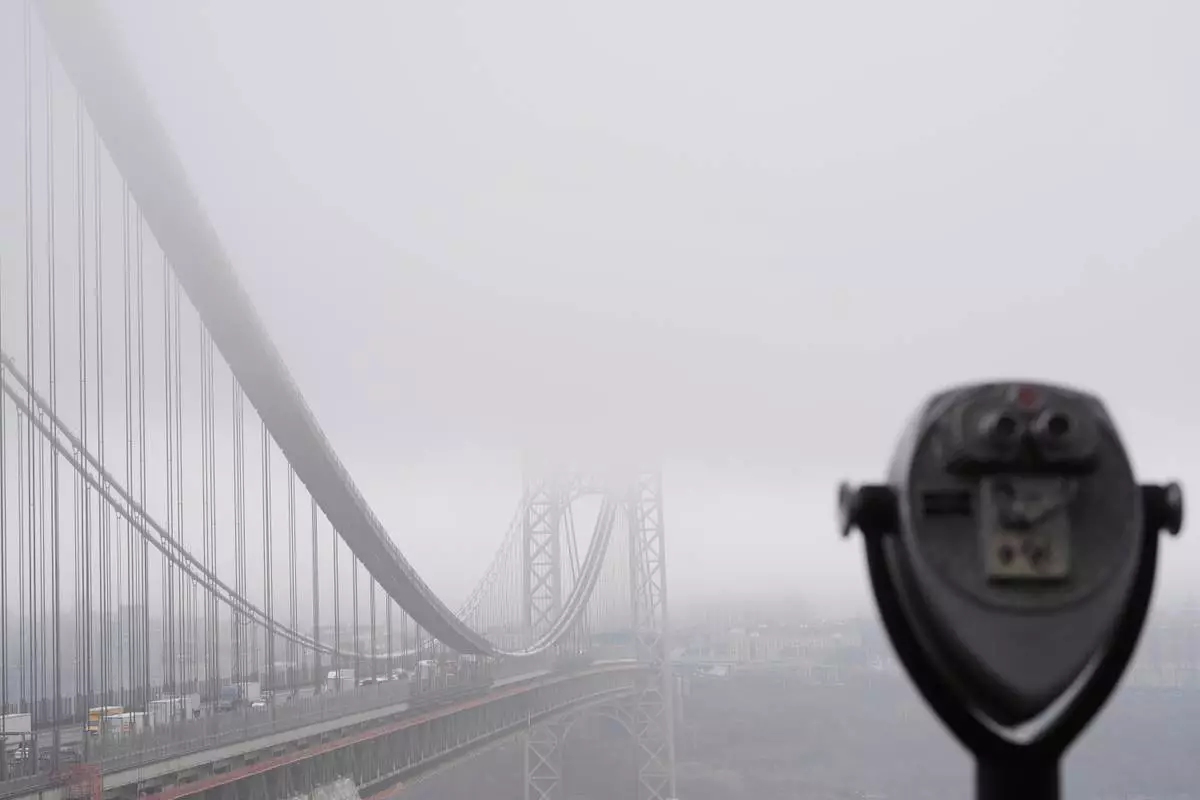
Dense fog and low clouds cover parts of the George Washington Bridge as seen from Fort Lee, N.J., Monday, March 16, 2026. (AP Photo/Seth Wenig)

Dense fog and low clouds cover parts of the George Washington Bridge as seen from Fort Lee, N.J., Monday, March 16, 2026. (AP Photo/Seth Wenig)

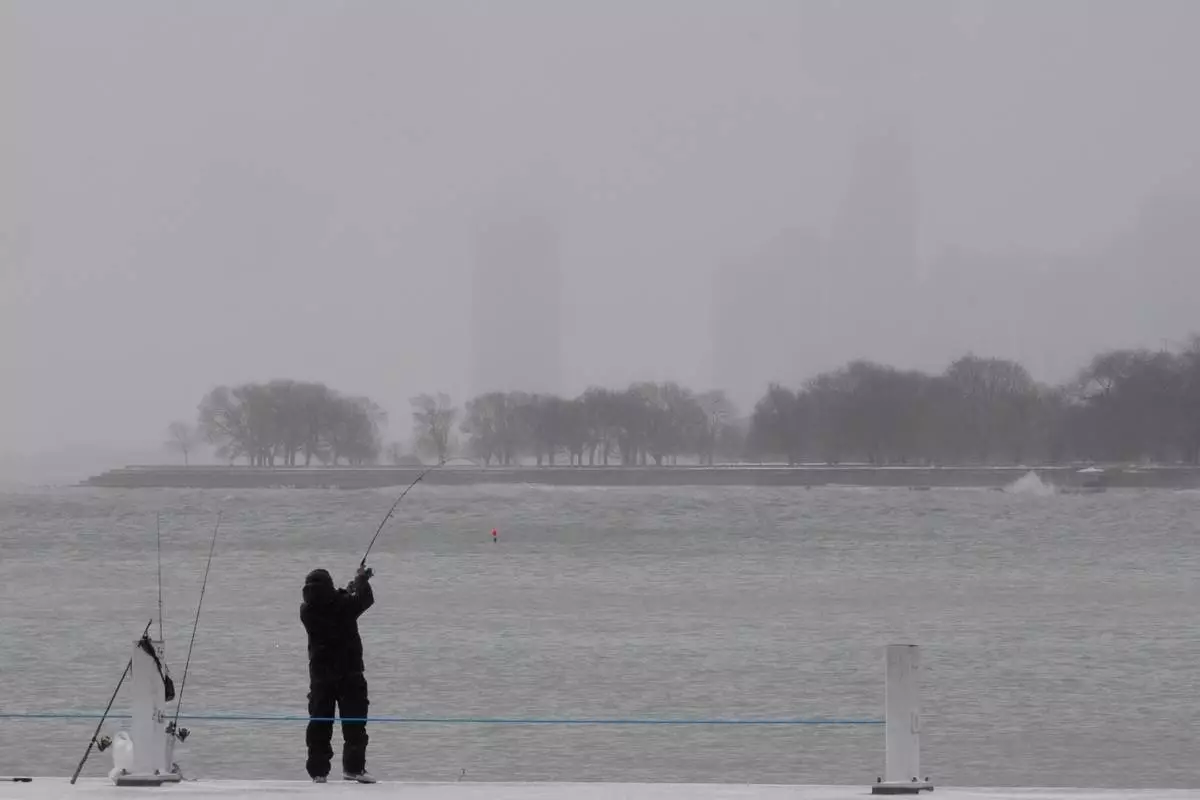
A person bundles up and fishes on a breakwater by Montrose Harbor, Monday morning, March 16, 2026, in downtown Chicago. (AP Photo/Kiichiro Sato)

A person bundles up and fishes on a breakwater by Montrose Harbor, Monday morning, March 16, 2026, in downtown Chicago. (AP Photo/Kiichiro Sato)

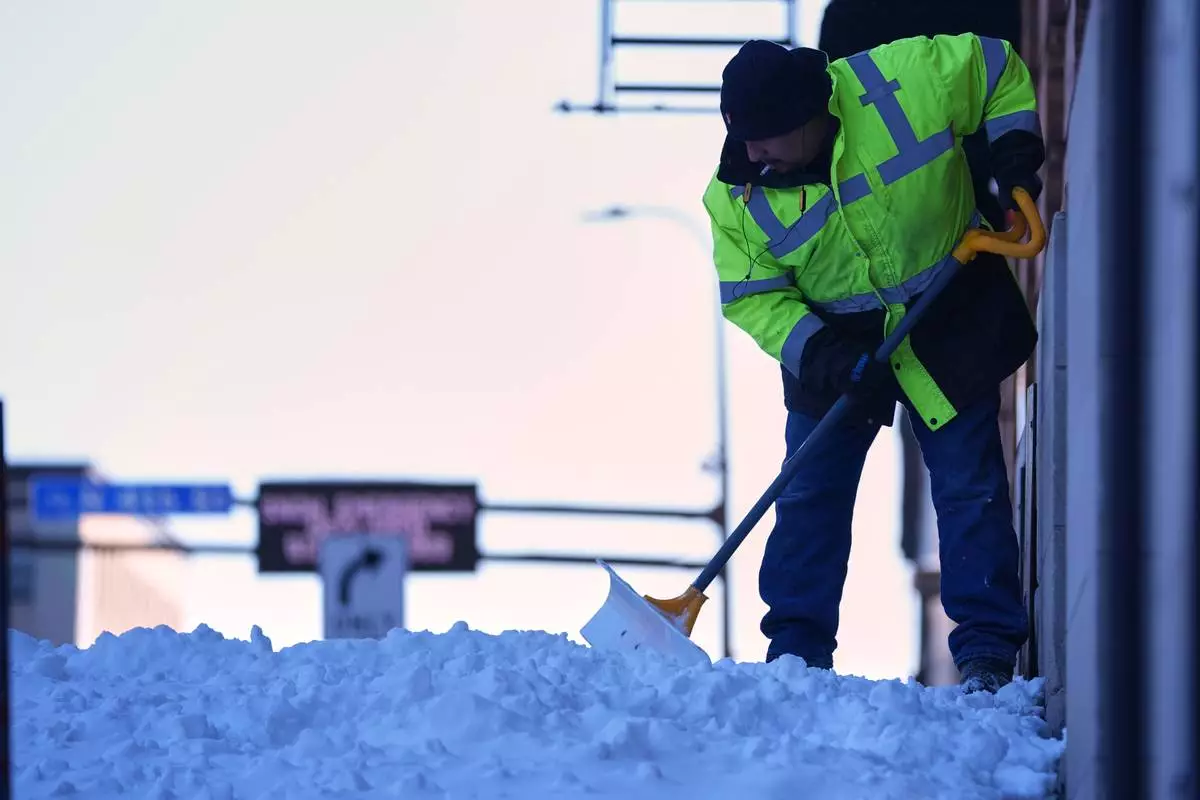
A man shovels snow after a snowstorm Monday, March 16, 2026, in Minneapolis. (AP Photo/Abbie Parr)

A man shovels snow after a snowstorm Monday, March 16, 2026, in Minneapolis. (AP Photo/Abbie Parr)

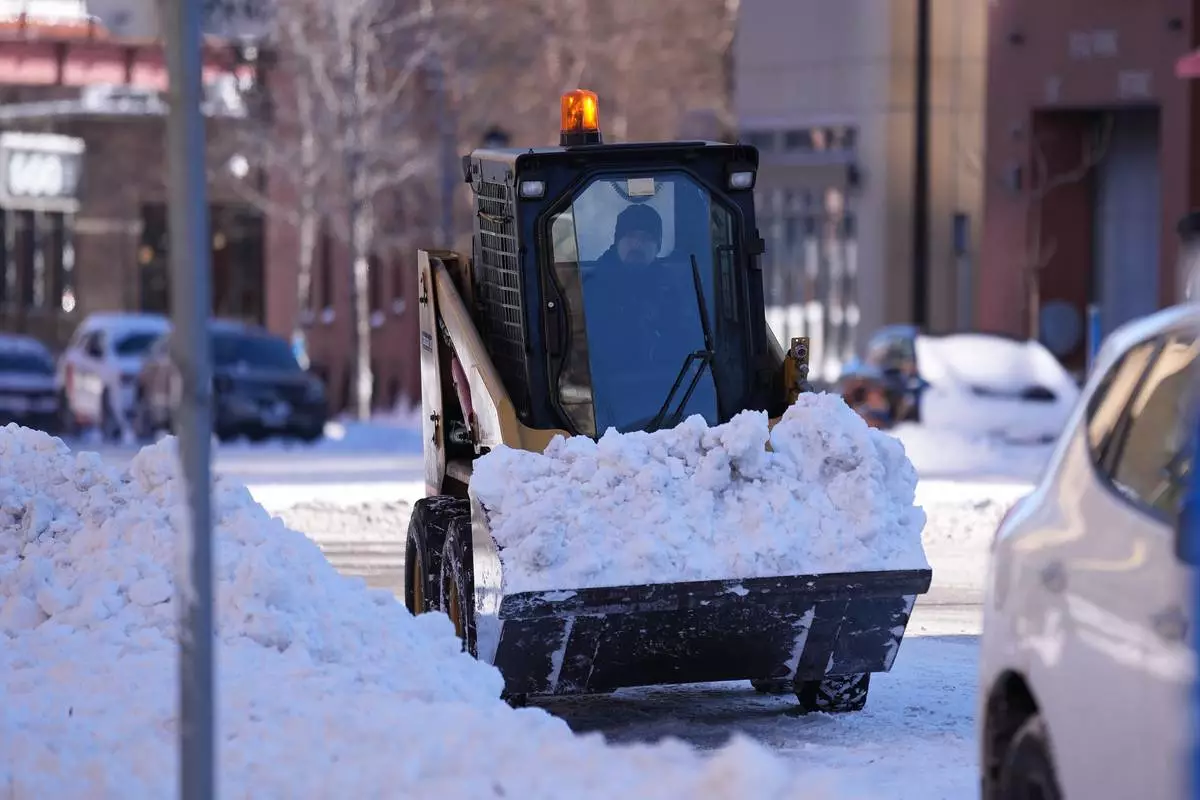
Snow is plowed after a snowstorm Monday, March 16, 2026, in Minneapolis. (AP Photo/Abbie Parr)

Snow is plowed after a snowstorm Monday, March 16, 2026, in Minneapolis. (AP Photo/Abbie Parr)

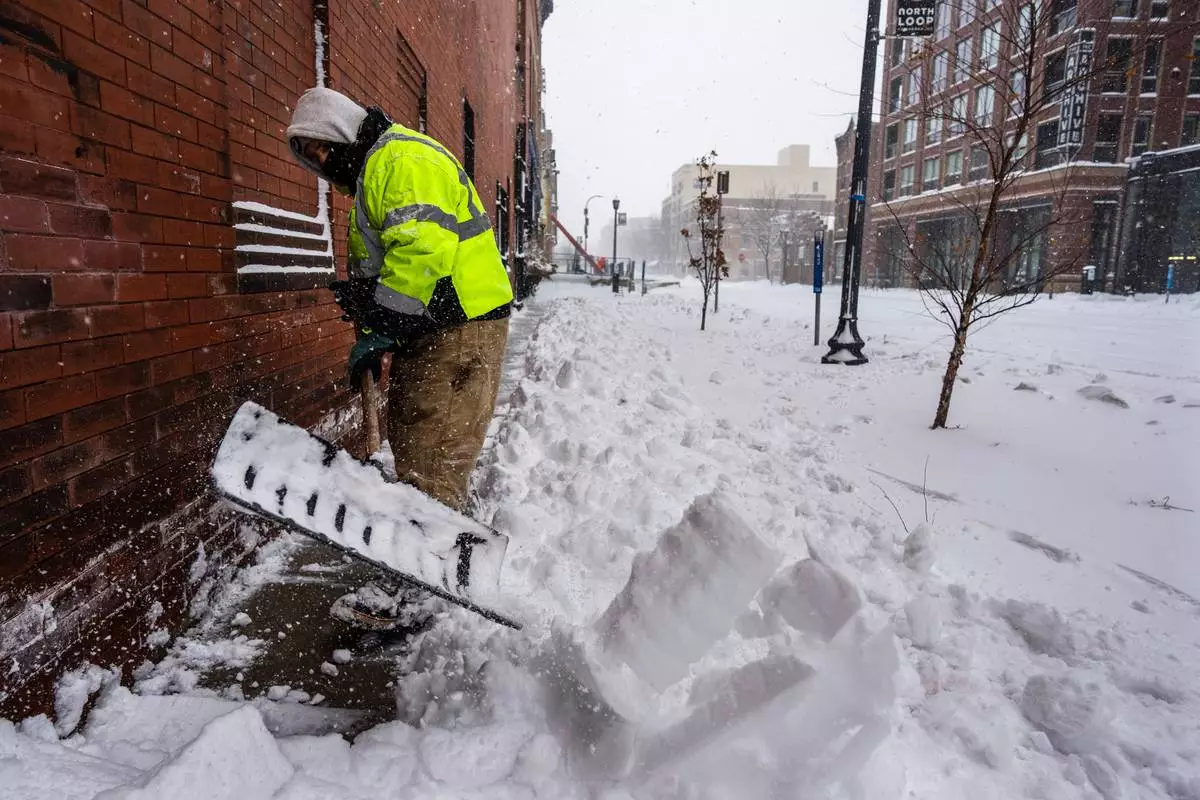
Victor Alomoto who is from Ecuador cleared the sidewalk for the River Valley Church in the North Loop Pedestrians during the snow storm in Minneapolis, Minn., on Sunday, March 15, 2026.(Richard Tsong-Taatarii/Minnesota Star Tribune via AP)

Victor Alomoto who is from Ecuador cleared the sidewalk for the River Valley Church in the North Loop Pedestrians during the snow storm in Minneapolis, Minn., on Sunday, March 15, 2026.(Richard Tsong-Taatarii/Minnesota Star Tribune via AP)

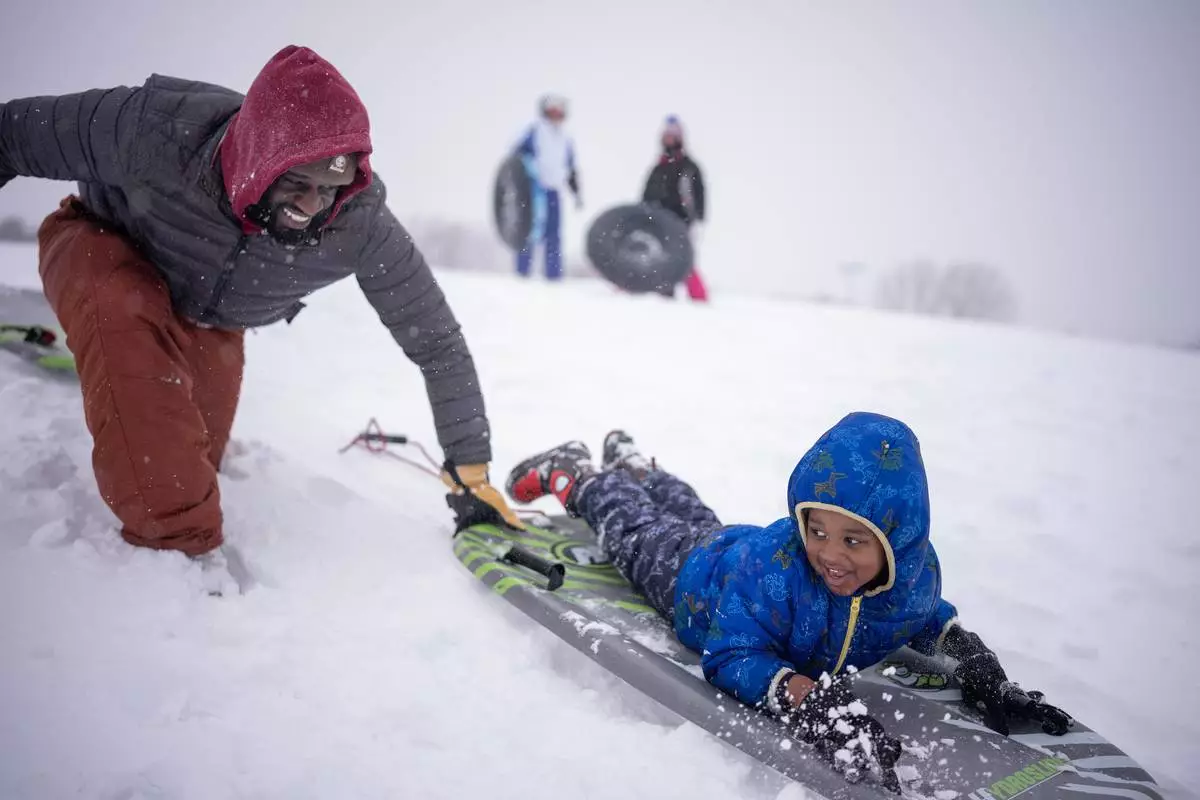
Ogo Akpati and his son Brycson Akpati, 3, braved the strong winds and had fun sliding down a hill in Central Park Sunday, March 15,2026 in Brooklyn Park, MN. (Jerry Holt/Minnesota Star Tribune via AP)

Ogo Akpati and his son Brycson Akpati, 3, braved the strong winds and had fun sliding down a hill in Central Park Sunday, March 15,2026 in Brooklyn Park, MN. (Jerry Holt/Minnesota Star Tribune via AP)

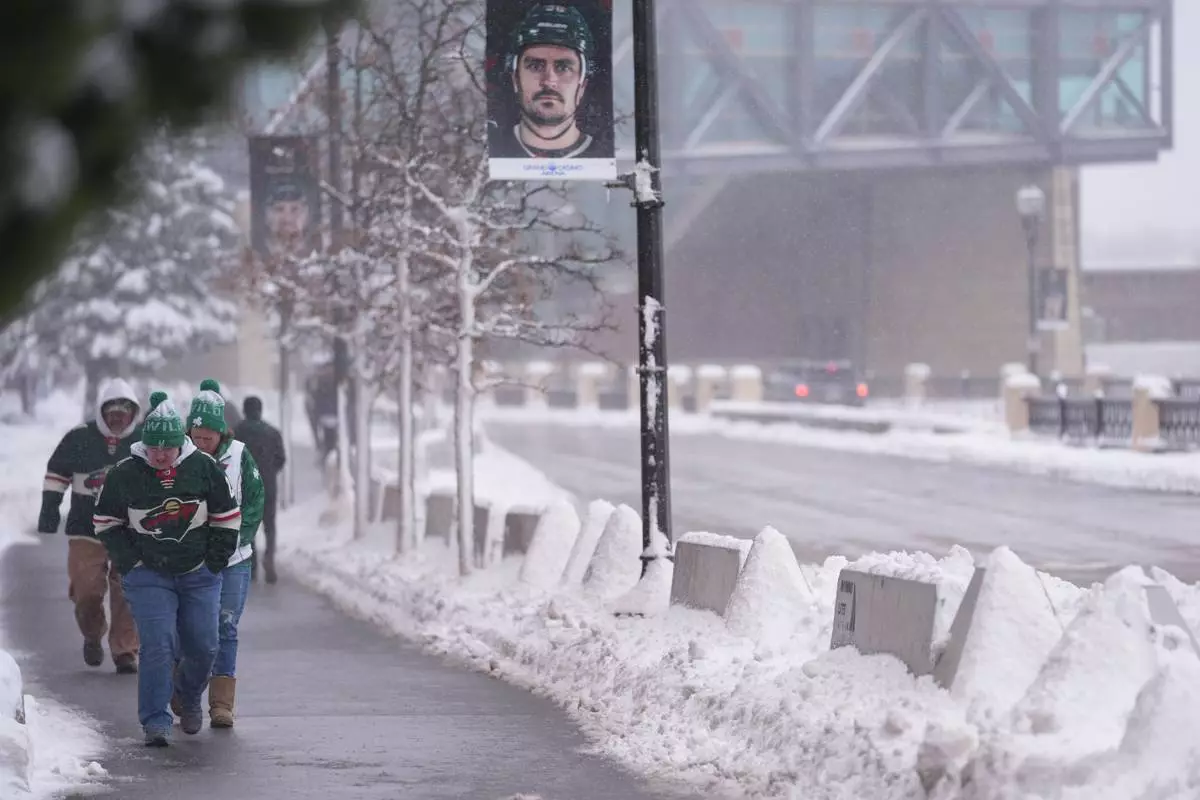
Fans walk through snowy streets before an NHL hockey game between the Minnesota Wild and Toronto Maple Leafs, Sunday, March 15, 2026, in St. Paul. (AP Photo/Abbie Parr)

Fans walk through snowy streets before an NHL hockey game between the Minnesota Wild and Toronto Maple Leafs, Sunday, March 15, 2026, in St. Paul. (AP Photo/Abbie Parr)

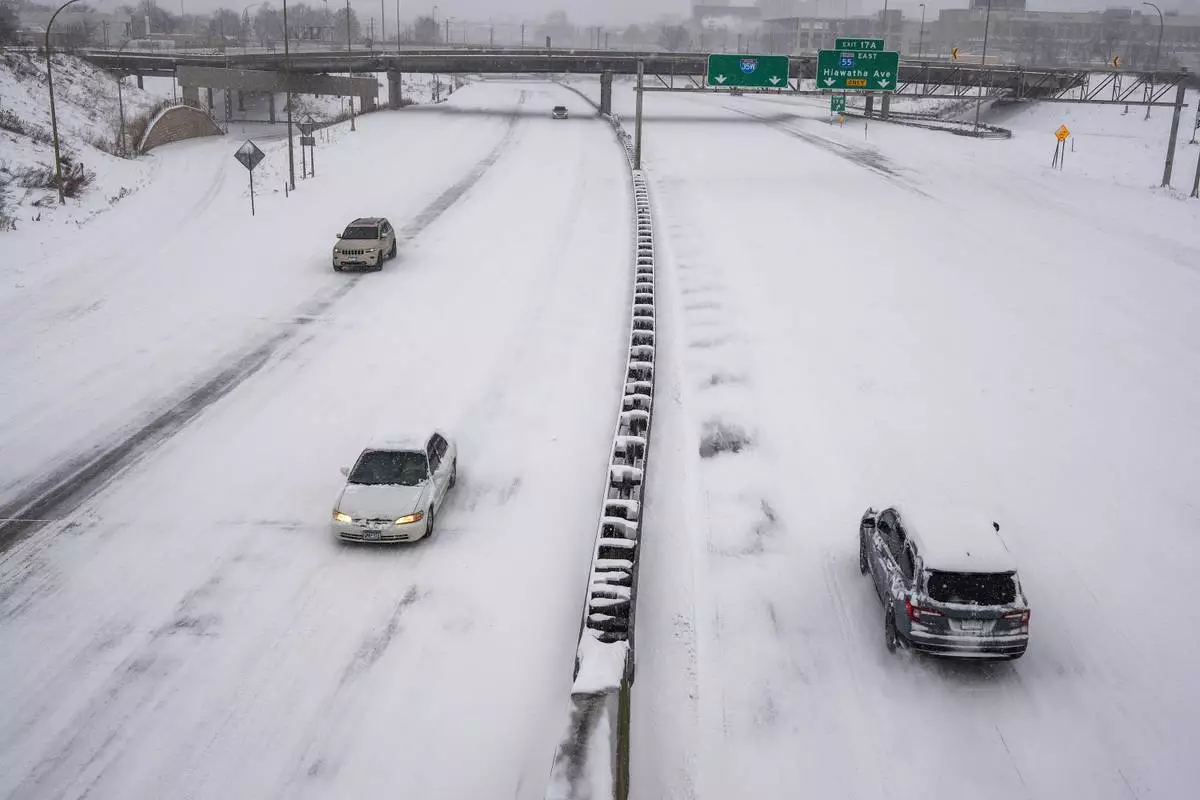
People drive on a snow-covered freeway during a snow storm Sunday, March 15, 2026, in Minneapolis. (Richard Tsong-Taatarii/Minnesota Star Tribune via AP)

People drive on a snow-covered freeway during a snow storm Sunday, March 15, 2026, in Minneapolis. (Richard Tsong-Taatarii/Minnesota Star Tribune via AP)

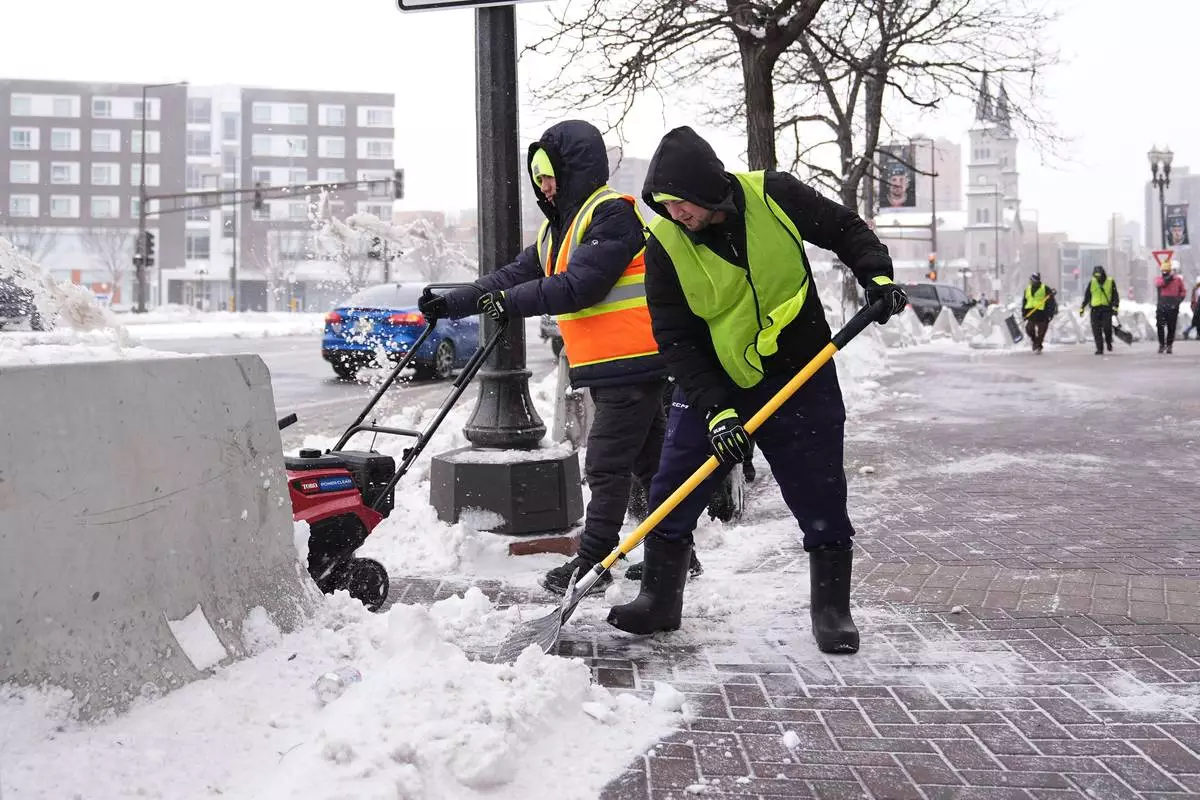
Workers clear snow off the ground Sunday, March 15, 2026, in St. Paul, Minn. (AP Photo/Abbie Parr)

Workers clear snow off the ground Sunday, March 15, 2026, in St. Paul, Minn. (AP Photo/Abbie Parr)

Recommended Articles