LONDON--(BUSINESS WIRE)--Nov 18, 2025--
Fourth, the leading provider of workforce and inventory management solutions for the hospitality sector, today announced the release of Fourth iQ 2.2, introducing new AI-powered recommendations designed to help managers better plan, communicate, and optimise their teams, while continuing to improve the overall user experience of the iQ App.
This press release features multimedia. View the full release here: https://www.businesswire.com/news/home/20251118623431/en/
Clinton Anderson, CEO at Fourth, said: “With every new release of Fourth iQ, we’re continuing to deliver exciting new functionality. iQ 2.2 helps managers make more informed, data-led decisions, while reducing the effort needed to stay on top of daily operations. Just as importantly, we’re listening to customer feedback and acting quickly to refine and enhance the iQ experience, ensuring the app continues to evolve in ways that make a please to use and deliver real impact on controlling cost and improving guest experience.”
Moving from reactive to proactive schedule operations
At the centre of the iQ 2.2 release are three new workforce management recommendations that support better scheduling decisions, improve communication, and strengthen operational performance.
Published Schedule Action – No more outdated schedules
This alert helps maintain an accurate schedule, and prompt communication, by reminding managers whenever there are updates to the schedule that have not been published yet. The notification helps maintain alignment between planned and actual staffing - preventing outdated schedules from being used, keeping teams informed and operations running smoothly.
Busy Periods Sales Alerts – Sales summary at-a-glance
The Labour Productivity system analyses actual sales data and identifies the top three busiest trading periods from the previous day. Managers receive a concise sales summary, helping them review performance and adjust upcoming schedules to better match demand.
Assign Employee Skill Action – Ensure the right mix of skills on each shift
Each employee is assigned a skill score within Fourth’s Auto-Scheduling solution based on their training and experience. When a new employee is added to the system, they are automatically assigned a score of 0 until updated by a manager. This action triggers an alert reminding managers to assign a skill score, ensuring only trained or qualified staff are scheduled for shifts. The feature helps maintain service while preventing untrained employees from being scheduled without experienced colleagues to support them.
An ever-increasing number of Fourth customers are benefitting from Fourth iQ for both workforce management and inventory management. Oscar Congote, Planning & Special Projects Director at International Restaurant Services Inc, shared their experience – “Fourth continues to innovate in ways that make forecasting more precise and actionable. With iQ, we can anticipate challenges before they happen and that kind of forward thinking makes a huge difference in our operations.”
An even more intuitive and insightful iQ experience
The iQ 2.2 release also includes a range of user interface updates driven by feedback from early adopters, reflecting Fourth’s commitment to continuous improvement and responsiveness to customer input.
Enhancements include:
Display of ‘iQ Reasoning’ text, giving managers more context behind each recommendation.
Updates to the prioritisation algorithm, ensuring time-sensitive actions appear first.
Regional support for dates, times, currencies, and decimals.
A refreshed experience featuring animated highlights, expandable recommendation cards, and an optimised iPad landscape layout for easier viewing and interaction.
Fourth iQ 2.2 builds on the growing success of the iQ App, expanding its library of AI-powered recommendations that help managers act faster, improve scheduling accuracy, and spend more time supporting their teams and delivering great guest experiences.
For more information, visit the Fourth website
About Fourth
When every hour of every shift matters, Fourth helps restaurants, retailers, and hotels conquer the day with data-driven workforce and inventory technology. The Fourth AI Platform leverages more than 20 years of rich data and advanced analytics to deliver actionable insights and demand forecasting for optimising operations, maximising margins, and empowering employees. With a streamlined business powered by the Fourth AI Platform, industry operators can act with certainty and conquer with confidence whatever comes their way every day. Fourth serves more than 15,000 customers across 120,000 locations globally. For more information, please visit uk.fourth.com.

Fourth launches iQ 2.2, enabling hospitality managers to proactively manage their scheduling operations within the iQ App
WASHINGTON (AP) — The U.S. Supreme Court is hearing arguments at 10 a.m. ET over the constitutionality of President Donald Trump’s order to end birthright citizenship for children born in the United States to someone in the country illegally or temporarily.
The birthright citizenship order, which Trump signed on Jan. 20, 2025, the first day of his second term, is part of his Republican administration’s broad immigration crackdown.
Trump plans to be in attendance. He will be the first sitting president to attend oral arguments at the nation’s highest court.
Every lower court to have considered the issue has found the order illegal and prevented it from taking effect. A definitive ruling by the nation’s highest court is expected by early summer.
Here’s the latest:
Way back in 1841, former President John Quincy Adams represented a shipload of African men and women who had been sold into slavery in the famous Amistad case.
Former President William Howard Taft became chief justice nearly eight years after leaving the White House in 1913. Charles Evans Hughes left the Supreme Court for a presidential run in 1912, which he nearly won, then returned to the court in 1930 as chief justice.
In 1966, Richard Nixon argued his only Supreme Court case, which he lost.
Twenty-four Democratic state attorneys general put out a statement Wednesday morning saying they’re “proud to lead the fight against this unlawful order.”
While Democratic attorneys general have sued the Trump administration scores of times, the plaintiffs in this case are represented by the American Civil Liberties Union and other civil rights groups.
The Democratic attorneys filed court papers supporting their position. Twenty-five of their Republican counterparts filed a friend-of-the-court brief backing the Trump administration.
The only state sitting this one out is New Hampshire.
More than 250,000 babies born in the U.S. each year would not be citizens, according to research from the Migration Policy Institute and Pennsylvania State University’s Population Research Institute.
The order would only apply going forward, the administration has said. But opponents have said a court ruling in Trump’s favor could pave the way for a later effort to take away citizenship from people who were born to parents who were not themselves U.S. citizens.
The president and first lady Melania Trump showed up for the court ritual marking the arrival of a new justice following the confirmations of Justice Neil Gorsuch in 2017 and Justice Brett Kavanaugh a year later.
The ceremony for Trump’s third appointee, Justice Amy Coney Barrett, was delayed a year because of the COVID-19 pandemic and Trump, who was no longer in office, did not attend.
Traditionally the president has avoided attending arguments to maintain distance between the government branches — since the executive officer’s presence is seen by many as a way to pressure the independent court to rule in their favor.
Given the unusual nature of it all — Trump’s presence in the courtroom spotlights how high the stakes are for him, as the court’s decision will have massive consequences on his longstanding promise to crack down on immigration.
Last year, Trump said that he badly wanted to attend a hearing on whether he overstepped federal law with his sweeping tariffs, but he decided against it, saying it would have been a distraction.
Adam Winkler, a constitutional law professor at UCLA, told the The Associated Press that Trump’s attending SCOTUS oral arguments signals how important the president views this case.
However, Trump’s presence “is unlikely to sway the justices,” Winkler said, adding that the SCOTUS justices “pride themselves in their independence, even if some agree with much of Trump’s agenda.”
The fanfare of Trump being in the courtroom will make for a different experience for the justices themselves, however, as “Trump’s presence will make the atmosphere a little bit more circus-like,” Winkler said.
Solicitor General D. John Sauer is making his ninth Supreme Court argument and second in as many weeks. Sauer’s biggest win to date was the presidential immunity decision that spared Trump from being tried for his effort to overturn the 2020 election.
Sauer was a Supreme Court law clerk to Justice Antonin Scalia early in his legal career.
ACLU legal director Cecillia Wang, the child of Chinese immigrants, is presenting her second argument to the Supreme Court. In the first Trump administration, a 5-4 conservative majority ruled against Wang’s clients in another immigration case.
It’s not an April Fool’s joke. Alito was born this day in 1950. Only Thomas, who turns 78 in June, is older than Alito among the nine justices.
In the post-pandemic era, the other justices allow the 77-year-old Thomas, the longest-serving member of the court, to pose a question or two before the free-for-all begins.
In a second round of questioning, the justices ask questions in order of seniority. Chief Justice John Roberts, whose center chair makes him the most senior, gets the first crack.
The justices have routinely gone beyond the allotted time since returning to the courtroom following the Covid-19 pandemic.
A buzzer and the court marshal’s cry, “All rise,” signal the justices’ entrance from behind red curtains. The livestream won’t kick in for several minutes, until after the ceremonial swearing-in of lawyers to the Supreme Court bar.
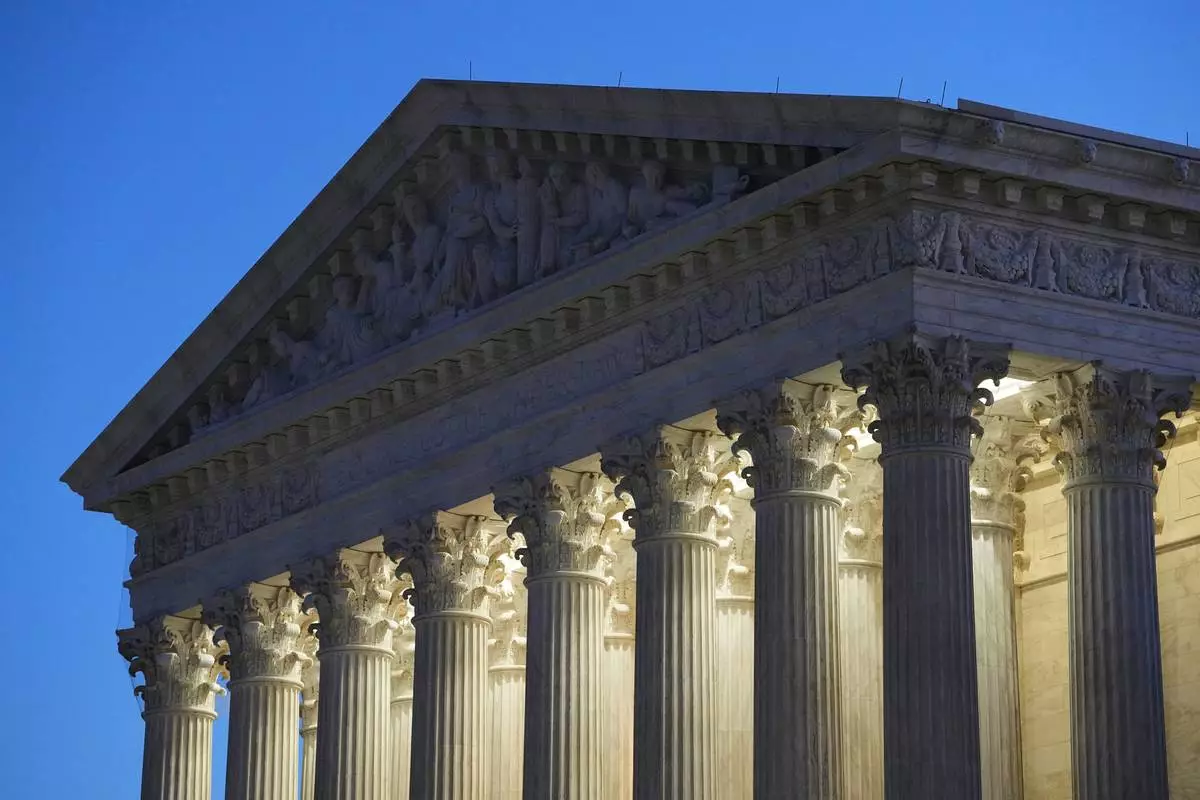
FILE - The U.S. Supreme Court is seen in Washington on Feb. 24, 2026. (AP Photo/Matt Rourke, File)
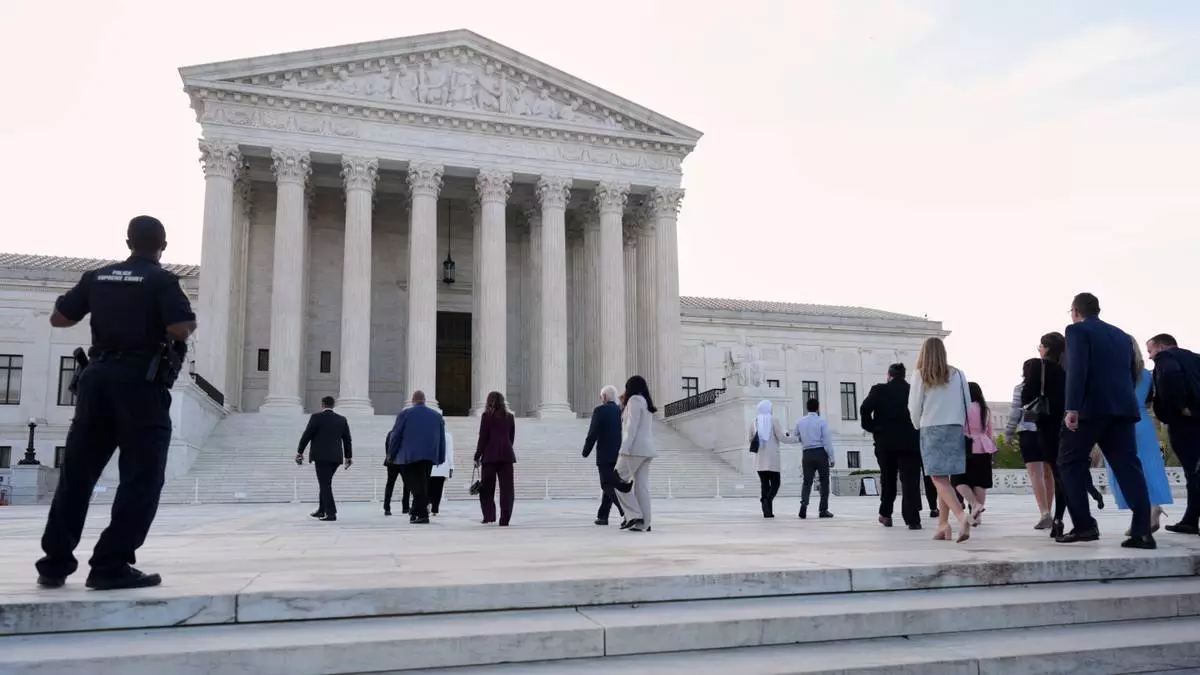
People arrive to walk inside the U.S. Supreme Court, on Capitol Hill in Washington, Wednesday, April 1, 2026. The Supreme Court justices will hear oral arguments today on whether President Donald Trump can deny citizenship to children born to parents who are in the United States illegally or temporarily. (AP Photo/J. Scott Applewhite)