PRISTINA, Kosovo (AP) — Kosovo lawmakers on Wednesday failed to elect a new government, paving the way for an early election following a monthslong political crisis in the small Balkan nation.
Prime Minister-designate Glauk Konjufca, from the governing Self-Determination Movement party won 56 votes in the 120-member assembly, which is just short of a majority needed for the election.
The vote is a blow for the governing party of acting Prime Minister Albin Kurti. The party won the most votes at an election in February, but not enough to rule alone. It has since failed to form a political alliance that would secure a parliamentary majority.
President Vjosa Osmani now must dissolve parliament and call an early vote within 10 days.
This is the first time that Kosovo hasn't been able to form a government since it declared independence from Serbia in February 2008 following a 1998-99 war that killed around 13,000 people.
Kurti, the acting prime minister who has been in power since 2021, has faced criticism for allegedly curbing political dialogue and straining relations with Kosovo's allies in the United States and the European Union.
Konjufca, who was proposed as a possible compromise solution instead of Kurti, has urged lawmakers to “spare” Kosovo from a another vote, saying it "would be arrogant to take the country to an election again.”
“If we hold one (vote) in December, who guarantees that we won’t have another one in March as well,” he said.
The prolonged crisis means that Kosovo hasn't approved a budget for next year, sparking fears of possible negative effects on the already poor economy in the country of 2 million people.
Serbia has refused to acknowledge Kosovo's independence which has been recognized by Washington and most of the EU's 27 countries but not Belgrade's allies Russia and China. Unresolved relations with Serbia have blocked Kosovo’s attempts to become a candidate country for EU membership.
Jovana Gec contributed to this report from Belgrade, Serbia.
This story has been corrected to show that the Kosovo president’s first name is Vjosa, not Vlosa.

FILE - Kosovo Prime Minister Albin Kurti speaks during an interview with The Associated Press in the capital Pristina, Friday, Sept. 29, 2023. (AP Photo/Visar Kryeziu, File)
NASA's launch team has loaded more than 700,000 gallons of fuel into the 32-story Space Launch System rocket, setting the stage for the Artemis II mission crew members to board.
The mission is NASA’s planned lunar fly-around by four astronauts that will be the first moon trip in 53 years.
The Space Launch System rocket is poised to blast off Wednesday evening with a two-hour launch window beginning at 6:24 p.m. EDT at Kennedy Space Center in Florida.
Artemis astronauts Reid Wiseman, Victor Glover, Christina Koch and Jeremy Hansen will be on board. They’ll hurtle several thousand miles beyond the moon, hang a U-turn and then come straight back. No circling around the moon, no stopping for a moonwalk — just a quick out-and-back lasting less than 10 days. NASA promises more boot prints in the gray lunar dust, but not before a couple practice missions.
Unlike the Apollo missions that sent astronauts to the moonfrom 1968 through 1972, Artemis’ debut crew includes a woman, a person of color and a Canadian citizen.
Artemis II is the opening shot of NASA’s grand plans for a permanent moon base. The space program is aiming for a moon landing near the lunar south pole in 2028.
The Latest:
“We should have done Artemis 50 years ago,” said John Tribe, a propulsion engineer during the Apollo era.
The launch team has loaded more than 700,000 gallons of fuel into the 32-story Space Launch System rocket, setting the stage for the Artemis II crew to board.
The wind is picking up at Cape Canaveral, more clouds are appearing and rain is expected in about two hours. But there is no lightning threat, NASA says, and there’s still an 80% chance the weather will be good enough to launch.
L-minus tracks the overall time to liftoff, counting down the days, hours and minutes away before the planned blastoff. It doesn’t include built-in holds, or pauses — that’s T-minus time.
The T-minus countdown in the final 10 minutes is where nerves tense up and hearts start pounding. Automated software kicks off a series of highly choreographed milestones. During this period, the clock can be stopped if a problem is spotted and restarted if it’s fixed in time.
T-0 is the moment of liftoff — zero — when the boosters ignite and the rocket begins its journey.
NASA has a narrow time frame each month to fly to the moon.
The Earth and moon must be aligned just so to achieve the proper trajectory for the mission. In any given month, there’s only about a week when Artemis II astronauts can lift off.
The Orion capsule needs to get a check of its life-support and other systems in near-Earth orbit. If that goes well, Orion will fire its main engine to hurtle toward the moon, taking advantage of the moon and Earth’s gravity to get there and back in a slingshot maneuver that requires little if any fuel.
Orion also needs sunlight for power and can’t be in darkness for more than 90 minutes at a time. Plus NASA wants to minimize heating during reentry at flight’s end.
The latest launch window runs through April 6. The next opportunity opens on April 30.
The hydrogen tank of the rocket’s core stage is 100% filled. NASA said no significant leaks have been observed so far in fueling. It was hydrogen leaks that prevented the rocket from flying in February.
The alarm clocks just went off in Kennedy Space Center’s crew quarters.
That means it’s rise and shine for the three Americans and one Canadian who are about to become the first lunar visitors in more than 53 years.
They have a long day ahead of them, whether they launch or not.
After breakfast, they’ll start suiting up. NASA’s launch window opens at 6:24 p.m. and lasts a full two hours.
Launch director Charlie Blackwell-Thompson is wearing green as are many of the controllers alongside her in the firing room.
Green represents “go” for NASA, a color symbolizing good luck.
The team is monitoring the fueling of the 322-foot moon rocket, set to blast off Wednesday evening.
A plush toy named Rise will ride with the Artemis II astronauts around the moon, carrying the names of more than 5.6 million people.
Rise is what’s known as a zero gravity indicator, which gives the astronauts a visual cue of when they reach space.
The design was inspired by the iconic “Earthrise” photo during Apollo 8, showing the planet as a shadowed blue marble from space in 1968.
Rise was selected from more than 2,600 contest submissions. It was designed by Lucas Ye of California.
Commander Reid Wiseman and his crew tucked a small memory card into Rise before the toy was loaded into the Orion capsule. The card bears the names of all those who signed up with NASA to vicariously tag along on the nearly 10-day journey.
“Zipping that little pocket on the bottom of Rise was kind of the moment that put it all together for me,” Wiseman said. “We are going for all and by all. It’s time to fly.”
NASA is fueling the new rocket that will send four astronauts to the moon.
Launch teams have begun pumping more than 700,000 gallons (2.6 million liters) of liquid hydrogen and liquid oxygen into the Space Launch System rocket at Kennedy Space Center in Florida.
It’s the latest milestone in the two-day countdown that kicked off on Monday when launch controllers reported to duty.
It will take at least four hours to fully load the rocket before astronauts climb aboard for humanity’s first flight to the moon since Apollo 17 in 1972.
The two-hour launch window opens at 6:24 p.m. EDT.
▶ Read more about Apollo vs. Artemis
The Americans who blazed the trail to the moon more than half a century ago were white men chosen for their military test pilot experience.
The Artemis II crew includes a woman, a person of color and a Canadian, products of a more diversified astronaut corps.
▶ Read more about Christina Koch, Victor Glover, Jeremy Hansen and Reid Wiseman
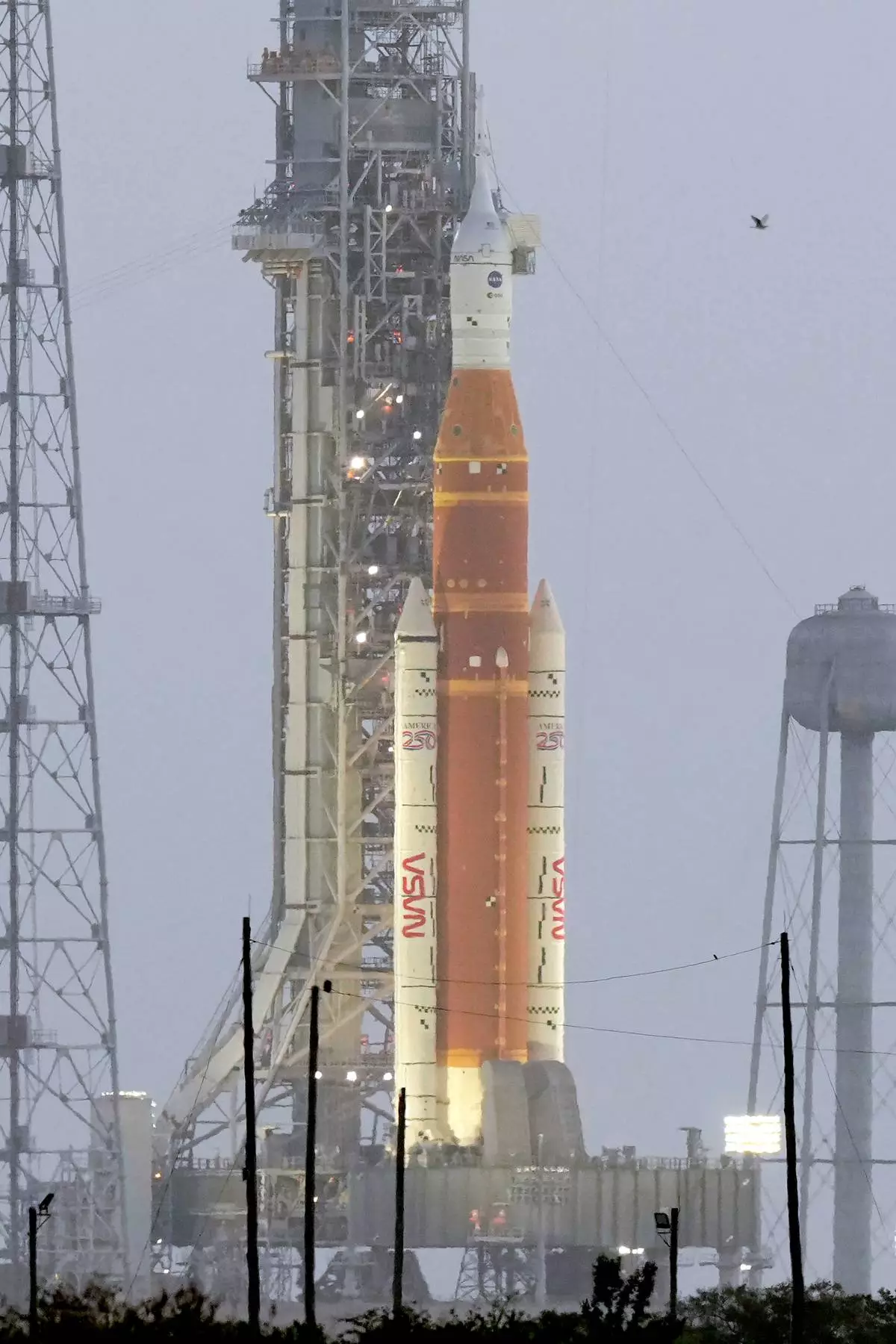
NASA's Artermis II moon rocket sits on Launch Pad 39-B at the Kennedy Space Center hours ahead of planned liftoff Wednesday, April 1, 2026, in Cape Canaveral, Fla. (AP Photo/Chris O'Meara)
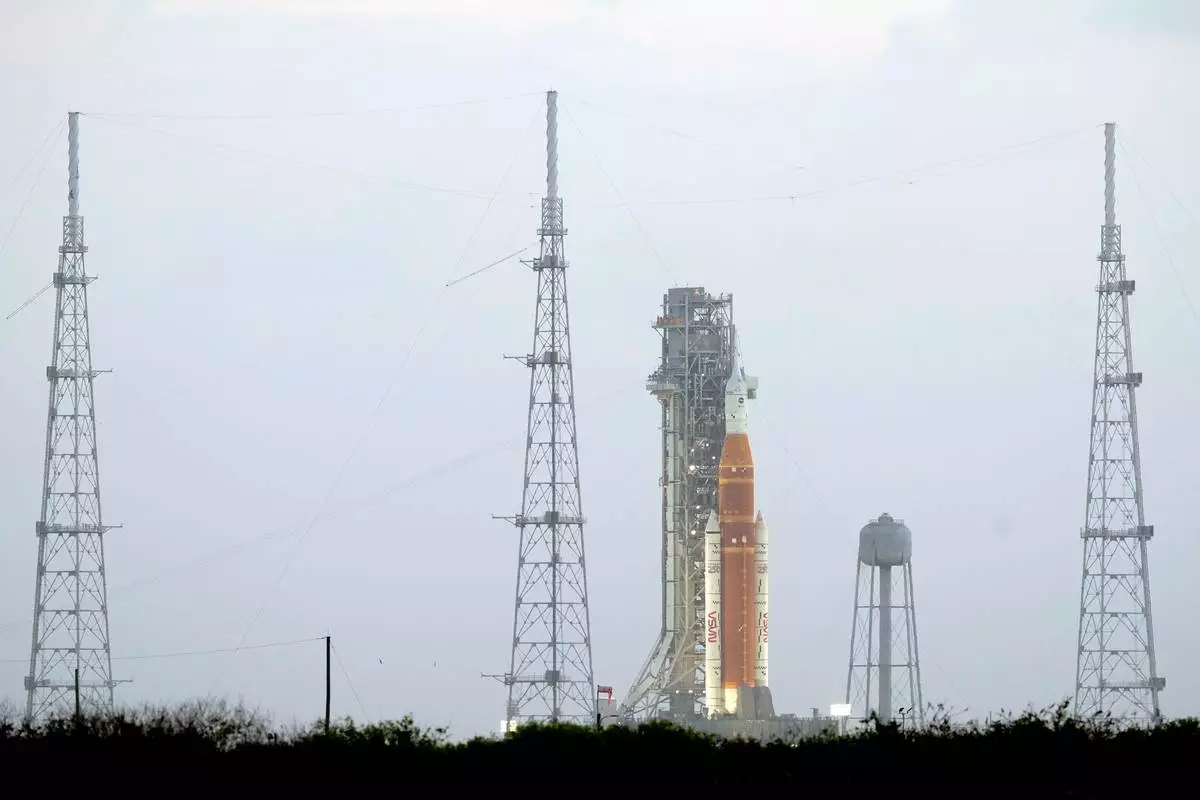
NASA's Artermis II moon rocket sits on Launch Pad 39-B at the Kennedy Space Center hours ahead of a planned launch attempt Wednesday, April 1, 2026, in Cape Canaveral, Fla. (AP Photo/Chris O'Meara)
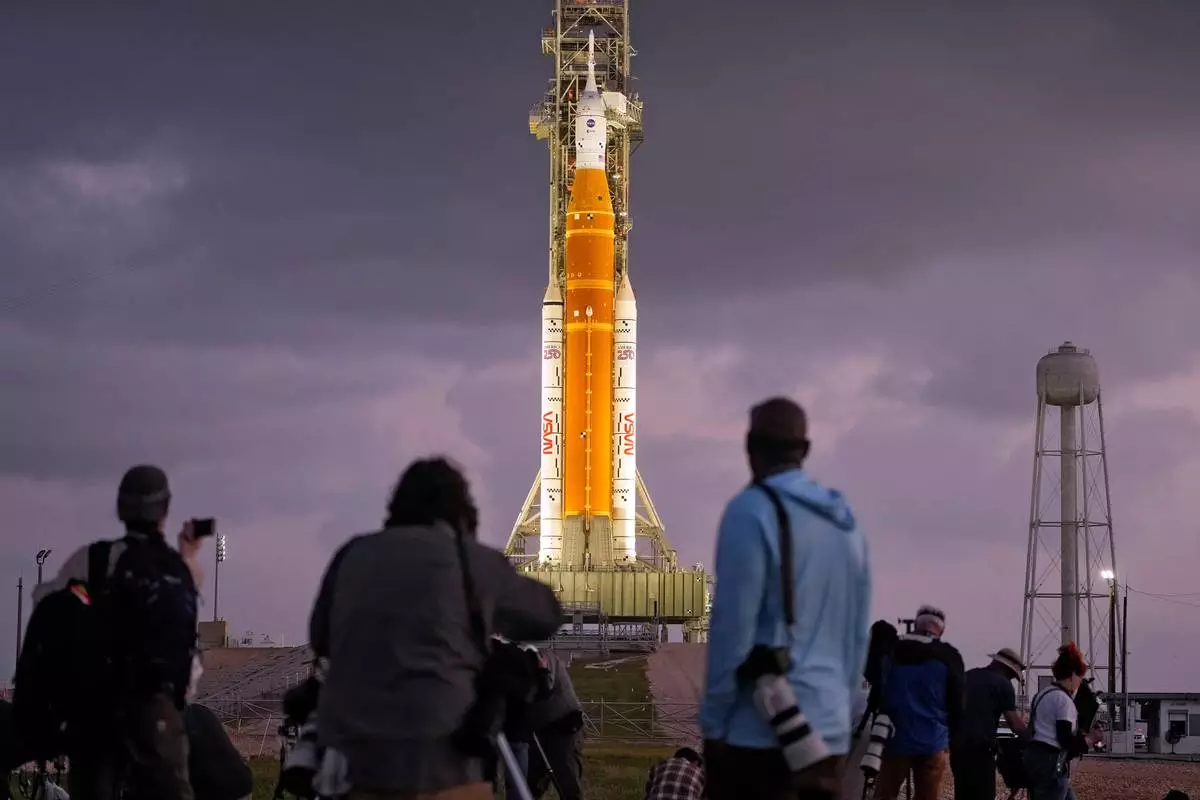
Photographers set up remote cameras near NASA's Artermis II moon rocket on Launch Pad 39-B just before sunrise at the Kennedy Space Center Tuesday, March 31, 2026, in Cape Canaveral, Fla. (AP Photo/Chris O'Meara)