TORONTO (AP) — Canadian Foreign Minister Anita Anand said Monday that Canada and India will move quickly to advance a trade deal after two years of strained relations, noting Ottawa has a new foreign policy in response to U.S. President Donald Trump's trade war.
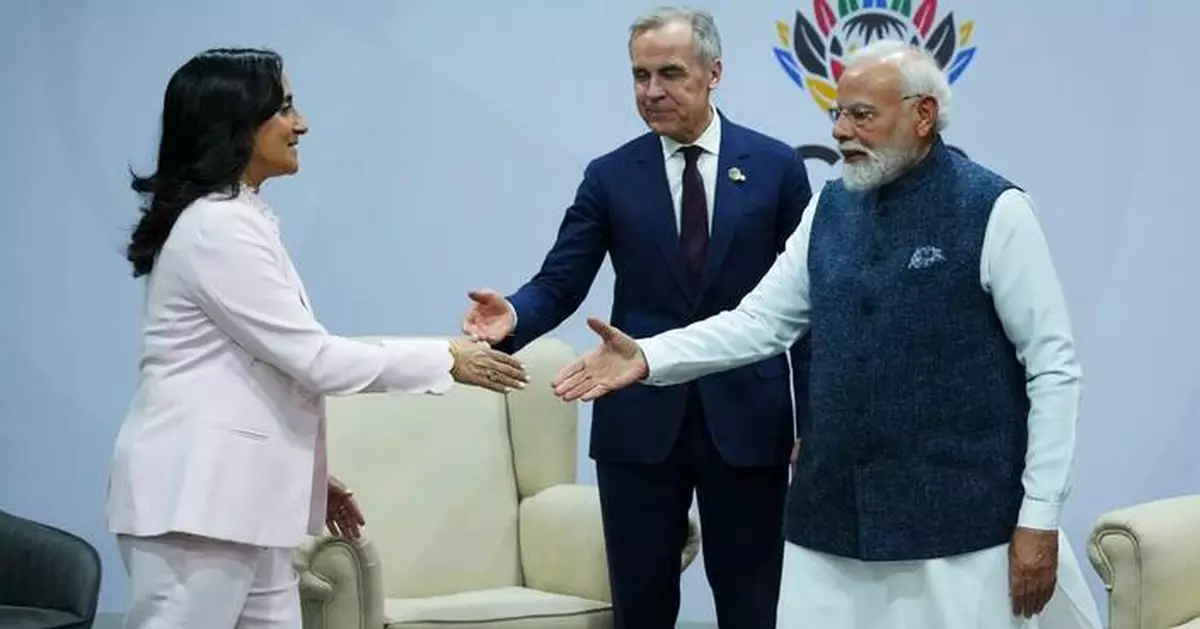
Anand's statement follows a meeting between Canadian Prime Minister Mark Carney and Indian Prime Minister Narendra Modi at the Group of 20 summit in South Africa this past weekend, where the leaders agreed to restart stalled talks for a new trade deal.
Relations between Canada and India have been strained since Canadian police accused New Delhi of playing a role in the June 2023 assassination of a Canadian Sikh activist near Vancouver.
“The leaders were adamant that this work proceed as quickly as possible so that timing is going to be expeditious,” Anand said in a telephone interview with The Associated Press.
Carney will visit India early next year.
Anand noted Carney's goal to double non-U.S. trade over the next decade. Canada is one of the most trade-dependent countries in the world, and more than 75% of Canada’s exports go to the U.S. Most exports to the U.S. are exempted by the USMCA trade agreement but that deal is up for review in 2026.
“This is a completely new approach to foreign policy that is responsive to the global economic environment in which we find ourselves,” Anand said. “There is a new government, a new foreign policy, a new prime minister and a new world order where countries are becoming more protectionist and this is a moment for Canada as a trading nation."
Canada is also seeking better relations with Beijing. Carney and Chinese President Xi Jinping took a step toward mending the long-fractured ties between their countries last month with a meeting at the Asia-Pacific summit.
In 2023, Ottawa suspended trade talks after going public with allegations from the Royal Canadian Mounted Police that the Indian government was behind an assassination of Sikh activist Hardeep Singh Nijjar.
Nijjar, 45, was fatally shot in his pickup truck after he left the Sikh temple he led in Surrey, British Columbia. An Indian-born citizen of Canada, he owned a plumbing business and was a leader in what remains of a once-strong movement to create an independent Sikh homeland.
Four Indian nationals living in Canada were charged with Niijar’s murder and are awaiting trial in Canada.
Relations improved in June when Carney invited Modi to the G7 summit in Alberta and when both countries agreed to restore their top diplomats in August.
“This is a step by step process. And in the last six months, significant steps have been taken,” Anand said.
Anand said both countries expect to be able to double bilateral trade by 2030, to US$50 billion, and noted that Canada is India’s seventh largest trade partner for goods and services, and one of the largest foreign investors in India.
Trump ended trade talks with Carney after the Ontario provincial government ran an anti-tariff advertisement in the U.S., which upset him. That followed a spring of acrimony, since abated, over the president’s insistence that Canada should become the 51st U.S. state.
Anand said Canada remains ready to resume trade talks with Trump.
“We are operating under the fact that the United States has fundamentally changed all of its trading relationships," Anand said. “We look forward to getting back to the table.”
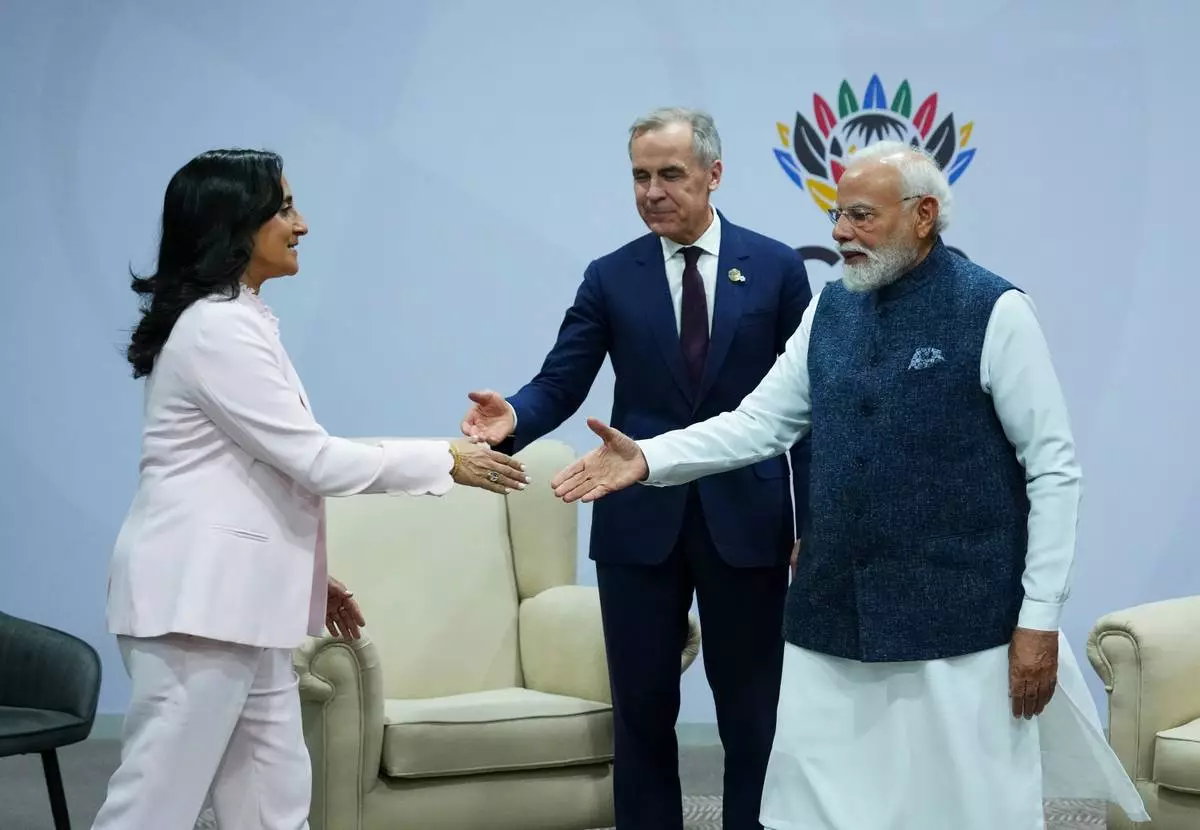
Canada's Prime Minister Mark Carney, middle, introduces Minister of Foreign Affairs Anita Anand, left, during a bilateral meeting with Indian Prime Minister Narendra Modi during the G20 Summit, in Johannesburg, Sunday, Nov. 23, 2025. (Sean Kilpatrick/The Canadian Press via AP)
NEW YORK (AP) — Stocks are rushing higher worldwide, and oil prices are easing Wednesday as hopes build that the war with Iran could end soon. That's even though some of the signals investors saw as hopeful are already under dispute, and several prior bouts of optimism in financial markets quickly got undercut by continued, fierce fighting in the war.
The S&P 500 rallied 0.9% and added to its leap from the day before, which was its best since last spring. That followed even bigger gains for stock markets across Europe and Asia, including an 8.4% surge in South Korea, which were catching up to Wall Street’s rally from Tuesday.
The Dow Jones Industrial Average was up 294 points, or 0.6%, as of 2:08 p.m. Eastern time, and the Nasdaq composite was 1.3% higher.
Oil prices also fell back toward $100 per barrel after President Donald Trump said late Tuesday that the U.S. military could end its offensive in two to three weeks.
That added to optimism following a couple tenuous signals of hope from earlier Tuesday that Wall Street latched onto, including a news report quoting Iran’s president as saying that it has “the necessary will to end the war” as long as certain requirements are met, including “guarantees to prevent a recurrence of aggression.”
The worry on Wall Street has been that the war may last a long time and keep oil and natural gas from the Persian Gulf out of global markets, which could create a brutal blast of inflation.
But hope has been quick to reverse to doubt on Wall Street, triggering manic swings back and forth for financial markets since the war with Iran began. Trump has also made statements that lifted markets, only to see the gains quickly disappear after increasing his military threats.
Shortly before Wall Street began trading on Wednesday, Trump claimed in a post on his social media network that Iran “has just asked the United States of America for a CEASEFIRE!”
“We will consider when Hormuz Strait is open, free, and clear. Until then, we are blasting Iran into oblivion or, as they say, back to the Stone Ages!!!”
But Iran’s Foreign Ministry spokesman, Esmail Baghaei, quickly called that claim “false and baseless,” according to a report on Iranian state television.
Oil prices also remain high, even if they’ve eased recently. The price for a barrel of Brent crude oil, the international standard, was sitting at $101.51 following its declines, which is still up from roughly $70 before the war began.
U.S. gasoline prices rose again overnight to a national average of $4.06 per gallon, according to the auto club AAA.
Iran, meanwhile, hit an oil tanker off the coast of Qatar and Kuwait’s airport on Wednesday while airstrikes battered Tehran as the fighting continued. Iran also continues to hold a grip on the Strait of Hormuz, where a fifth of the world’s traded oil passes during peacetime.
“De-escalation hopes have given markets a lift, but we think the effects of the war would, in many cases, persist even if the war did end soon,” Thomas Mathews, head of markets, Asia Pacific at Capital Economics, said in a research note Wednesday.
“It’s worth thinking through how markets might fare if the war were to end ‘very soon,’” he wrote. “Do markets have further to recover if sentiment continues to improve? The answer is almost certainly yes.”
The White House said Trump will deliver a public address Wednesday evening on the Iran war.
On Wall Street, most stocks rose as Big Tech powered the move higher. Gains of 3.8% for Alphabet and 0.8% for Nvidia were two of the strongest forces lifting the S&P 500.
Eli Lilly climbed 5.1% after U.S. regulators approved its GLP-1 pill for weight loss.
Such gains have pulled the S&P 500, which sits at the heart of many 401(k) accounts, back to within 5.6% of its all-time high set early this year. Just on Monday, the index briefly neared a 10% drop from its record, a steep-enough fall that professional investors have a name for it: a “correction.”
Nike sank 14.5% even though it reported a stronger profit for the latest quarter than expected. Analysts said it gave some lackluster financial forecasts.
Hasbro fell 4.8% after the toy company found someone had gained unauthorized access to its computer network and is working to assess the full impact.
Energy companies fell broadly as oil prices eased. Exxon Mobil slumped 5% and Chevron fell 4.9%.
In stock markets abroad, indexes leaped more than 2% in France and Germany. Asian markets had even bigger gains.
Tokyo’s Nikkei 225 jumped 5.2% after a survey showed business sentiment for major Japanese manufacturers improved despite worries about the Iran war.
In the bond market, Treasury yields held relatively steady after a report said U.S. retailers made more money in February than economists expected. A separate report said U.S. manufacturing growth last month was slightly faster than economists expected.
The 10-year Treasury yield rose to 4.32% from 4.30% late Tuesday.
AP Business Writers Chan Ho-him and Matt Ott contributed.
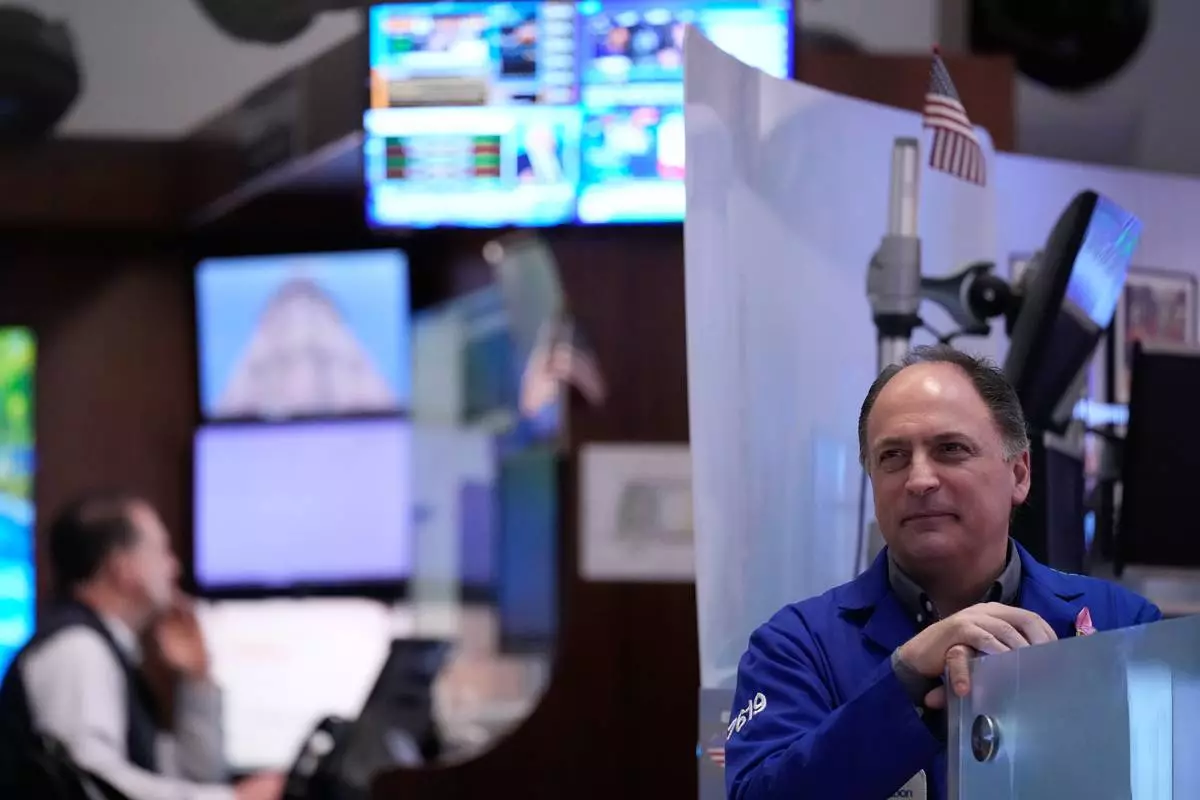
James Conti works on the floor at the New York Stock Exchange in New York, Tuesday, March 31, 2026. (AP Photo/Seth Wenig)
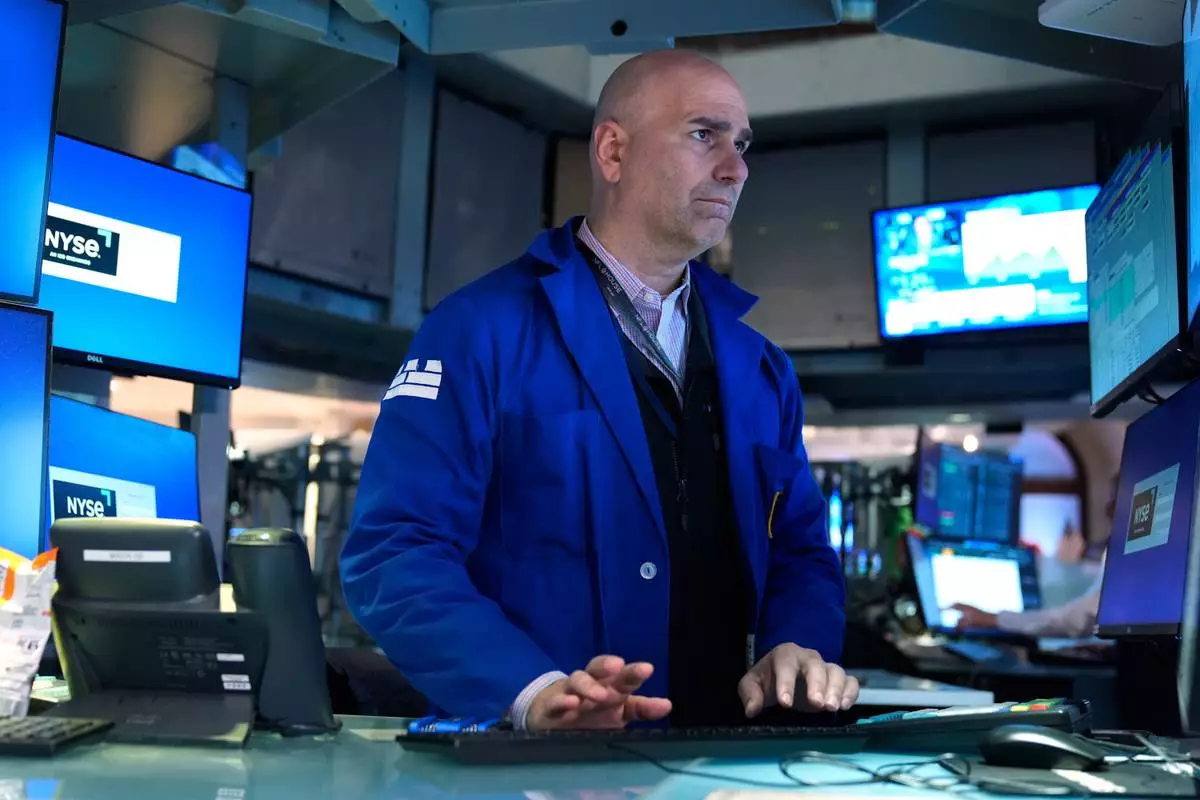
Philip Finale works on the floor at the New York Stock Exchange in New York, Tuesday, March 31, 2026. (AP Photo/Seth Wenig)
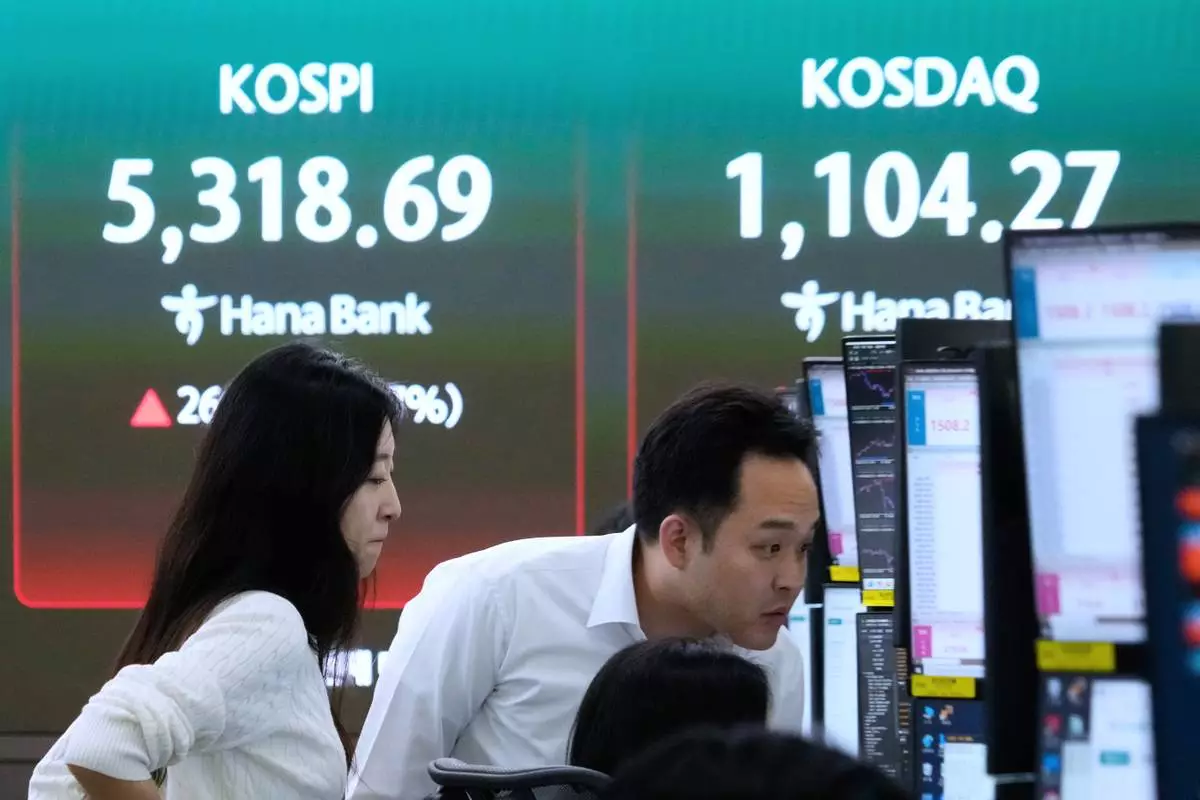
Currency traders watch monitors near a screen showing the Korea Composite Stock Price Index (KOSPI), left, at the foreign exchange dealing room of the Hana Bank headquarters in Seoul, South Korea, Wednesday, April 1, 2026. (AP Photo/Ahn Young-joon)
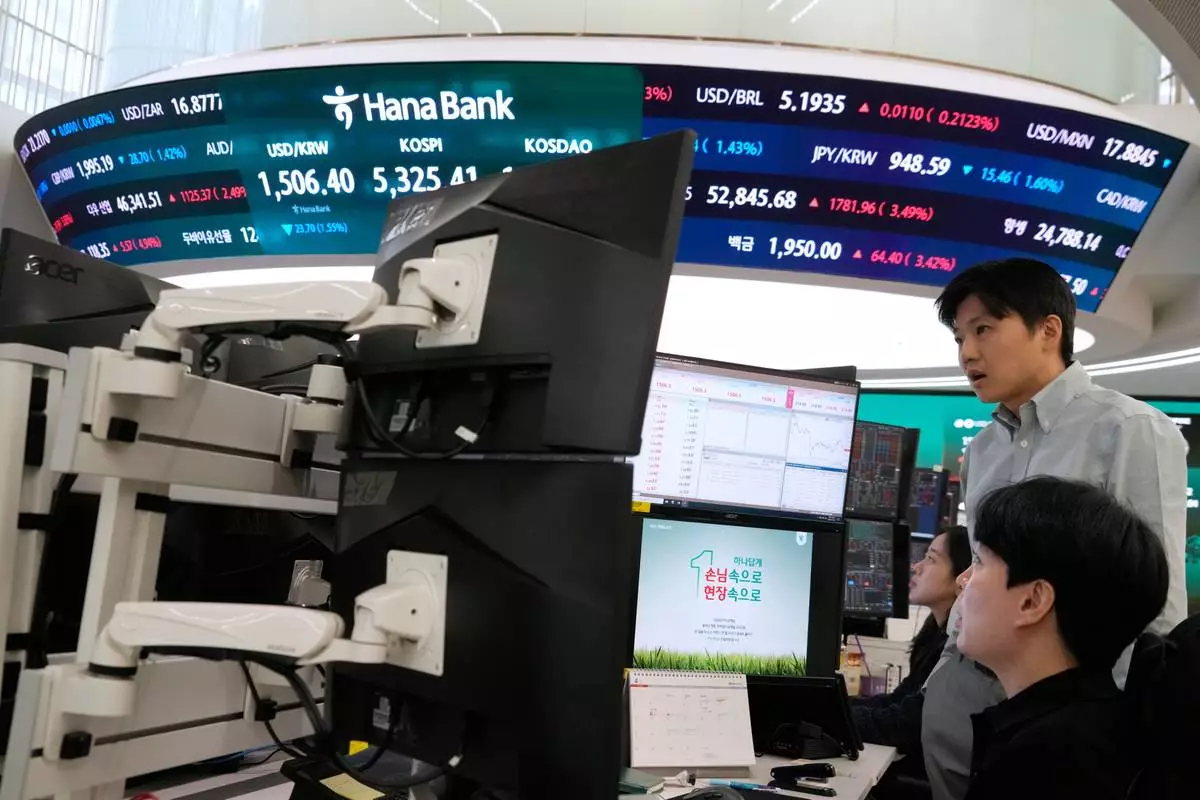
Currency traders watch monitors near a screen showing the Korea Composite Stock Price Index (KOSPI), top center, and the foreign exchange rate between U.S. dollar and South Korean won, top center left, at the foreign exchange dealing room of the Hana Bank headquarters in Seoul, South Korea, Wednesday, April 1, 2026. (AP Photo/Ahn Young-joon)
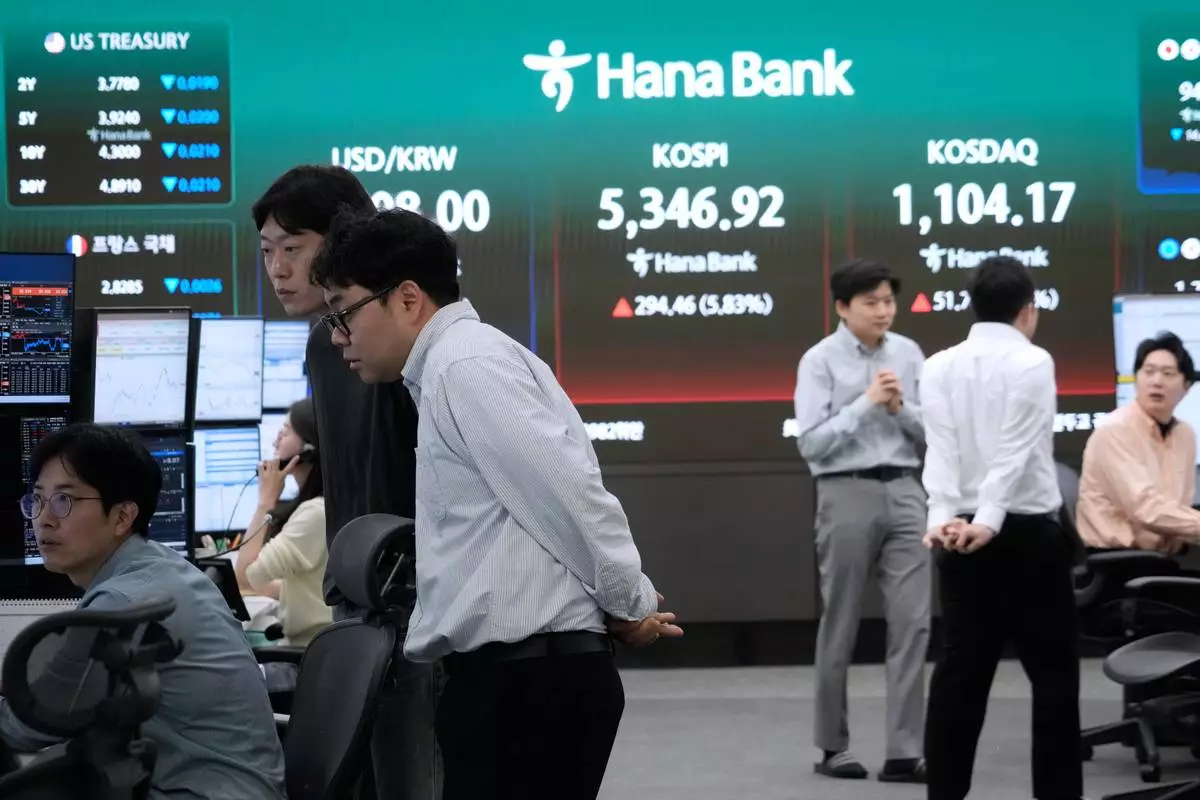
Currency traders work at the foreign exchange dealing room of the Hana Bank headquarters in Seoul, South Korea, Wednesday, April 1, 2026. (AP Photo/Ahn Young-joon)
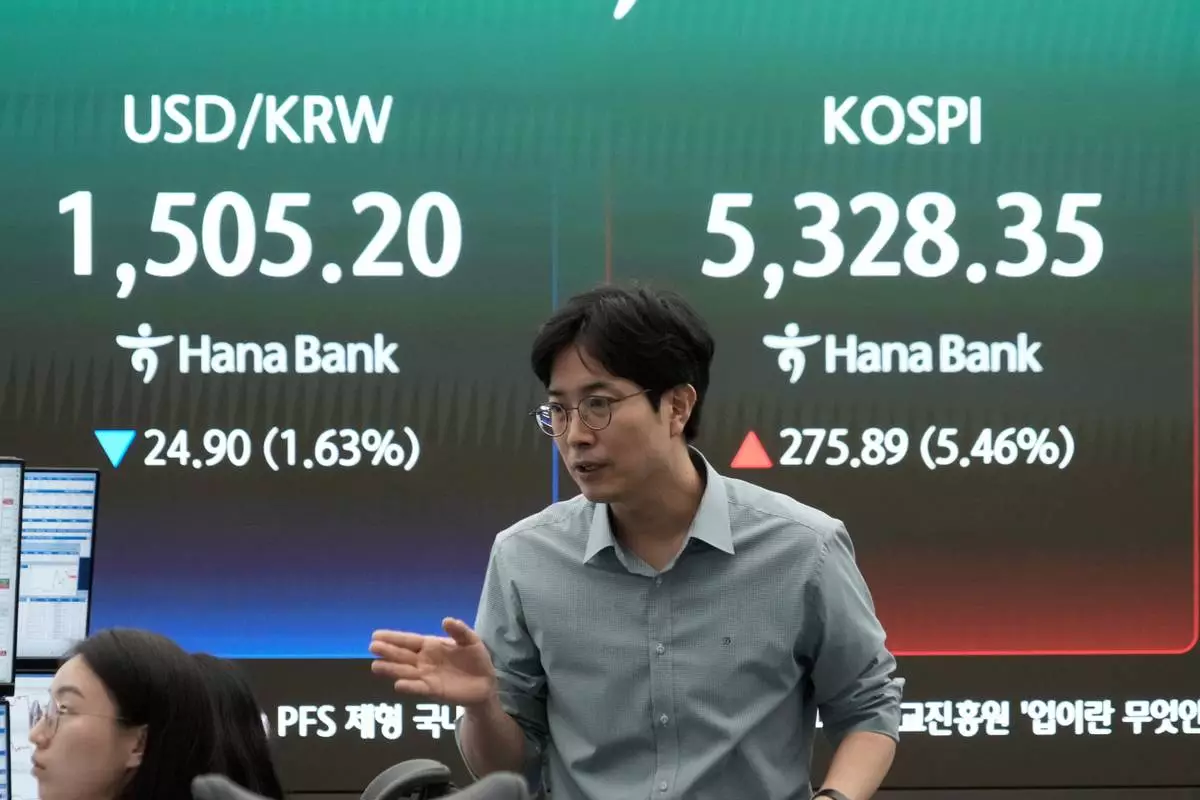
A currency trader reacts near a screen showing the Korea Composite Stock Price Index (KOSPI), right, and the foreign exchange rate between U.S. dollar and South Korean won at the foreign exchange dealing room of the Hana Bank headquarters in Seoul, South Korea, Wednesday, April 1, 2026. (AP Photo/Ahn Young-joon)
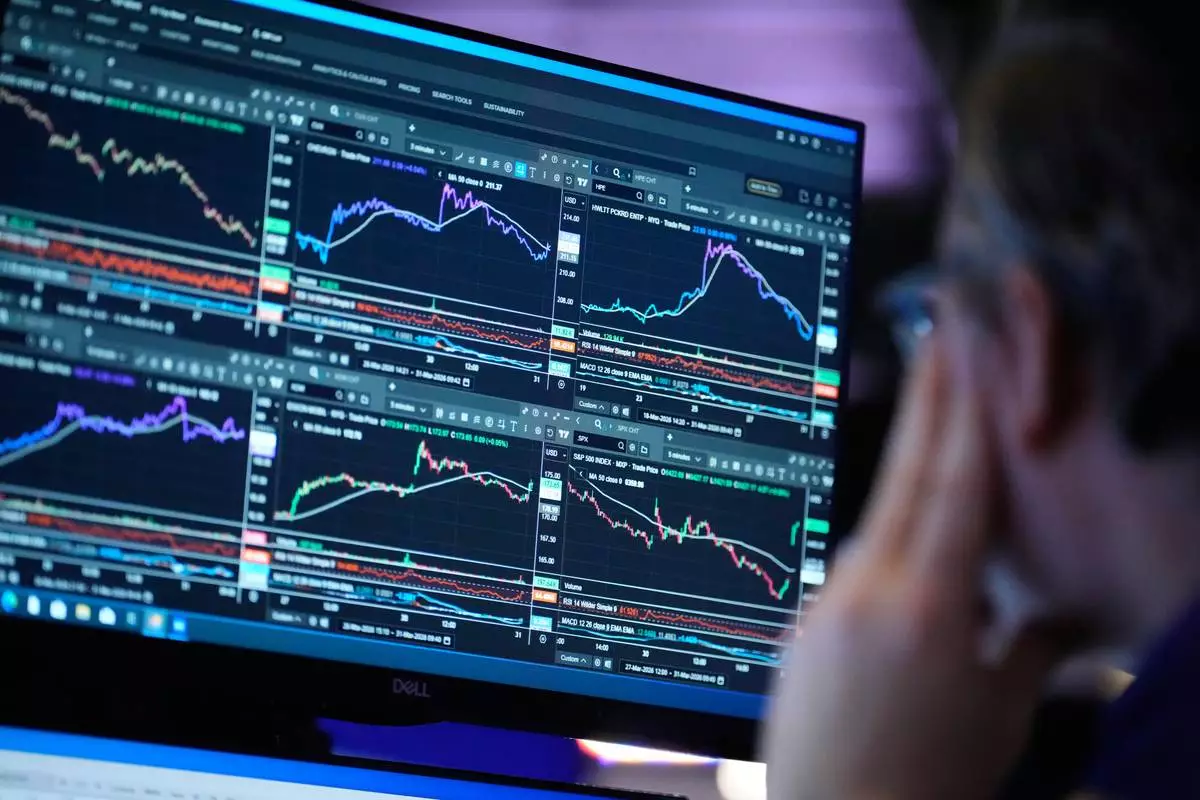
A screen displays financial information on the floor at the New York Stock Exchange in New York, Tuesday, March 31, 2026. (AP Photo/Seth Wenig)