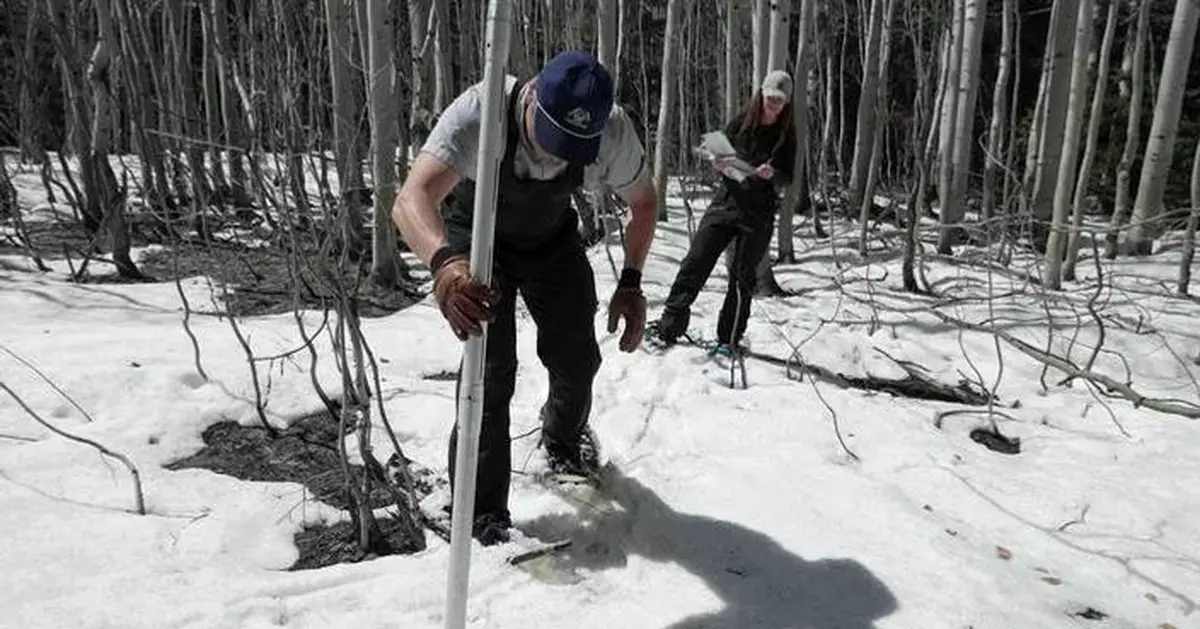
WALDEN, Colo. (AP) — Hydrologist Maureen Gutsch trudged through the mud and slush to confirm a grim picture: Colorado just had its worst snowpack since statewide recordkeeping began in 1941.
Even more troubling, mountain snow accumulations peaked a month early and contained just half the average moisture.
Click to Gallery
Philip Anderson pulls plastic off a bale of hay, Tuesday, March 31, 2026, in Walden, Colo. (AP Photo/Brittany Peterson)
Domestic well water fills a stock tank, Tuesday, March 31, 2026, in Walden, Colo. (AP Photo/Brittany Peterson)
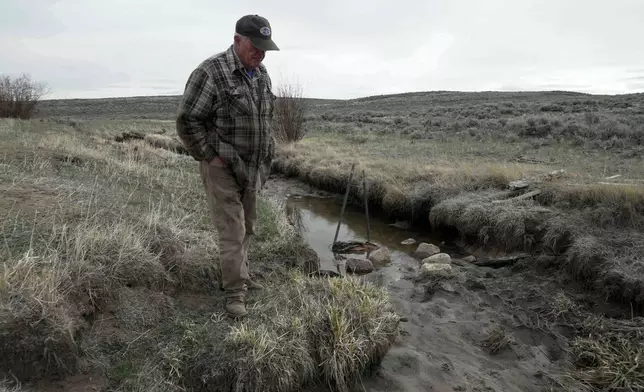
Philip Anderson looks at a dry ditch that usually transports water for stock and irrigation, Tuesday, March 31, 2026, in Walden, Colo. (AP Photo/Brittany Peterson)
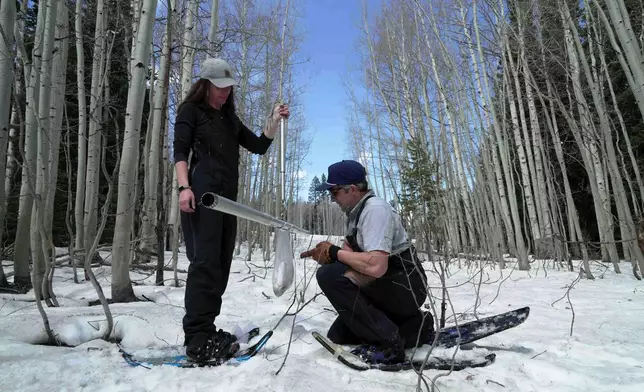
Snow surveyors, hydrologist, Maureen Gutsch, left, and Clinton Whitten weigh a snow sample, Monday, March 30, 2026, in Kremmling, Colo. (AP Photo/Brittany Peterson)
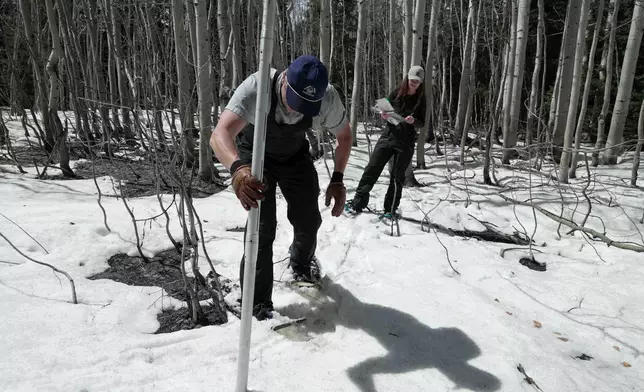
Clinton Whitten and hydrologist Maureen Gutsch, back, measure snow, Monday, March 30, 2026, in Kremmling, Colo. (AP Photo/Brittany Peterson)
As a warm winter with poor skiing conditions gave way to early springtime record heat, snow is vanishing from all but the highest elevations in the West. This week's record measurements are a clear sign that water shortages could worsen the ongoing significant drought, barring an unexpected deluge.
Gutsch struggled to match the mood of the sunny, 56-degree (13.3 degrees Celsius) weather as she stood in a section of the Rocky Mountains that's considered the headwaters of the Colorado River.
“We love being out here. We love being in the snow, taking these measurements. This year, it’s kind of hard to enjoy it because it’s slightly depressing with the conditions that we’ve seen,” said Gutsch, who is with the U.S. Department of Agriculture’s Natural Resources Conservation Service.
Cities in the region are imposing water-use restrictions, and ranchers are wondering how they will feed and water their cattle. Meanwhile, the threat of devastating wildfires looms.
Ranchers in Colorado's scenic mountain valleys near the Continental Divide are, in a sense, among the first in the region affected by drought, being nearest to the melting mountain snowpack.
They hardly need Gutsch to tell them how parched conditions are. They remember past droughts — bad ones in 2002, 1981, 1977 — and wonder how it bodes for their operations.
“I’ve never seen it so warm so early and no snow all winter long,” said Philip Anderson, a retired teacher who also has ranched most of his life in Colorado's North Park valley.
The heaviest snows in the high Rockies fall in late winter and early spring. Anderson’s place is at about 8,100 feet (2,500 meters) in elevation where a foot (30 centimeters) or more of snow often lingers on his pastures until springtime, helping to green up grass and refill stock ponds.
But without snow on the ground lately, his cows are grazing his grass before it can grow high and several ponds are dry. The ditch that would usually move water from the nearby Illinois River to his property is also dry — tapped already by neighbors with more senior water rights.
“A lot of the people which are closer to the mountains have to let the water go by and let those folks with the senior water rights have it,” Anderson said.
Anderson last had to haul water in his truck from a nearby wildlife refuge in 2002. That same year, he had to sell off his herd.
North Park — about 100 miles (161 kilometers) from the South Park valley that inspired the cartoon TV show — is a headwaters of the eastward-flowing Platte River system. Thirty-five miles (56 kilometers) west of Anderson's place, across the Continental Divide, is the Stanko Ranch on the Yampa River.
Jo Stanko dreads low flows because they allow her cattle to wade across the river. Then they need to be rounded up and brought back home.
This year, Stanko has been watering her parched meadow earlier than ever in 50 years of ranching. She plans to cut hay before June and may buy hay soon to feed her 70 cows after that.
“Hay's always a good investment, you know, because it might be really expensive,” she said.
An old saying in the West is that whiskey's for drinking and water's for fighting over. It especially applies when water becomes scarce amid a decades-long drought driven in part by human-caused climate change.
Meanwhile, the river's Upper Basin states of Colorado, New Mexico, Utah and Wyoming remain at an impasse in negotiations with the Lower Basin states of Arizona, California and Nevada to create new rules for managing the water during shortages.
Like the water itself, time is running short — the current rules expire in September.
A recent federal plan would conserve river water “completely on Arizona's back,” Democratic Gov. Katie Hobbs told a U.S. Chamber of Commerce meeting in March.
Upper Basin states say their cities, farmers and ranchers already use far less water than they are entitled to under the existing agreements. That's because they honor senior water rights — some of which date to the 1880s — before newer rights during droughts, Becky Mitchell, the Colorado River negotiator for Colorado, recently told other Upper Basin representatives.
“When there is less, we use less. This is not voluntary and no one gets paid as a result,” Mitchell said.
After missing multiple deadlines set by federal officials in recent months to reach agreement, the two sides are hiring lawyers in case the dispute goes to court.
After the driest and warmest winter on record, Salt Lake City announced a 10% daily cut in water use.
Reductions will be voluntary for residents, but the biggest nonresidential water users will have to consume no more than 200,000 gallons (2.6 million liters) per day.
On the other side of the Rockies, Denver Water is limiting lawn-watering and making other cuts in hopes of a 20% savings.
Precipitation west of the Continental Divide that's sent through tunnels to the eastern side provides about half of the city's water.
“We’re 7 to 8 feet (2 to 2.4 meters) of snow short of where we need to be,” Nathan Elder, water supply manager for Denver Water, said in a statement. “It would take a tremendous amount of snow to recover at this point, so it’s time to turn our attention to preserving what we have.”
Vast areas of California, Oregon and Nevada also are much drier than normal.
In California, where Sierra Nevada snowpack provides one-third of the state's water, a reading in the mountains near Lake Tahoe stood at just 18% of average for the second-lowest April 1 mark on record.
On the same day Denver approved the water restrictions, the city set a new high temperature record for March: 87 degrees (30 Celsius).
The previous record of 85 degrees (29 Celsius) was set just a week earlier.
Hot, dry weather is a recipe for wildfires. While other parts of the U.S., including the South and Southwest, face higher fire risk this spring, forecasters expect the threat in the Rockies to rise as above-average temperatures and below-normal precipitation persist into summer.
This week, the region is getting a reprieve and snow is back in the forecast by the end of the week in North Park. But Anderson said he needs a lot more — half an inch (1 centimeter) of rain every other day for several days — to get out of the drought.
Until then, he suggested that North Park water users work together to ensure everybody has enough.
"It’s pretty serious,” Anderson said. “If we just talk and communicate together and cooperate, we might be able to make it through this. But we’ll see.”
Gruver reported from Fort Collins, Colorado. Christopher Weber in Los Angeles and Amy Taxin in Santa Ana, California, contributed.
The Associated Press’ climate and environmental coverage receives financial support from multiple private foundations. AP is solely responsible for all content. Find AP’s standards for working with philanthropies, a list of supporters and funded coverage areas at AP.org.

Philip Anderson pulls plastic off a bale of hay, Tuesday, March 31, 2026, in Walden, Colo. (AP Photo/Brittany Peterson)

Domestic well water fills a stock tank, Tuesday, March 31, 2026, in Walden, Colo. (AP Photo/Brittany Peterson)
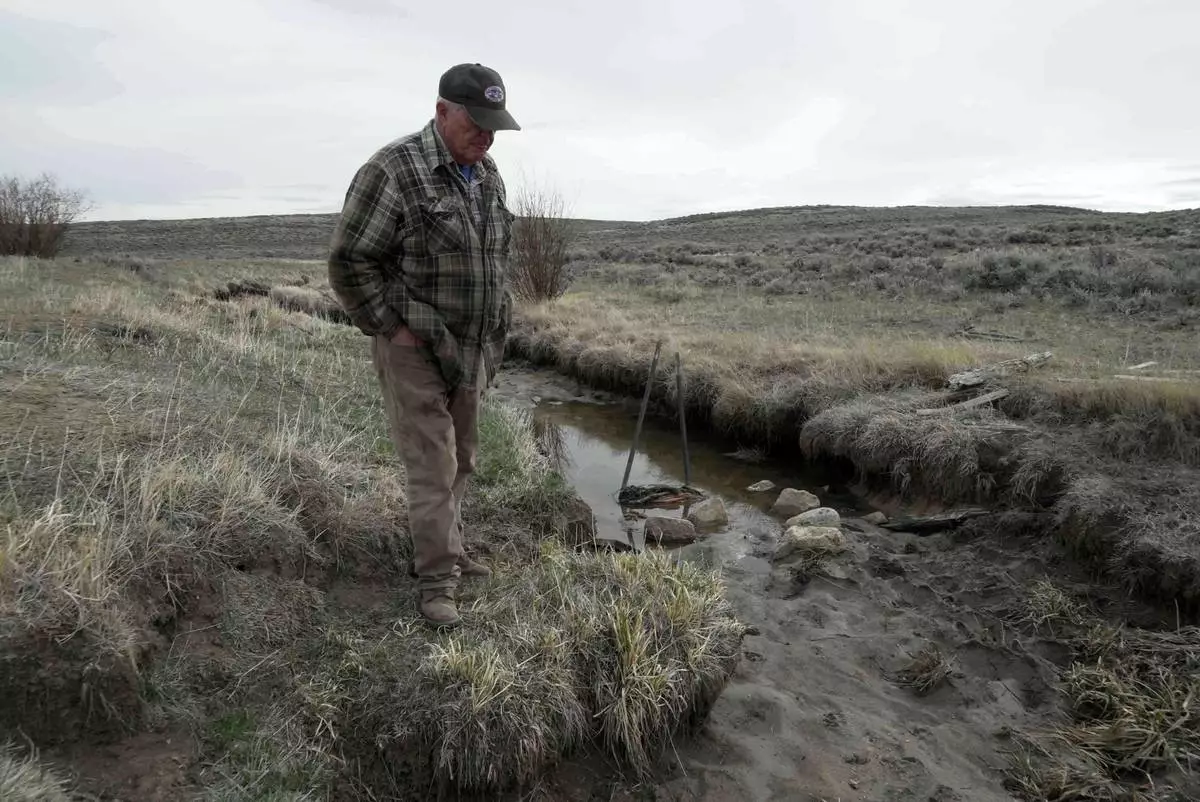
Philip Anderson looks at a dry ditch that usually transports water for stock and irrigation, Tuesday, March 31, 2026, in Walden, Colo. (AP Photo/Brittany Peterson)
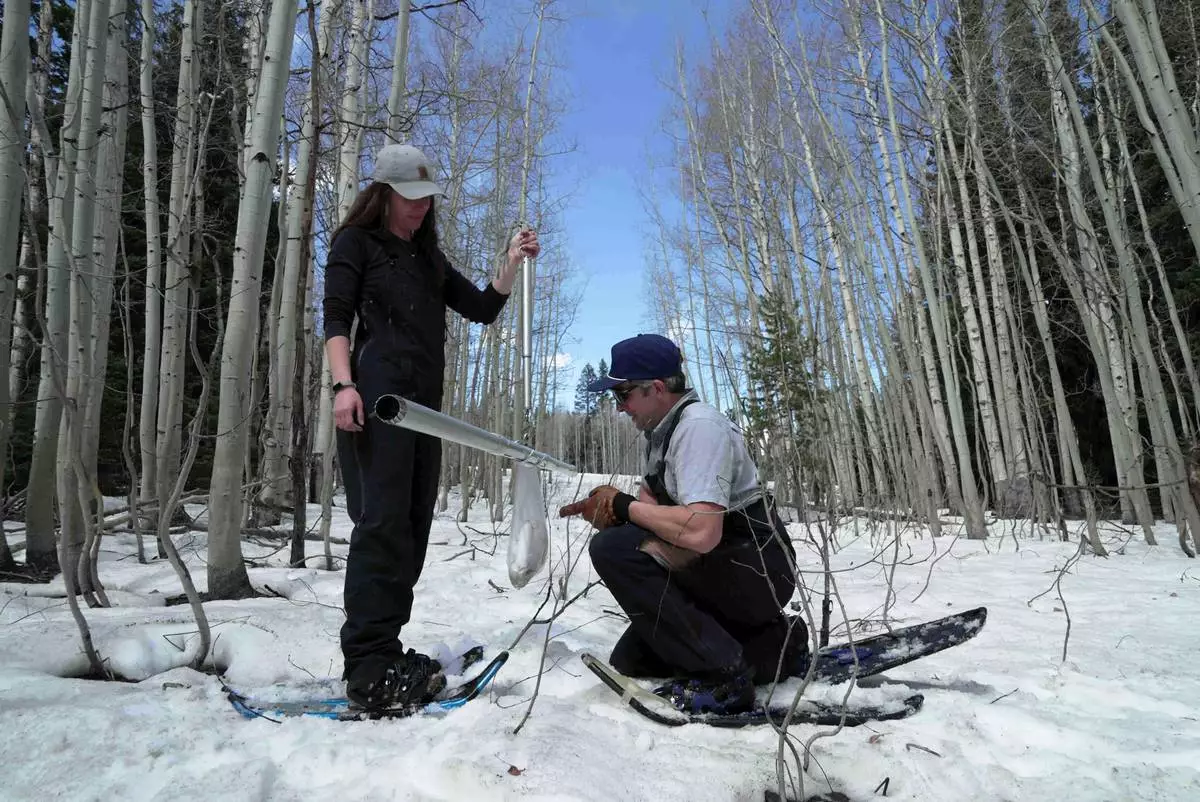
Snow surveyors, hydrologist, Maureen Gutsch, left, and Clinton Whitten weigh a snow sample, Monday, March 30, 2026, in Kremmling, Colo. (AP Photo/Brittany Peterson)
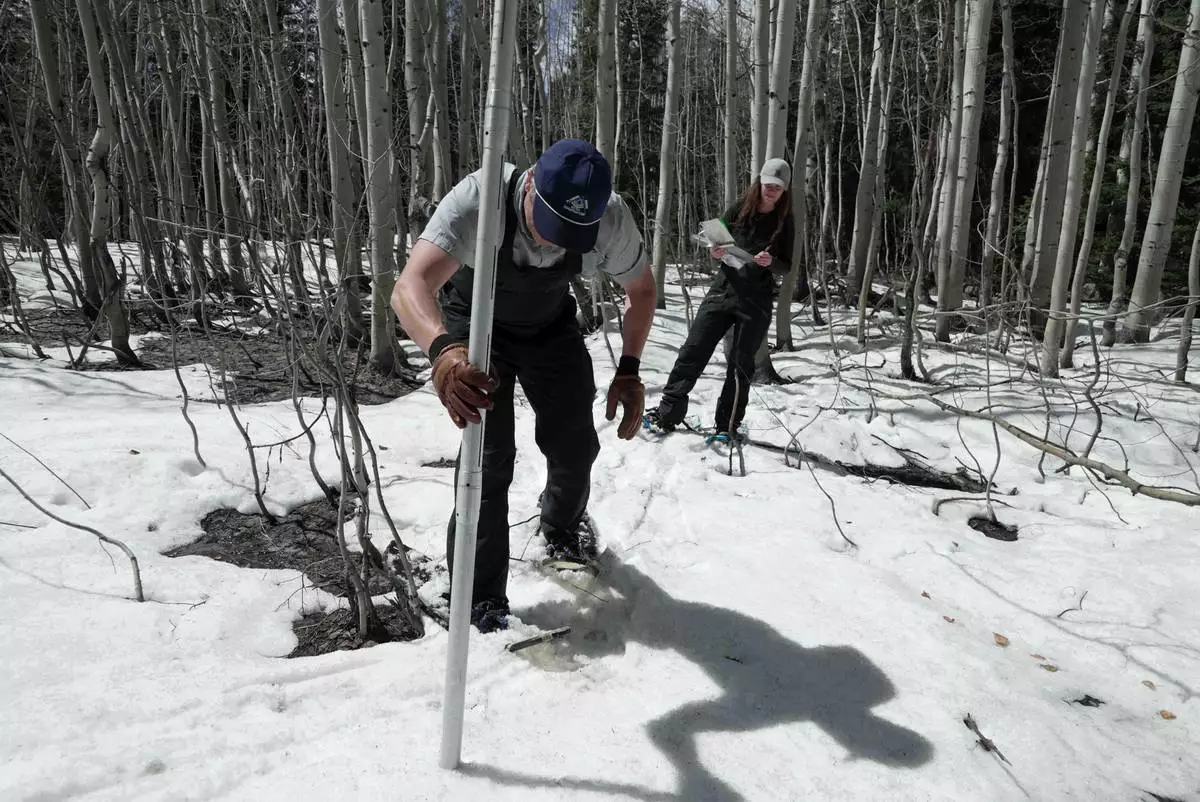
Clinton Whitten and hydrologist Maureen Gutsch, back, measure snow, Monday, March 30, 2026, in Kremmling, Colo. (AP Photo/Brittany Peterson)
The four Artemis II mission astronauts have entered the Orion capsule and are in place for humanity’s first trip to the moon in more than half a century, aiming for an evening liftoff. NASA is looking into a battery issue, but the launch countdown is still on
NASA's launch team loaded more than 700,000 gallons of fuel into the 32-story Space Launch System rocket early Wednesday, setting the stage for blast off in the evening, with a two-hour launch window beginning at 6:24 p.m. EDT at Kennedy Space Center in Florida.
Artemis astronauts Reid Wiseman, Victor Glover, Christina Koch and Jeremy Hansen will be on board. They’ll hurtle several thousand miles beyond the moon, hang a U-turn and then come straight back. No circling around the moon, no stopping for a moonwalk — just a quick out-and-back lasting less than 10 days. NASA promises more boot prints in the gray lunar dust, but not before a couple practice missions.
Unlike the Apollo missions that sent astronauts to the moon from 1968 through 1972, Artemis’ debut crew includes a woman, a person of color and a Canadian citizen.
Artemis II is the opening shot of NASA’s grand plans for a permanent moon base. The space program is aiming for a moon landing near the lunar south pole in 2028.
The Latest:
NASA has cleared the mission for launch after a battery issue was resolved. It is believed to be an instrumentation issue and not a problem with the battery itself.
Holds or pauses are built into the countdown ahead of time to provide a buffer to the schedule.
NASA can extend these holds if a problem is detected. This gives the launch team time to investigate the issue and resume counting if it can be fixed in time. NASA can also call an unplanned hold if necessary.
The first planned was set at the 12-hour, 35-minute mark — before fueling — and lasted for two hours and 45 minutes.
The second planned hold occurs at the 40-minute mark and lasts 30 minutes. It’s during this hold that the launch director polls the team to determine whether everyone is “go” or to proceed.
With 52 minutes remaining in the countdown, NASA’s Derrol Nail reported that one of two batteries in the abort system is not displaying the proper temperature.
The launch team is scrambling to determine whether a sensor is at fault or whether the battery itself is faulty. NASA cannot proceed past the six-minute mark unless confident in the batteries’ operation.
Like with Apollo, the mission will end with a splashdown homecoming into the Pacific.
Navy recovery ships will be stationed off the coast of San Diego as Orion parachutes into the ocean.
There’s a medical kit aboard Orion containing basic first-aid items, common medications like antibiotics, and medical devices such as a blood pressure monitor and thermometer.
Astronauts can also have private medical consultations with flight surgeons on the ground via video, similar to a telehealth visit on Earth.
Ahead of launch, the crew was in quarantine to avoid falling ill.
“President Trump is excited about the next phase with the historic upcoming Artemis II launch,” said White House spokesperson Liz Huston. “This effort will strengthen American leadership in space, usher in scientific discoveries, and serve as the proving ground for missions to Mars.”
Trump is expected to monitor Wednesday’s launch from the White House.
An unspecified issue with the rocket’s flight-termination system, which would send a self-destruct signal to the rocket in case it veered off course and was aiming for a populated area, has been resolved, NASA said.
Spectators cheered when NASA made its announcement.
There is an unspecified issue with the rocket’s flight-termination system, which would send a self-destruct signal to the rocket in case it veered off course and was aiming for a populated area.
“Pretty unique situation here,” NASA commentator Derrol Nail explained.
One of the launch controllers has been called into service to dash over to the adjoining Vehicle Assembly Building to grab space shuttle-era equipment, he said. He stressed that it is not a problem with the rocket itself.
“At this moment the range is no-go, but that is not stopping us from moving forward in the countdown,” Nail reported.
Forget about puree squeezed from toothpaste-style tubes.
Modern space food is more appetizing and nutritious than the meals that flew to space in the 1960s — though options are still limited.
During the Artemis II mission, astronauts can feast on mac and cheese, tortillas and vegetable quiche. Drinks include coffee, green tea and lemonade, among other beverages.
Astronauts use water to rehydrate their meals and a food warmer to heat up their food. Menus are designed to minimize crumbs, which can pose a danger if they clog spacecraft equipment or get into astronauts’ eyes.
Fresh food isn’t an option since the Orion capsule lacks refrigeration.
The space agency recently rejiggered its Artemis moon exploration program, modeling it after fast-paced Apollo, which launched moonshots in quick succession in the 1960s and 1970s.
Last month NASA’s new administrator Jared Isaacman laid out a blueprint for a moon base that, along with lunar drones and rovers, is expected to cost $20 billion over the next seven years.
▶ Read more about the retooled Artemis program
Space weather forecasters plan to closely track the sun as the Artemis II crew heads to the moon and back.
In recent months, huge eruptions on the sun’s surface have triggered solar storms that spawned colorful auroras in unexpected places on Earth.
Artemis II astronauts will wear personal dosimeters to monitor radiation levels. If there’s a sudden spike, astronauts can reconfigure the cabin into a shelter by putting barriers to shield themselves from incoming radiation.
President Donald Trump wished them well via social media ahead of the planned launch: “God bless our incredible Astronauts, God bless NASA and God bless the Greatest Nation ever to exist.”
Speaking of Artemis II astronaut — and first-time space flier — Jeremy Hansen, Canadian Space Agency President Lisa Campbell told NASA on Wednesday, “We’re very proud. He’s so ready. He’s been waiting for this his whole life, preparing, training, and he’s a wonderful example of Canada.”
Charlie Mars, 90, who worked on Apollo’s command and lunar modules: “Because it was the first time, there was an energy. There was a passion that probably is not exactly the same today and hasn’t been for a while.”
JoAnn Morgan, 85, who was the lone female engineer inside launch control during the Apollo 11 landing:
“It will be even greater when they actually have a woman who plants her boots on the moon.”
Charlie Duke, 90, Apollo 16 moonwalker: “If the first ones are successful and we start landing at the south pole, I think millions are going to be watching that. I know I will if I’m still here.”
Everyone needs to go — even in space.
There were no bathrooms on the Apollo missions. Astronauts urinated into bags and diapers.
A primitive potty was aboard the U.S. space station, Skylab, in the 1970s. The International Space Station now features three bathrooms as the orbiting complex expanded.
The Orion capsule is equipped with a compact lunar loo that was tested on the space station several years ago.
Known as the universal waste management system, the titanium toilet uses air suction instead of water and gravity to remove waste, similar to earlier space commodes. It’s also designed to better accommodate female astronauts.
The system collects urine and solid waste separately — No. 1 is vented into space and No. 2 is stowed for the return trip.
Lucas Ye’s design for a zero gravity indicator was picked from more than 2,600 submissions to fly to the moon. It also won him a trip to watch the Artemis II launch from Kennedy Space Center.
The 8-year-old from California designed a plush toy called “Rise,” inspired by the iconic ″Earthrise’’ photo taken during Apollo 8.
Interviewed by NASA, he said he was, “Really, really, really, really, really, really, really surprised and very happy” to win and be here.
To prevent bone and muscle loss in space, astronauts will keep in shape using a device that acts like a yo-yo.
They can do exercises such as rowing, squats and dead lifts.
Each astronaut will spend about a half hour a day exercising on the device, developed by the Canadian Space Agency.
The four Artemis astronauts have entered the Orion capsule and are in place for humanity’s first trip to the moon in 53 years.
After they arrived at the launch pad, they rode an elevator up to the capsule and signed their names to the so-called white room, where they stage for boarding.
They donned their helmets, made some final adjustments to the suits, and climbed into the capsule. If they take off as planned, they will remain in the capsule — with about as much room as a small camper van — for the next 10 days.
Watching a rocket launch can be confusing if you’re unfamiliar with the jargon, or specialized language, used by NASA.
Here’s a guide to some key terms:
NASA chief Jared Isaacman has had pizza delivered to the launch team in Cape Canaveral. It’s lunchtime for the team as the opening of the launch window at 6:24 p.m. EDT approaches.
It’s an escape system designed to ferry Artemis II astronauts to safety if there’s an emergency on the pad or during initial ascent.
A tower structure mounted on top of Orion can be activated to quickly rip the capsule and astronauts away from the SLS rocket and release it for a parachute splashdown in the ocean, according to Lockheed Martin.
The Canadian fighter pilot and physicist is making his space debut and serving as his country’s first emissary to the moon.
“Maybe I’m naive, but I don’t feel a lot of personal pressure.”
Hansen, 50, grew up on a farm near London, Ontario, before moving to Ingersoll and pursuing a flying career.
He realizes only now how much effort it took to send men to the moon during Apollo.
“When I walk out and I look at the moon now, it looks and feels a little bit farther than it used to be,” he said.
Dangers still loom — something he’s shared with his college-aged son and twin daughters. “The most likely outcome is that we will come back safe. There’s a chance we won’t, and you will be able to move through life even if that happens,” he assured them.
The SLS rocket stands 322 feet (98 meters), shorter than the Apollo program’s Saturn V rocket. But it’s but more powerful at liftoff thanks to a pair of strap-on boosters.
Atop the rocket is the Orion capsule carrying the Artemis II crew.
The solid rocket boosters are bigger versions of the rocket motors on the space shuttles that carried up most of the parts of the International Space Station, as well as the astronaut construction crews.
The SLS uses the same fuel — liquid hydrogen — as the shuttle did.
Hydrogen leaks repeatedly grounded the shuttles as well as the SLS during testing in 2022 and again earlier this year, bumping Artemis II into April.
The last time Koch blasted into space, she was gone almost a year so she’s not sweating a quick trip to the moon and back.
The 47-year-old electrical engineer from Jacksonville, North Carolina, holds the record for the longest single spaceflight by a woman — 328 days. She took part in the first all-female spacewalk during her lengthy stay at the space station in 2019.
Before she got called up by NASA, Koch spent a year at a South Pole research station. Between that and her space stint, she feels she’s “inoculated” most of her family and friends.
“So far, I haven’t gotten too many nerves from folks. Maybe my dog, but I’ve reassured her that it’s only 10 days. It’s not going to be as long as last time.”
Her and her husband’s rescue pooch is named Sadie Lou.
As one of NASA’s few Black astronauts, Glover sees his presence on the mission as “a force for good.”
The 49-year-old Navy captain and former combat pilot from Pomona, California, makes it a habit to listen to Gil Scott-Heron’s “Whitey on the Moon” and Marvin Gaye’s “Make Me Wanna Holler” from the white-dominated Apollo era.
“I listen to those for perspective,” he said. “It captures what we did well, what we did poorly.”
The ability for him now to offer hope to others is “an amazing blessing and a privilege.”
He’s hyper-focused on running “our best race so that we can hand the baton off to the next leg” — a 2027 practice docking mission in orbit around Earth between an Orion crew capsule and one or two lunar landers.
Wiseman, Glover, Koch and Hansen have left the Neil Armstrong Operations and Checkout Building and are on their way to launch pad 39B.
Waving to family, colleagues and news photographers, the crew boarded the so-called astrovan for the 9-mile ride to the launch pad and their awaiting SLS rocket.
Before their highly anticipated walkout, commander Reid Wiseman and his crew played a quick card game with NASA’s chief astronaut Scott Tingle. It’s a preflight tradition since the space shuttle era.
Losing is good: It means the astronaut has gotten rid of all bad luck before launching.
The four thanked the suit techs and posed for photos, keeping a safe distance from many of the bystanders to avoid germs. They then went down the elevator at the Neil Armstrong Operations & Checkout Building and walk out to a barrage of cameras and cheers.
They’ll take a custom-designed astrovan for the ride to the launch pad
House Speaker Mike Johnson posted on the social media site X ahead of the planned Artemis II launch.
“Praying for the safety and success of the Artemis II crew and @NASA as they undertake a mission that will carry humanity farther into space than we have gone in over half a century. I had the privilege of hosting these courageous pioneers at the State of the Union earlier this year. Americans are watching proudly as our Golden Age reaches new heights!” Johnson wrote.
Wiseman, 50, a retired Navy captain from Baltimore, was serving as NASA’s chief astronaut when asked three years ago to lead humanity’s first lunar trip since 1972.
His wife Carroll’s death from cancer in 2020 gave him pause.
His two teenage daughters, especially the older one, had “zero interest” in him launching again after a 2014 trip to the International Space Station.
“We talked about it and I said, ’Look, of all the people on planet Earth right now, there are four people that are in a position to go fly around the moon,” he said. “I cannot say no to that opportunity.”
The next day, homemade moon cupcakes awaited him, along with his daughters’ support.
Artemis is the twin sister of Apollo in Greek mythology. They are the children of Zeus and Leto. Artemis has long been associated with the moon.
While the Artemis name builds on the Apollo program and pays homage to it, “there is no way we could be that same mission or ever hope to even be,” said NASA astronaut Christina Koch, part of the Artemis II crew.
The Apollo program was all about beating the Russians to the moon and planting the U.S. flag. NASA sent 24 astronauts to the moon between 1968 and 1972, including 12 moonwalkers. Now China is the competition.
NASA is striving for a long-term lunar presence under Artemis, with Mars to follow.
The Artemis II astronauts are now in their orange Orion spacesuits that they will wear for launch and reentry. Testing these new suits is one of the main goals of the mission.
The four are expected to emerge for their trip to the pad sometime before 2 p.m.
NASA created bright orange custom spacesuits for launch and reentry. Astronauts will also use them in case of a depressurization or some other emergency.
They can survive up to six days in the suits, inserting a straw into the helmet to sip water or protein shakes and relying on undergarment bags and bladders as a built-in toilet.
Future Artemis crews to the lunar surface will wear white moonwalking suits designed by Axiom Space.
During the Apollo era, astronauts wore the same white bulky spacesuits for launch and return as well as for moonwalks because there wasn’t enough storage on board for different outfits.
“We should have done Artemis 50 years ago,” said John Tribe, a propulsion engineer during the Apollo era.
The launch team has loaded more than 700,000 gallons of fuel into the 32-story Space Launch System rocket, setting the stage for the Artemis II crew to board.
The wind is picking up at Cape Canaveral, more clouds are appearing and rain is expected in about two hours. But there is no lightning threat, NASA says, and there’s still an 80% chance the weather will be good enough to launch.
L-minus tracks the overall time to liftoff, counting down the days, hours and minutes away before the planned blastoff. It doesn’t include built-in holds, or pauses — that’s T-minus time.
The T-minus countdown in the final 10 minutes is where nerves tense up and hearts start pounding. Automated software kicks off a series of highly choreographed milestones. During this period, the clock can be stopped if a problem is spotted and restarted if it’s fixed in time.
T-0 is the moment of liftoff — zero — when the boosters ignite and the rocket begins its journey.
NASA has a narrow time frame each month to fly to the moon.
The Earth and moon must be aligned just so to achieve the proper trajectory for the mission. In any given month, there’s only about a week when Artemis II astronauts can lift off.
The Orion capsule needs to get a check of its life-support and other systems in near-Earth orbit. If that goes well, Orion will fire its main engine to hurtle toward the moon, taking advantage of the moon and Earth’s gravity to get there and back in a slingshot maneuver that requires little if any fuel.
Orion also needs sunlight for power and can’t be in darkness for more than 90 minutes at a time. Plus NASA wants to minimize heating during reentry at flight’s end.
The latest launch window runs through April 6. The next opportunity opens on April 30.
The hydrogen tank of the rocket’s core stage is 100% filled. NASA said no significant leaks have been observed so far in fueling. It was hydrogen leaks that prevented the rocket from flying in February.
The alarm clocks just went off in Kennedy Space Center’s crew quarters.
That means it’s rise and shine for the three Americans and one Canadian who are about to become the first lunar visitors in more than 53 years.
They have a long day ahead of them, whether they launch or not.
After breakfast, they’ll start suiting up. NASA’s launch window opens at 6:24 p.m. and lasts a full two hours.
Launch director Charlie Blackwell-Thompson is wearing green as are many of the controllers alongside her in the firing room.
Green represents “go” for NASA, a color symbolizing good luck.
The team is monitoring the fueling of the 322-foot moon rocket, set to blast off Wednesday evening.
A plush toy named Rise will ride with the Artemis II astronauts around the moon, carrying the names of more than 5.6 million people.
Rise is what’s known as a zero gravity indicator, which gives the astronauts a visual cue of when they reach space.
The design was inspired by the iconic “Earthrise” photo during Apollo 8, showing the planet as a shadowed blue marble from space in 1968.
Rise was selected from more than 2,600 contest submissions. It was designed by Lucas Ye of California.
Commander Reid Wiseman and his crew tucked a small memory card into Rise before the toy was loaded into the Orion capsule. The card bears the names of all those who signed up with NASA to vicariously tag along on the nearly 10-day journey.
“Zipping that little pocket on the bottom of Rise was kind of the moment that put it all together for me,” Wiseman said. “We are going for all and by all. It’s time to fly.”
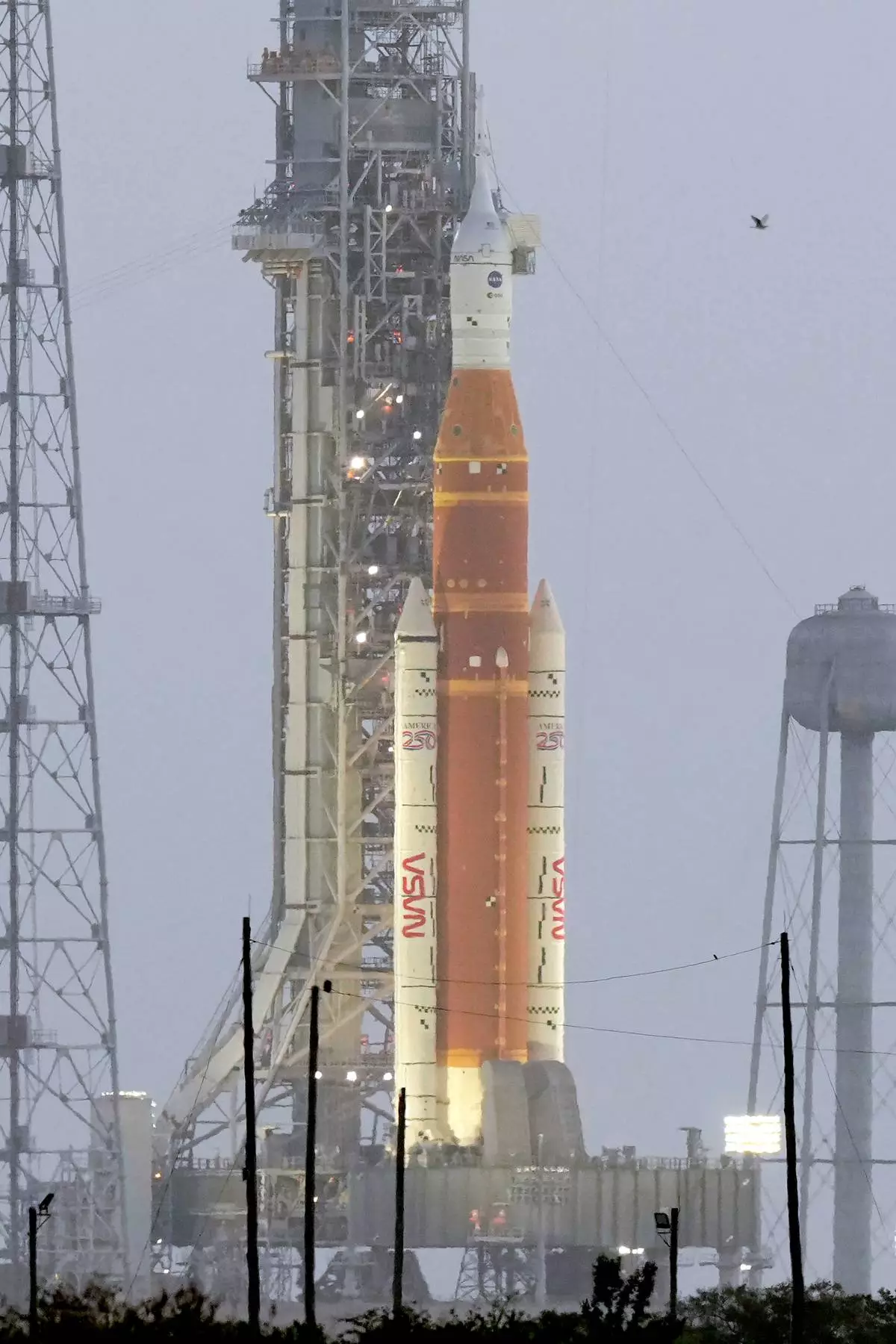
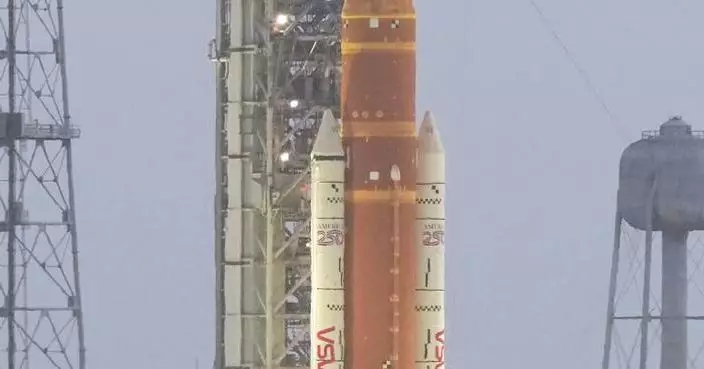
NASA's Artermis II moon rocket sits on Launch Pad 39-B at the Kennedy Space Center hours ahead of planned liftoff Wednesday, April 1, 2026, in Cape Canaveral, Fla. (AP Photo/Chris O'Meara)
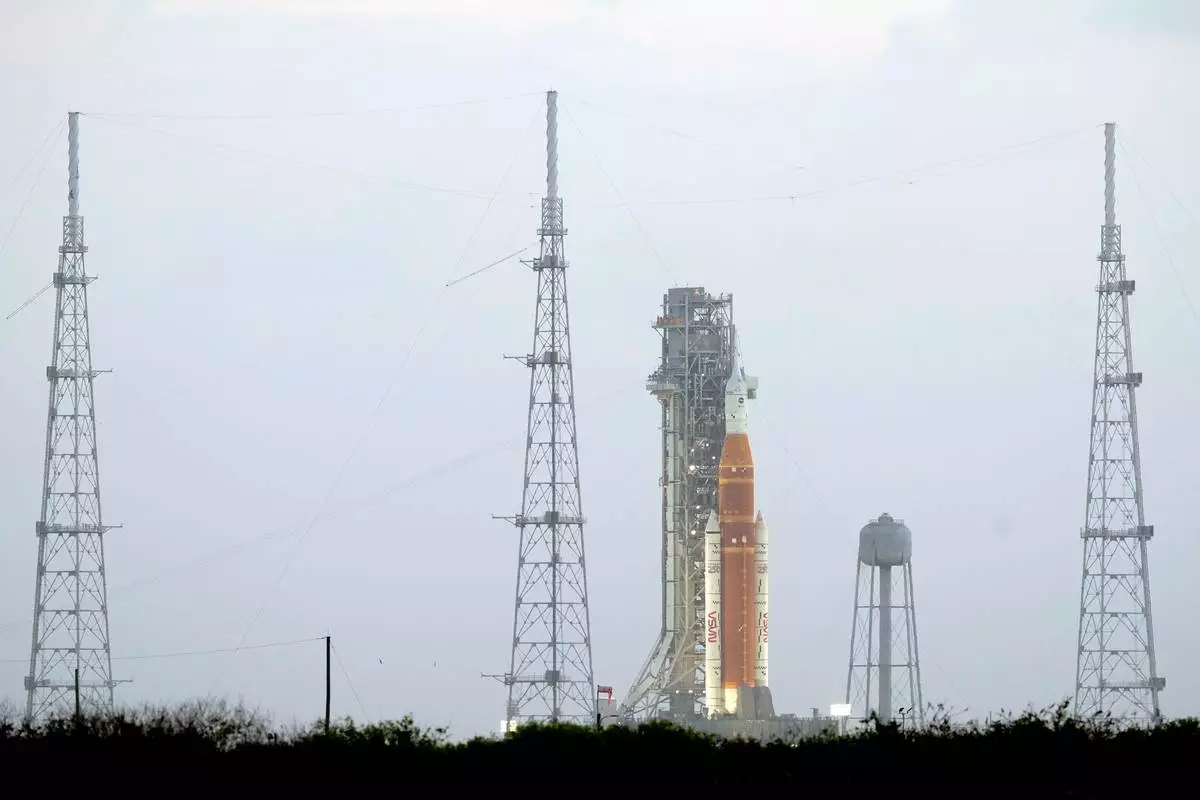
NASA's Artermis II moon rocket sits on Launch Pad 39-B at the Kennedy Space Center hours ahead of a planned launch attempt Wednesday, April 1, 2026, in Cape Canaveral, Fla. (AP Photo/Chris O'Meara)
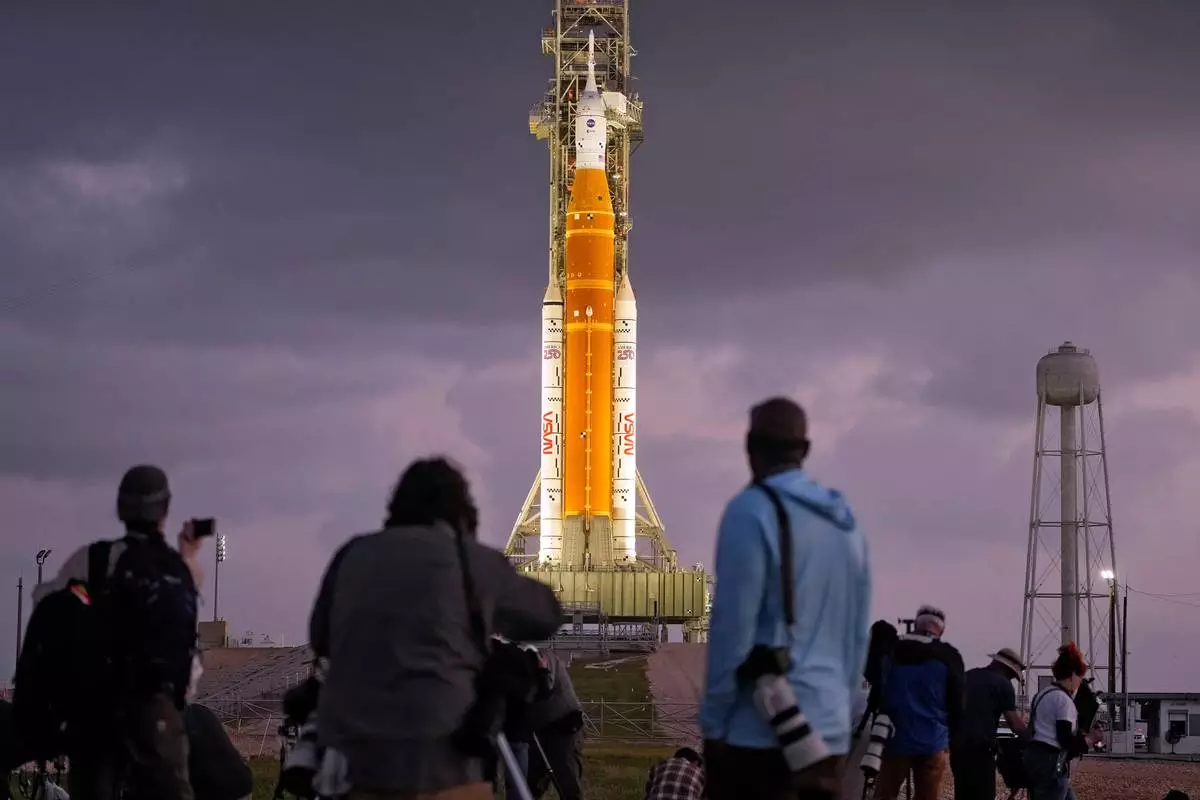
Photographers set up remote cameras near NASA's Artermis II moon rocket on Launch Pad 39-B just before sunrise at the Kennedy Space Center Tuesday, March 31, 2026, in Cape Canaveral, Fla. (AP Photo/Chris O'Meara)