China will, during the 15th Five-Year Plan period (2026-2030), launch a series of scientific satellite missions, focusing on major frontiers such as the origins of the universe, the origin of space weather, and the search for Earth-like exoplanets, officials said at a press conference in Beijing on Monday about the latest achievements of the country's space science pilot program.
Key missions include the "Hongmeng Program," the Kuafu-2 satellite, and mission to search for Earth-like planets outside our solar system, as well as an upgraded X-ray timing and polarization space observatory. Scientists aim to make new breakthroughs in areas such as the "cosmic dark age," the sun's magnetic cycle, and finding Earth-like exoplanets, according to Wang Chi, an academician of the Chinese Academy of Sciences (CAS) and director of its National Space Science Center.
"As we move into the 15th Five-Year Plan period, we will strive to make original scientific breakthroughs in understanding the origins and evolution of the universe, the origins of space weather, and the origins of life on exoplanets. We also hope that the results produced by our scientific satellites will stand as landmark achievements as China advances toward becoming a leading science and technology power by 2035," he said.
Since the launch of the Strategic Priority Program (SPP) on Space Science -- a CAS space science program in 2011, eight scientific satellites have been sent into space: the Dark Matter Particle Explorer, the Shijian-10 retrievable satellite, the Quantum Experiments at Space Scale, the Hard X-ray Modulation Telescope (also called Insight-HXMT), the Taiji-1 satellite, the Gravitational Wave High-energy Electromagnetic Counterpart All-sky Monitor, the Advanced Space-based Solar Observatory, and the Einstein Probe (EP).
On an extreme macroscopic scale, the program has produced the world's first all-sky X-ray map. And on an extreme microscopic scale, it has obtained the most precise fine structures to date in the energy spectra of cosmic-ray electrons, protons, helium and boron nuclei. A Chinese satellite has for the first time directly measured the strongest magnetic field in the universe and detected the high-speed jet closest to a black hole. Collectively, these breakthroughs have propelled China’s space science innovation into the fast lane.
While achieving scientific breakthroughs, the program has also driven leapfrog development in cutting-edge payload and satellite platform technologies. In just a few examples, China has mastered key technologies such as satellite-to-ground optical-link alignment, realized an integrated satellite platform and payload design, and developed the world's leading large-field, high-sensitivity lobster-eye X-ray telescope.
The program also carries out comprehensive international cooperation on multiple levels. The EP satellite -- led by China, with participation from the European Space Agency (ESA), Germany and France -- marks the first time the ESA has participated in a Chinese space science mission as an "opportunity mission". Such missions have established international science teams and promoted data sharing.
The Einstein Probe (EP) satellite has discovered a new type of X-ray transient source, EP241021a, providing key information for the understanding of mysterious transient objects. The EP satellite has also detected a weak X-ray burst, EP240904a, within the Milky Way, opening new pathway for locating stellar-mass black holes; and for the first time detected the EP240801a transient source, challenging the established classification of gamma-ray bursts, according to Yuan Weimin, principal investigator of the EP mission.
"(During the 15th Five-Year Plan period,) we will study large-sample X-ray flares. We have already accumulated data on the X-ray flares of the largest sample of stars in the world, and will conduct systematic analysis," Yuan said.
"The satellites under the SPP have gone through a 15-year journey since the program's inception, showcasing China's achievements in space science with breakthroughs across multiple areas, and a strong overall momentum in development," Wang said.
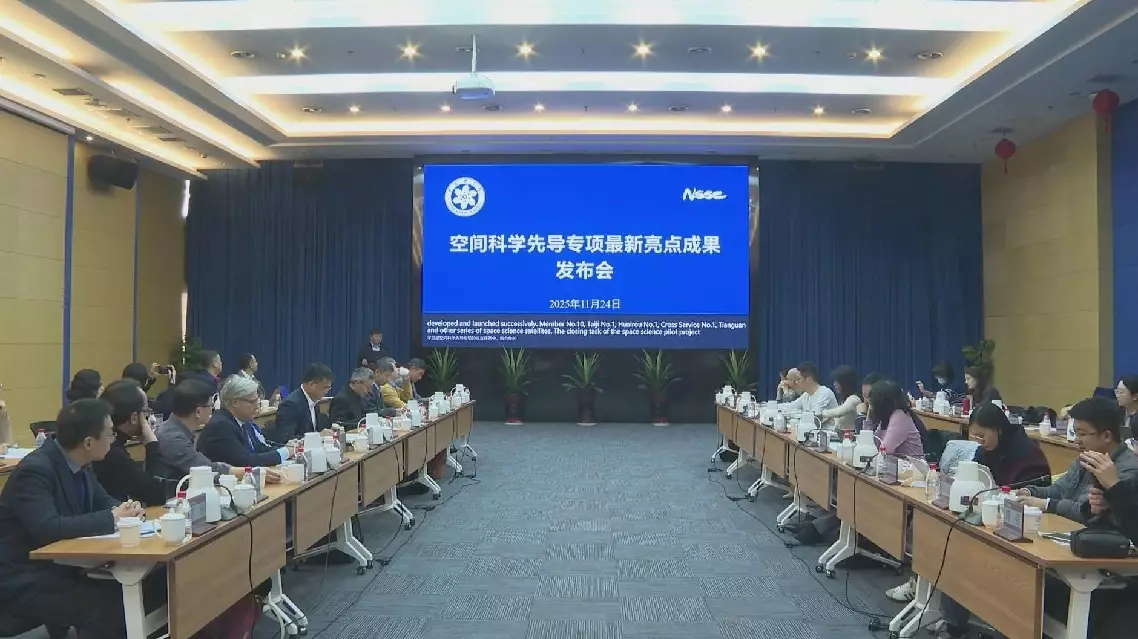
China to explore origins of universe, search for Earth-like exoplanets, other space science missions during 2026-2030