Four Chinese athletes proudly participated in the Milan-Cortina 2026 Winter Olympics torch relay in Greece on Thursday, highlighting international unity and Olympic spirit.
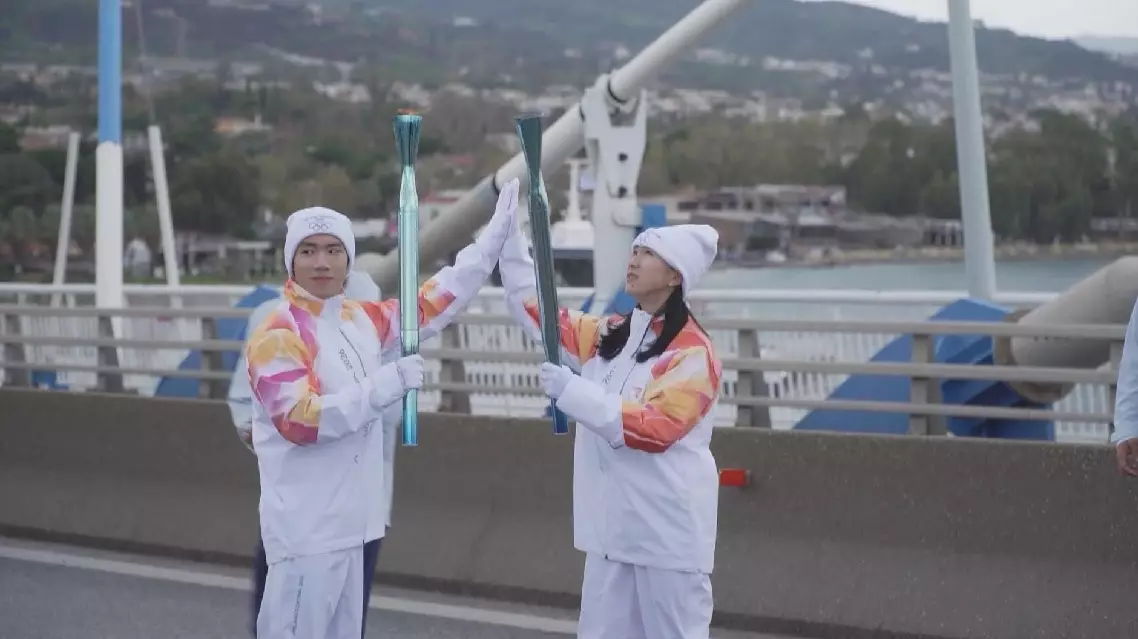
On Thursday, the Olympic torch relay continued its second day in Greece, with four Chinese athletes participating in the symbolic event near the iconic Rio-Antirrio Bridge close to Patras, Greece's third-largest city.
The torch relay, which began in Ancient Olympia on Wednesday, is set to cover 2,200 kilometers across seven Greek provinces and 23 cities before the flame is handed over to the Italian organizers in Athens on December 4.
Representing China were gymnast Zhang Boheng, track and field athlete Chen Yujie, basketball player Wang Siyu, and trail runner Wu Yongbo. The group joined local torchbearers in carrying the Olympic flame close to the bridge connecting the Peloponnese Peninsula to mainland Greece.
"I feel incredibly proud to participate in this torch relay on behalf of Chinese athletes and the national gymnastics team. This is a great encouragement for me personally," said Zhang Boheng.
"I hope all Chinese winter sports athletes can achieve great results. I want to see everyone fulfill their dreams, enjoy the games, and show their best in Milan," said Wu Yongbo.
The torch relay follows the traditional ceremony held in Ancient Olympia, where the Olympic flame was ignited using the sun's rays at the Temple of Hera. Despite weather disruptions that forced parts of the ceremony indoors this year, organizers emphasized that the Olympic symbolism and message of peace remain undiminished.
The flame, symbolizing peace and unity, continues its journey through Greece before heading to Italy, where preparations are in full swing for the 2026 Winter Games.
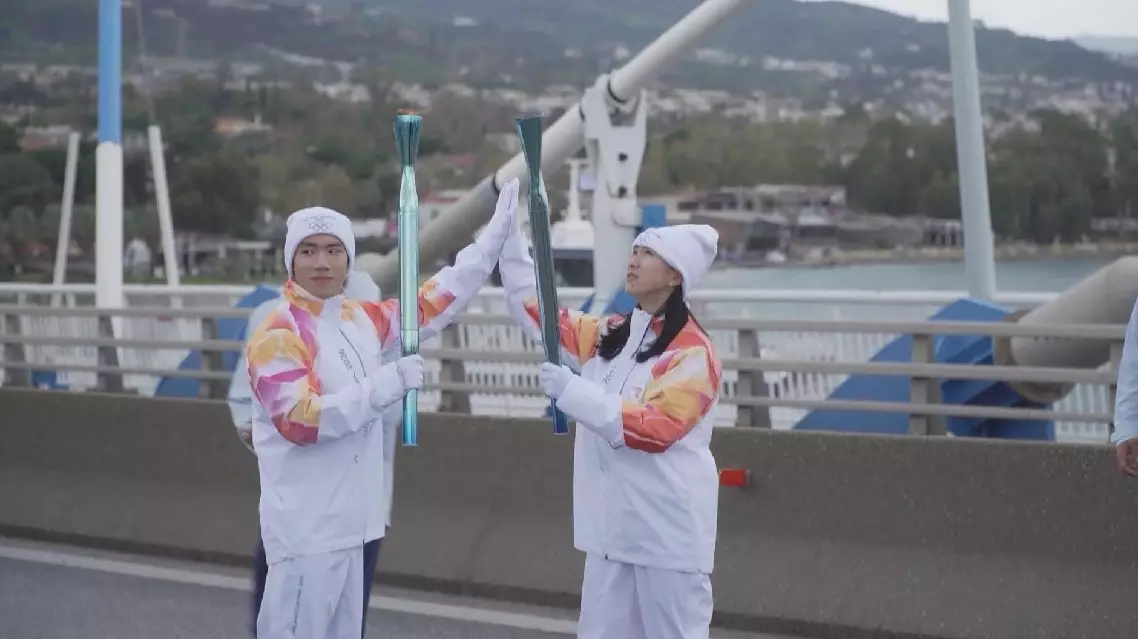
Chinese athletes join Milan 2026 torch relay in Greece
A solar-powered borehole drilling program supported by China has expanded water access across Zimbabwe's rural and peri-urban communities, strengthening disaster recovery and sustaining livelihoods since Cyclone Idai struck in 2019.
Tropical Cyclone Idai entered Zimbabwe from neighboring Mozambique, triggering floods and causing tragic losses of life and property.
Launched under a Chinese government initiative to restore water and sanitation services after cyclones and drought, the program has delivered lasting benefits.
At Mahusekwa Growth Point, where boreholes were drilled last year, reliable water now sustains dozens of small businesses and households, underscoring how the intervention continues to shape community resilience seven years on.
"We now have clean water to wash our products and for customers to wash their hands before they eat. We also fetch water to use at our homes because there is an intermittent supply," said Cynthia Garan'nga, a market vendor.
Reliable water access has also created employment opportunities, especially for young entrepreneurs such as car wash owner Loveness Marabwanya.
"Maybe I was going to get people to fetch water for me from the river, but it's very far and I was going to pay more for that. To imagine that the water is just like a few meters away, it's very easy and convenient for me," she said.
The borehole is solar powered, which means the community can access water at any hour of the day, and that refers to greater reliability and sustainability. There are no longer any limitations of fuel costs or power cuts.
Mahusekwa is one of more than 300 communities nationwide benefiting from boreholes drilled under Chinese disaster assistance. Around 60 of them are in Mashonaland East, where water shortages had long slowed development and undermined food security.
"These boreholes came at the right time. Remember the last two or three years we have been having droughts," said Jeremiah Gwanzura, chairperson of Marondera Rural District Council.
Gwanzura says the availability of water is sustaining livelihoods and boosting production, even during prolonged dry spells.
"We have livelihoods in terms of livestock cattle, people are doing boilers behind the scenes, road runners, goats, piggery projects within the rural set-up, and if there is the missing link of water, it means we are going nowhere. Some of the areas in the rural areas are using it for nutritional gardens, going to the market, so they will be watering their vegetables, they will be watering their plants," he said.
At a national level, authorities say the boreholes reflect a shift from emergency response to long-term resilience.
"In any disaster recovery programme, what we always talk about is building-back better. And I'm sure this principle of building-back better, you can actually see it in the way that we are establishing these boreholes in Chimanimani, Masvingo, Midlands and Mashonaland East," said Nathan Nkomo, chief director of the Civil Protection Department.
Beyond water access, China has also supported food security through agricultural training, helping communities rebuild stronger and more sustainably in the years since Cyclone Idai.
China-supported borehole program expands water access, strengthens Zimbabwe's disaster recovery