Southern Thailand is facing its worst flooding in years, with tens of thousands of residents trapped and emergency responders stretched thin as relentless monsoon rains continue to pound the region.
In Hat Yai, Songkhla Province, more than 77,000 people have been affected. Treacherous conditions, collapsed infrastructure, and ongoing rainfall have severely hampered rescue efforts, leaving many still stranded with limited access to help.
On Thursday, authorities confirmed that the death toll in Songkhla Province has climbed to 55, making it one of the hardest-hit areas in Thailand's south.
During a press briefing, government spokesperson Siripong Angkasakulkiat said that updated data from Songklanagarind Hospital as of Thursday shows 85 fatalities linked to the crisis. Of those, 55 deaths were directly caused by the floods, and another 30 occurred during the disaster period but resulted from unrelated causes.
He also noted that a full assessment remains impossible, as many flood-hit areas are still inaccessible and figures on missing persons are not yet finalized. With evacuations ongoing, the situation remains fluid.
Water levels are expected to drop below riverbanks by Thursday evening, Siripong added, which may finally allow for faster operations and the start of a large-scale cleanup effort.
But for now, the human toll remains immense.
On board one of the military trucks-turned-medical bays was Rewadee, a 67-year-old woman, pale and injured after debris gashed her leg two days earlier.
"I fell on the floor of my house. When the water receded, it left a lot of mud," she said.
Rewadee is among the hundreds of injured being treated on the move. These military trucks are now doubling as emergency mobile hospitals.
On another rescue trip, a pregnant woman in labor was loaded onto the vehicle by soldiers as flooded roads delayed her access to care. A rescuer navigated the vehicle through submerged roads that turned a 15-minute hospital drive into a journey that lasted hours.
The Thai military has dispatched troops, helicopters, flat-bottomed boats, and specialized forces to aid relief. Yet, resource limitations and geography pose immense challenges.
"It's a crisis, definitely a crisis. I've lived here for 35 years. This is the worst I've ever seen. We face many obstacles because sometimes our equipment doesn't match the severity of the situation. Big boats can't enter narrow alleys and small boats can't handle the strong currents. And communication is the biggest problem. Some people call for help but when we get there, we can't contact them," said Maj. Natthapol Khanatong, deputy commander of the 1st Infantry Regiment.
Despite nonstop rescue efforts, deteriorating conditions compound the emergency - roads are underwater, bridges have collapsed, and entire neighborhoods remain cut off. As emergency hotlines flood with calls, teams struggle to respond quickly enough.
Nationwide, the Department of Disaster Prevention and Mitigation reported that nearly 2.7 million people across over 980,000 households have been impacted in southern Thailand as of Wednesday.
Meanwhile, the Thai Meteorological Department warned that heavy rainfall will continue through midweek, and advises residents in mountainous and low-lying areas to stay alert for flash floods and forest runoff.
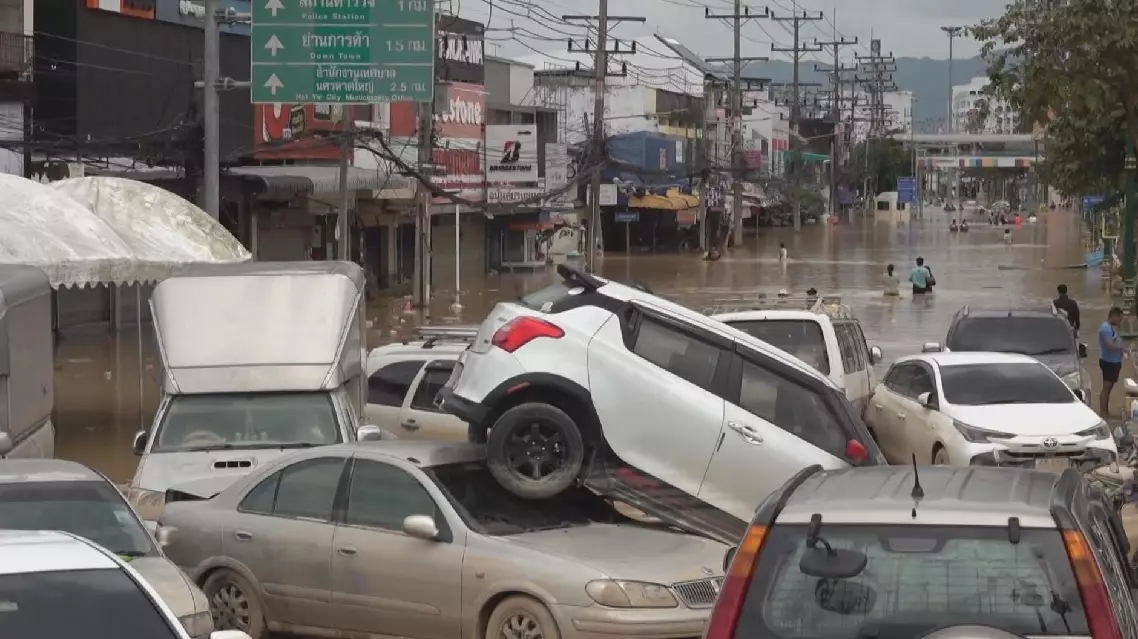
Southern Thailand floods overwhelm rescue teams