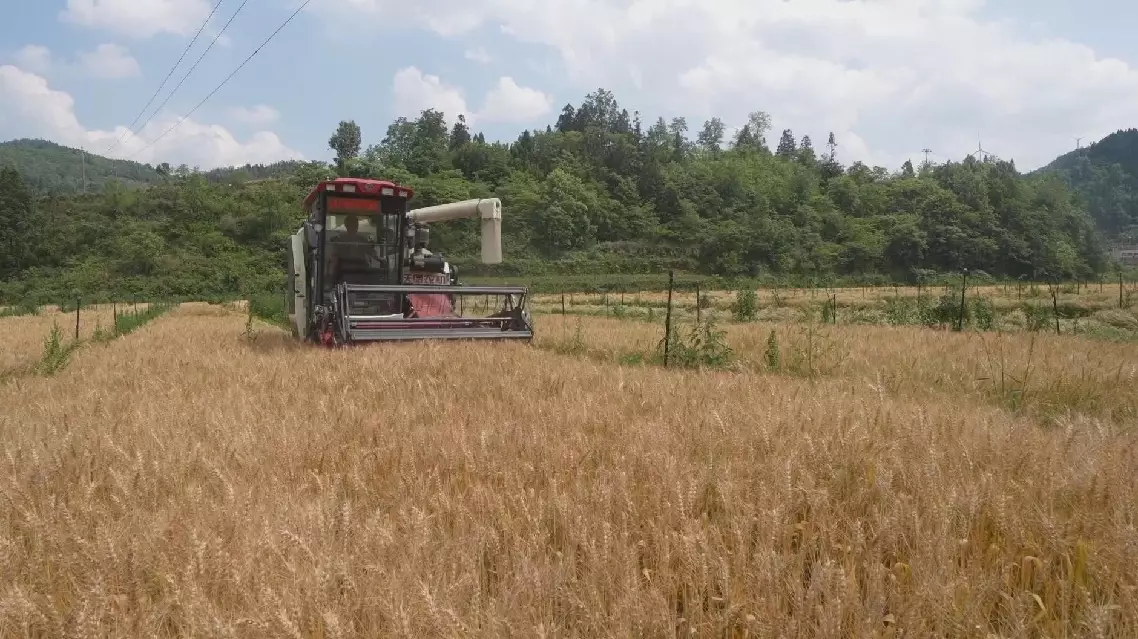
Xinjiang Uygur Autonomous Region in northwest China has been stepping up its efforts in sand control around the Taklimakan Desert over the past year, with key counties on the edge of the desert making remarkable achievements in afforestation.
The Taklimakan, located in the heart of the Tarim Basin, is China's largest desert and the world's second-largest drifting desert, spanning more than 330,000 square kilometers, nearly one-fifth of Xinjiang's total land area.
For generations, it has posed a formidable challenge to survival and development in the region. Over the recent decades, Xinjiang has mobilized joint efforts across multiple regions to build a protective green shield around the desert.
As of Nov 28, 2024, a sand-blocking barrier of 3,046 kilometers encircling the Taklimakan has been fully established, marking the longest green ecological barrier around a desert in the world.
Over the past year, the work of desert control has been continuously proceeding with remarkable results. As of the end of October 2025, Xinjiang had treated over 914,000 hectares of desertification.
People in Qiemo County have spared no efforts in sand prevention and control, transforming thousands of hectares of barren desert into a green landscape and building a windbreak and sand-fixing forest stretching over 20 kilometers.
Bachu County in Kashgar Prefecture has promoted ecological restoration through techniques such as reed barriers and three-dimensional planting, completing the treatment of over 66,600 hectares of desertified land and continuously consolidating the achievements in ecological governance of the Taklimakan Desert.
In 2023, the vast desert in Ruoqiang County was completely covered by crisscrossing barriers in just two years, thanks to the combined efforts of engineering sand control and biological sand fixation.
While intensifying desert control efforts, the locals have also made their efforts to develop arable land and aquatic products, achieving a double harvest of economic and ecological benefits. To date, the total area of desert-growing economic crops in Xinjiang has exceeded 720,000 hectares, generating a total output value of 28.9 billion yuan (about 4.1 billion U.S. dollars).
At the Houheba Desertification Control Base in Minfeng County, Hotan Prefecture, experimental fields are being planted with 22 kinds of Chinese medicinal herbs and 10 kinds of cash crops.
By exploring diversified governance approaches, Yutian County has formed a 20,000-hectare planting area of red willow and tamarisk, a 16,000-hectare inoculation area for cistanche deserticola, and a rose field over 4,600 hectares, forging a new path for the coordinated development of ecology and economy.
Located on the edge of the desert, Hotan County is witnessing a booming development of aquaculture. The area for large-scale aquaculture of crabs, bass, and lobsters has jumped to over 350 hectares as of today.
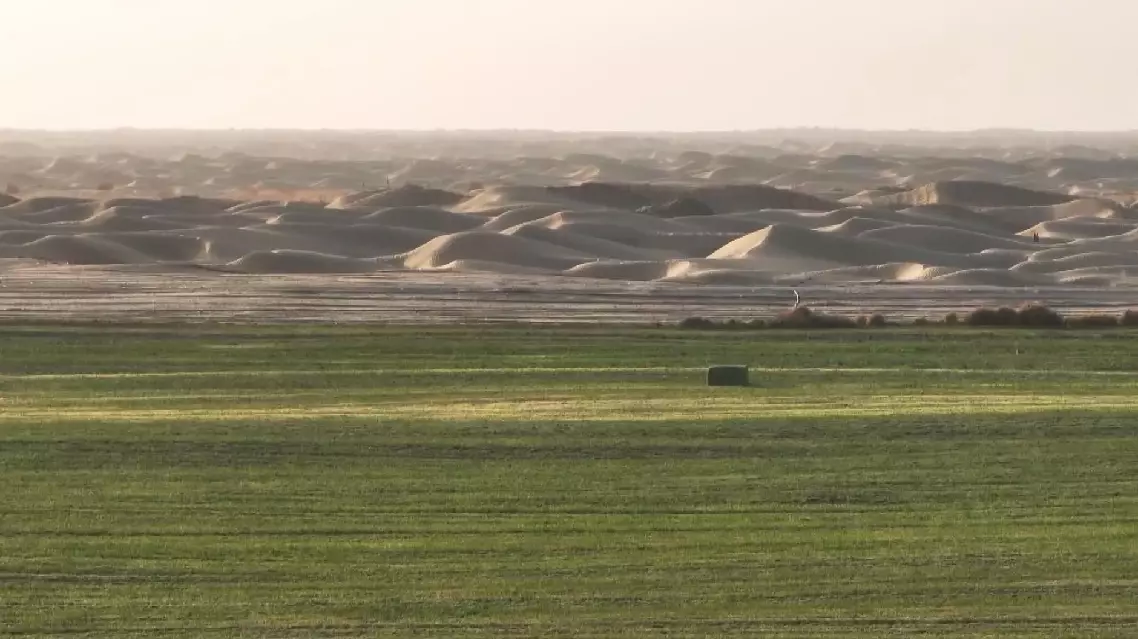
Xinjiang makes miracles in battle against Taklimakan Desert