Skip to Content Facebook Feature Image

Families mourn Nanjing Massacre victims ahead of national memorial day

China

China

China

Families mourn Nanjing Massacre victims ahead of national memorial day

2025-12-01 11:56 Last Updated At:14:07

A fortnight before China's national memorial day for the victims of the Nanjing Massacre, families of the victims on Sunday gathered at a memorial hall in Nanjing, the capital of Jiangsu Province in the east, to commemorate their loved ones.

According to statistics, another eight survivors of the Nanjing Massacre passed away this year, leaving only 24 registered survivors still alive.

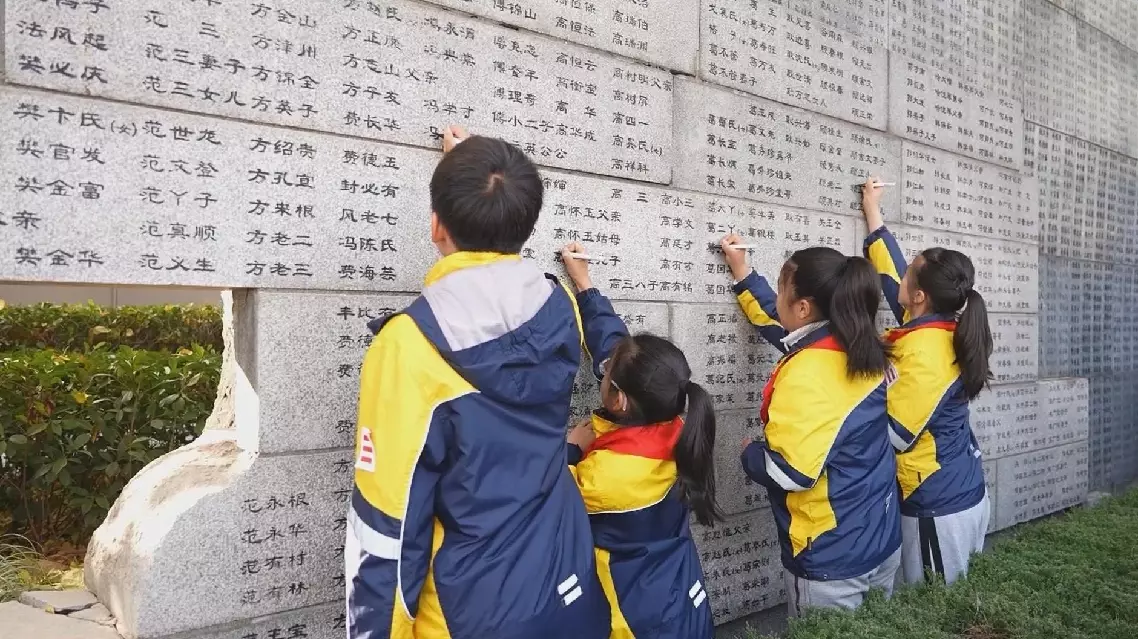
Survivors and families of victims paid tribute before a "wailing wall" outside the Memorial Hall of the Victims in Nanjing Massacre by Japanese Invaders. They bowed, laid flowers and observed a moment of silence in front of the wall, which bears the names of more than 10,000 people who were killed 88 years ago.

"Tracing the names on the wall makes me feel like I got closer to my grandparents and my uncles. Today, I have a responsibility and obligation to let more people learn about this history, so that we can work together to safeguard peace," said Chang Xiaomei, daughter of massacre survivor Chang Zhiqiang who passed away in late 2022 at 94.

To ensure this history is never forgotten, Chang has documented her father's experiences in a book published in Chinese, English and Japanese.

To date, 38 Chinese and foreign nationals, including Chang, have been officially recognized as inheritors of the historical memory of the Nanjing Massacre, continuing the survivors' mission through documentation, education and international exchange.

"We must never forget this history of national humiliation. We should keep peace in mind, study hard, build our motherland into a stronger and more prosperous nation, and make sure that such tragedies will never happen again," said Zhang Chenxi, a primary school student who attended the memorial event.

"The purpose of the event is to mourn the victims of the Nanjing Massacre, and to ensure that everyone remembers the historical truth of the massacre and passes on this historical truth and memory from generation to generation," said Li Xueqing, a staff member of the Memorial Hall of the Victims in Nanjing Massacre by Japanese Invaders.

China will observe its 12th national memorial day for the victims of the Nanjing Massacre on Dec 13, commemorating the day in 1937 when invading Japanese troops captured Nanjing, and began six weeks of slaughter that claimed the lives of more than 300,000 Chinese civilians and unarmed soldiers.
Families mourn Nanjing Massacre victims ahead of national memorial day

Families mourn Nanjing Massacre victims ahead of national memorial day
The U.S.-Israeli airstrikes against Iran since February 28 have inflicted irreparable damage on the country's priceless cultural heritage sites, according to Hassan Fartousi, secretary-general of the Iranian National Commission for UNESCO.

Speaking to the press on Tuesday, Fartousi said that 132 cultural heritage items have been attacked in recent strikes, emphasizing that the losses extend far beyond monetary valuation.

"Last night, I was told that 132 pieces [items] of our cultural heritage have been attacked, and it is really impossible to say how much the costs are, and it can be said that these (damaged cultural heritage items) are priceless and irreparable. How can these be defined?" Fartousi said.

Among the most severely affected sites is the Golestan Palace, a UNESCO World Heritage Site inscribed in 2013.

Fartousi said that about 40 percent of the palace's historic mirror works, dating back nearly 220 years to the Qajar period, have been damaged.

"Unfortunately, in Golestan Palace, there are almost 40 percent of the mirror works [that] have been damaged which belong to almost 220 years ago, the Qajar period. The same situation [occurred] in the Saad Abad complex [in] which the Green Palace [was] attacked in a way which the specialists were telling me very sadly that it may not be possible to repair some of the damages," he said.

The Golestan Palace complex, selected as the royal residence and seat of power by the Qajar ruling family in the 19th century, has been described by UNESCO as "a masterpiece of the Qajar era, embodying the successful integration of earlier Persian crafts and architecture with Western influences."

The Saad Abad complex, a sprawling former royal compound in northern Tehran, encompasses an extensive park with multiple buildings now serving as museums dedicated to Iran's cultural history. The official residence of Iran's president is located adjacent to the site.

U.S.-Israeli airstrikes cause irreparable damage to Iran's cultural heritage sites: UNESCO official

U.S.-Israeli airstrikes cause irreparable damage to Iran's cultural heritage sites: UNESCO official

Recommended Articles