LITTLE ROCK, Ark.--(BUSINESS WIRE)--Dec 1, 2025--
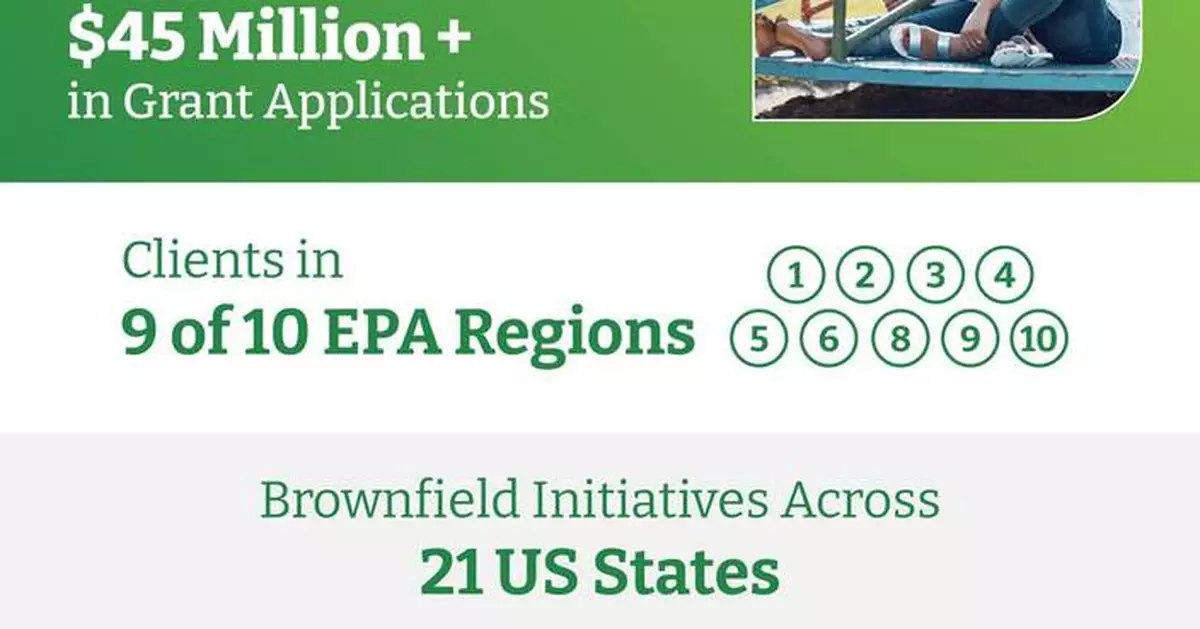
Montrose Environmental Group, Inc. (NYSE: MEG) is on a mission to enhance environmental stewardship and support economic development by helping communities unlock federal funding for brownfields restoration and community revitalization. In 2025, Montrose assisted with over 20 EPA Grant applications totaling more than $45 million in potential awards—many for communities that didn’t even know they qualified for funding or had a compelling story to tell.
This press release features multimedia. View the full release here: https://www.businesswire.com/news/home/20251201772866/en/
These grants are breathing new life into underutilized and environmentally challenged properties, transforming them into spaces for housing, tourism, manufacturing, and more. Montrose’s brownfields and community revitalization work spans 21 states across 9 out of 10 EPA regions, with projects ranging from flood recovery in Vermont to wildfire recovery in Hawaii.
New Projects Making an Impact:
“Montrose is proud to help communities rediscover and meet their potential,” said Chris Gdak, Practice Leader at Montrose Environmental Group. “We’re not just cleaning up properties—we’re restoring purpose to places that have been overlooked for decades. The energy and hope these projects bring to residents is deeply rewarding and impactful.”
Montrose’s approach goes beyond funding strategies and grant writing. The company fosters lasting partnerships with local governments, tribal organizations, and nonprofits to guide them through the entire revitalization journey—from identifying eligible sites to implementing community-driven reuse plans.
With a growing footprint and a commitment to underserved areas, Montrose is helping communities reclaim their future—one project at a time.
Learn more about the difference Brownfield revitalization can make:
Contaminated Land to Community Sports Complex: The Chase Fieldhouse Project
From Industrial Legacy to Community Asset: Transforming the Former American Car and Foundry Site
See what Montrose’sBrownfields Redevelopment Service & Consultantscan do for you.
About Montrose
Montrose is a leading environmental solutions company focused on supporting commercial and government organizations as they deal with the challenges of today and prepare for what’s coming tomorrow. With ~3,500 employees across 120 locations worldwide, Montrose combines deep local knowledge with an integrated approach to design, engineering, and operations, enabling Montrose to respond effectively and efficiently to the unique requirements of each project. From comprehensive air measurement and laboratory services to regulatory compliance, emergency response, permitting, engineering, and remediation, Montrose delivers innovative and practical solutions that keep its clients on top of their immediate needs – and well ahead of the strategic curve. For more information, visit www.montrose-env.com. Follow us on LinkedIn.
Forward‐Looking Statements
This press release contains forward-looking statements within the meaning of Section 27A of the Securities Act of 1933, as amended, and Section 21E of the Securities Exchange Act of 1934, as amended. Forward-looking statements may be identified by the use of words such as "intend," "expect", and "may", and other similar expressions that predict or indicate future events or that are not statements of historical matters. Forward-looking statements are based on current information available at the time the statements are made and on management’s reasonable belief or expectations with respect to future events, and are subject to risks and uncertainties, many of which are beyond the Company’s control, that could cause actual performance or results to differ materially from the belief or expectations expressed in or suggested by the forward-looking statements. Additional factors or events that could cause actual results to differ may also emerge from time to time, and it is not possible for the Company to predict all of them. Forward-looking statements speak only as of the date on which they are made, and the Company undertakes no obligation to update any forward-looking statement to reflect future events, developments or otherwise, except as may be required by applicable law. Investors are referred to the Company’s filings with the Securities and Exchange Commission, including its Annual Report on Form 10-K for the year ended December 31, 2023, for additional information regarding the risks and uncertainties that may cause actual results to differ materially from those expressed in any forward-looking statement.

Reviving America’s Overlooked Spaces: Montrose Environmental Group Helps Communities Access Over $45 Million in Federal Grants
NEW YORK (AP) — Walmart delivered another quarter of impressive sales with speedy deliveries and low prices becoming a strong magnet for people across the income spectrum that are spending more on almost everything, particularly gasoline.
Yet like other major retailers posting financial results this week, Walmart was cautious about the rest of the year given the current economic uncertainty. On Thursday, it issued a forecast for the current quarter that was weaker than what Wall Street had been expecting.
Shares slipped about 7% Thursday.
Walmart has resonated with many Americans who are increasingly careful about where they spend their money as inflation takes a bigger bite out of paychecks, notably gasoline which has soared since the start of the Iran war in late February. Walmart can serve as a barometer of consumer spending given its vast customer base. More than 150 million customers are on its website or in its stores every week, according to Walmart.
One telling shift during the quarter that captures the stress many Americans are feeling: The number of gallons that customers put in their cars during visits to U.S. Walmart and Sam’s Club gas stations fell below 10 for the first time since 2022, which was the midst of the COVID-19 pandemic.
“That’s an indication of stress,” said Chief Financial Officer John David Rainey.
Walmart touted strong sales that were fueled by online shopping on Thursday.
Comparable sales at U.S. Walmart stores rose 4.1% during the three-month period ended April 30. Walmart’s U.S online sales rose 26%, the company said.
Walmart’s promise of lower prices, faster delivery and a refresh of its merchandise has attracted wealthier shoppers. The biggest gains in market share for Walmart are coming from households with annual income over $100,000. That shift is taking place as lower-income shoppers become more entrenched in what economists collectively call a K-shaped economy.
“We see with our customers that the high-income customer is spending with confidence into many categories, while the lower income consumer is more budget conscious and perhaps navigating financial distress,” Rainey told analysts on Thursday.
Rainey told analysts that higher fuel prices took a bite out of profits as it was forced to absorb higher transportation costs. And while the company is focused on offering low prices, Walmart may raise prices later if fuel costs remain high, he said.
U.S. retailers have spent months navigating an uncertain economic environment, from President Donald Trump’s tariffs to the impact of soaring gasoline prices due to the war. The average price for a gallon of regular gasoline raced higher this week and did so again overnight. Gasoline prices are about 45% above where they were at this time last year.
Based on quarterly financial reports from Walmart, Target, Home Depot, Lowe's and TJX, shoppers are cautious but still spending, helped by more generous tax refunds. Yet there is a widespread belief among economists that once those refunds dry up, shoppers will pull back on spending. Consumer spending is the dominant economic engine for the U.S., and retreat would have broad implications for the U.S.
Target reported the largest jump in comparable sales in four years Wednesday, but a cautious outlook overshadowed rather convincing evidence that changes under the company’s new CEO are landing solidly with customers. Target raised its annual revenue outlook Wednesday, but it was still below the pace of its first quarter this year.
The nation’s two largest home improvement retailers Home Depot and Lowe’s reported strong sales, but both companies said that customers are putting off larger home projects.
“I think, overall, this has been the most difficult housing market that I’ve faced in this business since the financial crisis,” Lowe’s CEO Marvin Ellison said this week.
Walmart, based in Bentonville, Arkansas reported first-quarter earnings of $5.33 billion, or 67 cents, for the quarter ended April 30. Adjusted per-share results were 66 cents, matching the 66 cents that analysts expected, according to FactSet.
For the year-ago quarter, the company reported net income of $4.48 billion, or 56 cents per share.
Sales rose 7.3% to $177.75 billion in the fiscal first quarter, above the $174.84 billion that analysts predicted.
Walmart said higher fuel prices took a bite out of profits as it was forced to absorb higher transportation costs.
The company highlighted its speedier deliveries, which is driving more shoppers to buy more often. Rainey said that roughly 60% of U.S. online deliveries arrive at customers' homes in 30 minutes or less.
For the second quarter, Walmart expects sales to be 4% to 5% higher than the same period a year ago. It also expects per-share profit to be between 72 cents and 74 cents. Analysts had been projecting per-share earns of 75 cents on sales of $186.2 billion, according to FactSet.
Walmart stuck to the annual guidance that it issued in February.
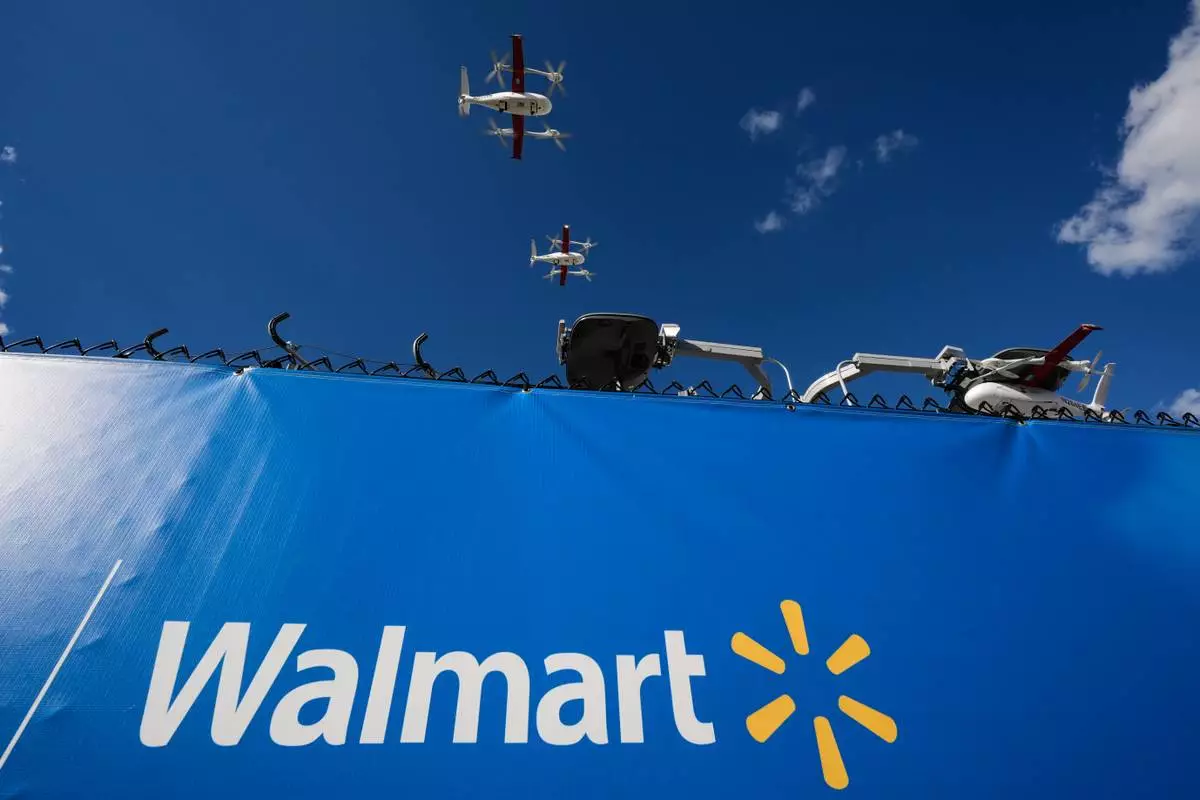
Drones operated by Zipline leave base to make deliveries from a Walmart store in Pea Ridge, Ark., Friday, Sept. 26, 2025. (AP Photo/Charlie Riedel)